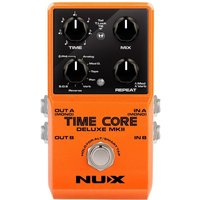
The NUX Time Core Deluxe mkII Pedal is ideal for guitarists looking for a compact stereo-capable delay with deep control and modern connectivity. It packs seven stereo delay effects including digital analogue tape mod ping pong reverse and hold. The onboard tap tempo function helps you sync delays with your playing and the trails on/off option allows your repeats to fade naturally or stop instantly when bypassed. Theres also support for external footswitches and MIDI via TRS plus a USB-C port for firmware updates so you can keep everything running smoothly. With Tone Lock you can freeze your settings during a performance and recall them with ease using the save feature. Whether youre crafting ambient textures or tight rhythmic patterns this pedal makes it simple to dial in the sound you need.
NUX Time Core Deluxe mkII Pedal
This is a New NUX Time Core Deluxe mkII Pedal from NUX its found in our Specialist Effects Pedals on the Just Pedals menu. Read More below.
As an affiliate partner, we may earn a small commission when you buy through our links — at no extra cost to you.

Related videos

Brand
NUX
NUX made its industry debut in 2006 and is one of the brands owned by Cherub Technology. Its official catalogue ranges from analogue and digital stompboxes to multi-effects, amplifiers, wireless systems, drums, keyboards and recording gear. Cherub lists company locations in Guangdong, China, as well as overseas offices; that identifies the company base, not the factory for every NUX product. JustPedals listings include the NBP-5 Melvin Lee Davis bass preamp, NAI-5 Optima Air acoustic simulator and NDR-5 Atlantic delay and reverb. The range rewards model-by-model comparisons of signal path, presets and instrument-specific features.
Category
Specialist Effects Pedals
Specialist effects alter the signal in ways that do not sit cleanly inside one established family. They may use granular processing, frequency shifting, resonators, freeze or sustain, bit reduction, ring modulation, feedback networks or combinations of several techniques. The relevant distinction is the underlying process, its tracking or latency, and how completely the dry signal can be blended or replaced.
Tags
Analogue
The signal is shaped by continuously varying electronic circuitry rather than being converted into a digital effect algorithm. Component choice, operating voltage and circuit tolerances influence headroom, noise, clipping texture and the small variations in response between designs.
Digital
Converts the signal or control process into numerical data for algorithmic processing. Digital designs can provide precise timing, long memory, complex routing and repeatable presets; sample rate, conversion, internal resolution and latency influence fidelity and response.
MIDI
Sends, receives or responds to Musical Instrument Digital Interface messages rather than carrying the instrument audio itself. Program changes recall presets, continuous controllers move parameters, and MIDI clock or transport messages synchronise timing between devices.
Stereo
Processes, creates or passes two audio channels. True stereo preserves separate left and right inputs, while mono-to-stereo effects generate spatial differences internally; routing, phase behaviour and whether trails remain stereo determine the resulting image. Some outputs sum to mono when only one socket is connected, which can change level or modulation depth.
Tap Tempo
Measures repeated foot taps and converts their interval into an effect rate or delay time. Subdivisions translate that pulse into dotted, triplet or other rhythmic values, while averaging and range limits influence how quickly and accurately the tempo settles.
Others Just Ordered :
- I Love A Happy Accident… – Animals Pedal

- Animals Pedal Vintage Van Driving is Very Fun Overdrive
- Animals Pedal Sunday Afternoon Is Infinity Bender

- Ninevolt Pedals | Bath Time Reverb (Animals Pedal)
- This Fuzz Pedal Makes No Sense… But It Sounds Incredible

- ANIME Pedals | Animals Pedal Custom Illustrated Series