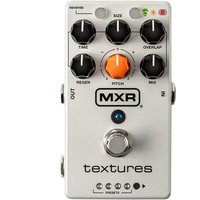
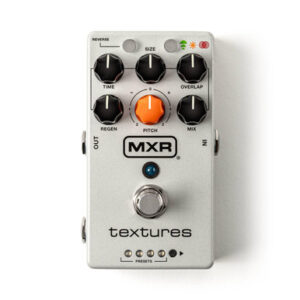
The MXR Textures Granular Synth Engine transforms your guitar into an endlessly creative sound design tool breaking your playing into tiny fragments and rebuilding it into evolving pads shimmering ambience glitched rhythms and atmospheric soundscapes. Powered by advanced granular synthesis and intelligent dynamics processing it continuously captures your performance and reshapes it in real time. Wherever your creativity takes you the Textures pedal provides an inspiring platform for sonic exploration while remaining intuitive enough to start creating immediately. Eight factory presets provide instant access to a wide range of ready-to-play sounds while extensive editing lets you tailor every aspect of the granular engine to suit your own style. Three operating modes comprehensive grain-shaping controls onboard ambience effects and full stereo connectivity make the pedal equally at home on stage or in the studio. Expression pedal compatibility flexible output routing deep secondary parameters and preset storage ensure seamless integration into modern rigs giving adventurous players an incredibly powerful creative tool.
MXR Textures Granular Synth Engine Effects Pedal
This is a New MXR Textures Granular Synth Engine Effects Pedal from MXR its found in our Specialist Effects Pedals on the Just Pedals menu. Read More below.
As an affiliate partner, we may earn a small commission when you buy through our links — at no extra cost to you.
Related videos



Brand
MXR
MXR’s first product was the Phase 90, released in 1972. Dunlop’s official MXR history traces the early line from that compact phaser to the Distortion+, Dyna Comp compressor and Blue Box octave fuzz—circuits that remain central reference points for the brand. JustPedals carries those classic families alongside the Carbon Copy analog delay, Micro Amp, Talk Box and bass effects. MXR’s range is deliberately broader than one effect category: compare the model number and version, especially where a classic circuit has later reissues, mini enclosures or expanded controls.
Category
Specialist Effects Pedals
Specialist effects alter the signal in ways that do not sit cleanly inside one established family. They may use granular processing, frequency shifting, resonators, freeze or sustain, bit reduction, ring modulation, feedback networks or combinations of several techniques. The relevant distinction is the underlying process, its tracking or latency, and how completely the dry signal can be blended or replaced.
Tags
Bass
Voiced or equipped to retain low-frequency fundamentals and the higher headroom of a bass signal. Clean blends, crossovers and bass-specific filter ranges can preserve weight and articulation while the effected portion adds harmonics, movement or ambience.
Presets
Stores complete groups of parameter values for later recall. The number of locations, switching time, spillover behaviour and whether presets include routing, expression and MIDI assignments determine how completely one sound can change into another.
Stereo
Processes, creates or passes two audio channels. True stereo preserves separate left and right inputs, while mono-to-stereo effects generate spatial differences internally; routing, phase behaviour and whether trails remain stereo determine the resulting image. Some outputs sum to mono when only one socket is connected, which can change level or modulation depth.
Synth
Generates or reshapes the signal through oscillator, filter and envelope behaviour associated with synthesis. Tracking, envelope response, pitch range, polyphony and dry blend determine whether the generated voice follows the instrument as bass, lead, pad or abstract texture.
Others Just Ordered :
- I Love A Happy Accident… – Animals Pedal

- Animals Pedal Vintage Van Driving is Very Fun Overdrive

- Animals Pedal Sunday Afternoon Is Infinity Bender

- Ninevolt Pedals | Bath Time Reverb (Animals Pedal)
- This Fuzz Pedal Makes No Sense… But It Sounds Incredible

- ANIME Pedals | Animals Pedal Custom Illustrated Series