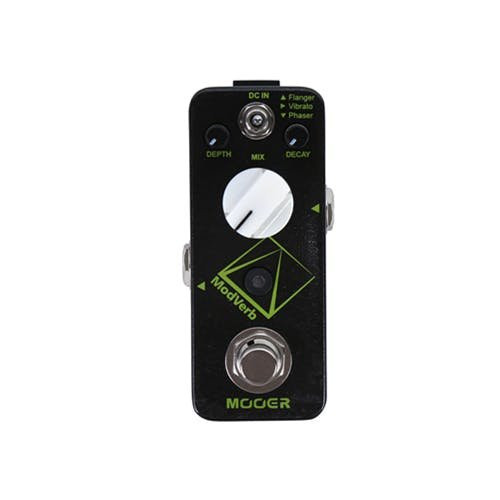
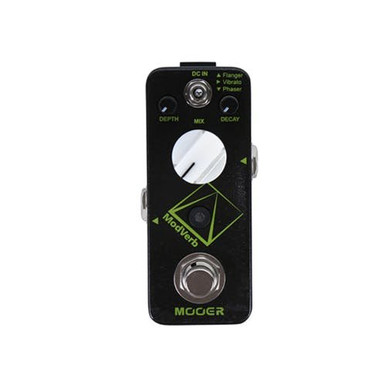



Here’s what Mooer say about the Modeverb Digital Reverb & Modulation Pedal MODVERB brings together 3 of our most popular modulation effects with a brand new reverb algorithm. Ambient tones are easily obtained as you combine Flanger, Vibrato or Phaser with a high quality pristine digital reverb. The intuitive and versatile controls make it simple to dial in the MODVERB. The modulation speed can be swiftly adjusted using the tap tempo button and prepare to be frozen in time when you hold down the footswitch to activate eternal feedback. Specifications Input:1/4” mono audio jack.(Impedance: 470k Ohms) Output:1/4” mono audio jack(mpedance: 100 Ohms) Power requirements:AC adapter 9V DC, centre negative. Current Draw:160mA Dimensions: 93.5mm(D) x 42mm(W) x 52mm(H) Weight:146g



Mooer MRV4 Modverb Digital Reverb Pedal
This is a New Mooer MRV4 Modverb Digital Reverb Pedal from Mooer, listed in Reverb Pedals on Just Pedals. Read More below.
As an affiliate partner, we may earn a small commission when you buy through our links — at no extra cost to you.
Related videos
Brand
Mooer
MOOER entered the music-gear market in 2010 with miniature guitar effects pedals, conceived by four music-and-technology enthusiasts in Shenzhen, China. The company later expanded into preamp pedals, amp modelling, impulse-response loaders and multi-effects, including the GE200 and RADAR IR Loader. JustPedals listings show the compact effects side of the range: Reecho digital delay, Green Mile overdrive, Liquid Phaser, Triangolo tremolo and Pure Boost. MOOER’s small enclosures are a design choice, not a guide to how much control a model offers; check its modes, switching and power needs individually.
Category
Reverb Pedals
Reverb creates the dense pattern of reflections heard after sound enters a physical or imagined space. Room, hall, plate and spring models differ in reflection density, frequency decay and modulation, while ambient algorithms extend or transform the tail beyond natural acoustics. Decay, pre-delay, damping, diffusion and wet/dry balance define the apparent size, surface and distance of that space.
Tags
Digital
Converts the signal or control process into numerical data for algorithmic processing. Digital designs can provide precise timing, long memory, complex routing and repeatable presets; sample rate, conversion, internal resolution and latency influence fidelity and response.
Tap Tempo
Measures repeated foot taps and converts their interval into an effect rate or delay time. Subdivisions translate that pulse into dotted, triplet or other rhythmic values, while averaging and range limits influence how quickly and accurately the tempo settles.
Others Just Ordered :
- Mooer Meta FX – Review
- MOOER META FX Review: 3 Effects in 1—but Here’s the Problem

- I Wasn’t Expecting To Be Impressed – But What Is The Mooer Meta FX?

- Mooer // META FX Stereo Multi-Effect Platform (Demo)
- A NEW GENERATION OF PEDALS IS HERE – Mooer Meta FX Reverb Review

- Mooer META FX | All the REVERBS from subtle to WILD!