
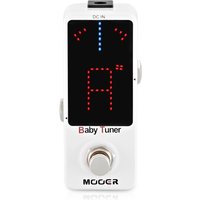
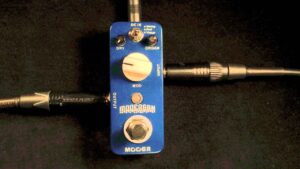
The Mooer Baby Tuner Pedal is a game-changer for ensuring you are always in tune. This high-precision micro pedal is accurate up to 1 point making it an essential accessory for guitarists bassists and other musicians who demand the best sound quality. With its intuitive footswitch design the Mooer Baby Tun Pedal is easy to power on/off and use hands-free while playing. And thanks to its compact and sleek design this tuner pedal can fit onto any pedalboard with ease. This pedal comes designed with a detection range of 12Hz to 4186Hz making it versatile enough to work with most electric or electro-acoustic instruments including seven-string guitars or five-string basses. With a display that uses 108 high-brightness LEDs this tuner pedal is visible even in strong light or sunlight. And thanks to the true bypass switch there is no signal loss or hum making it a valuable addition to any setup. The tiny but mighty accessory that will keep you in tune and sounding fantastic.
Mooer Baby Tuner Pedal
This is a New Mooer Baby Tuner Pedal from Mooer Audio its found in our Tuner Pedals on the Just Pedals menu. Read More below.
As an affiliate partner, we may earn a small commission when you buy through our links — at no extra cost to you.
Related videos

Brand
Mooer Audio
In the current JustPedals catalogue, Mooer Audio is represented by Multi-Effects Pedals, Looper Pedals and Wah & Filter Pedals. Current listings include Baby Bomb 30, ABY and X2 Preamp. That makes the range relevant to players looking for drive, gain and clipping, plus time-based effects and ambience. Check each model for its exact circuit or processing platform, controls, power requirements and connections, particularly where the catalogue includes both pedals and supporting gear.
Category
Tuner Pedals
A tuner pedal measures the input frequency and shows whether the played note is sharp, flat or in tune. Detection speed, display resolution and note range affect accuracy, especially for low tunings and extended-range instruments. Buffered or true-bypass switching changes the signal path, while mute, strobe display, reference-pitch calibration and alternate-tuning modes shape operation.
Tags
Acoustic
Voiced for the wider dynamics, strong transient detail and pickup characteristics of acoustic instruments. High input impedance, phase reversal, notch filtering and restrained processing help preserve body resonance while controlling piezo harshness and feedback. Balanced outputs may also carry the corrected signal directly to a mixer or interface.
True Bypass
Connects input directly to output through mechanical or relay switching when the effect is off, removing the active circuit from the audio path. It avoids buffer colour but leaves cable capacitance and switching design to influence high-frequency loss and possible switching noise.
Others Just Ordered :
- I Love A Happy Accident… – Animals Pedal

- Animals Pedal Vintage Van Driving is Very Fun Overdrive

- Animals Pedal Sunday Afternoon Is Infinity Bender

- Ninevolt Pedals | Bath Time Reverb (Animals Pedal)

- This Fuzz Pedal Makes No Sense… But It Sounds Incredible

- ANIME Pedals | Animals Pedal Custom Illustrated Series