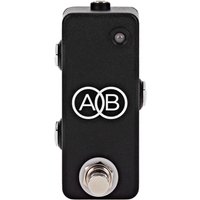
The JHS Pedals Mini A/B Box is an ultra-compact input or output selector adding a huge amount of versatility to your setup. Perfect for a wide range of live applications this pedal can be utilised to instantly select between two different amps take your tuner out of your signal chain switch between two guitars mute your signal and much more. Designed specifically for live application if you need to swap guitars or tones on dual-amplifier rigs then this is the pedal youll need to do it instantly – with no fuss whatsoever. The JHS Pedals Mini A/B Box features a dual colour red/green LED allowing you to tell immediately whether the A or B connection is currently in use. The pedal is passive in operation but requires a standard 9V DC negative power supply for the LED to function. Whats more with this pedal is both robust and highly compact and its tiny footprint means that it takes up next to no room on your pedalboard so you can expand your rig further. If youre looking for a guitar pedal which provides the ultimate on-stage convenience then look no further.
JHS Pedals Mini A/B Box
This is a New JHS Pedals Mini A/B Box from JHS Pedals its found in our Specialist Effects Pedals on the Just Pedals menu. Read More below.
As an affiliate partner, we may earn a small commission when you buy through our links — at no extra cost to you.
Related videos



Brand
JHS Pedals
JHS Pedals grew from Josh Scott’s pedal-modification work in 2007 into a Kansas City effects maker. Scott’s first original designs followed in 2008; the Morning Glory began as his reinvention of the Marshall Bluesbreaker. The JustPedals catalogue carries the Morning Glory V4 and Muffuletta, along with practical tools such as the Little Black Buffer, Buffered Splitter and Little Black Amp Box. JHS describes its guitar pedals as made in Kansas City, USA. The range mixes original drive and fuzz designs with utility pedals, so the current listings show more than a single “boutique overdrive” identity.
Category
Specialist Effects Pedals
Specialist effects alter the signal in ways that do not sit cleanly inside one established family. They may use granular processing, frequency shifting, resonators, freeze or sustain, bit reduction, ring modulation, feedback networks or combinations of several techniques. The relevant distinction is the underlying process, its tracking or latency, and how completely the dry signal can be blended or replaced.
Others Just Ordered :
- I Love A Happy Accident… – Animals Pedal

- Animals Pedal Vintage Van Driving is Very Fun Overdrive
- Animals Pedal Sunday Afternoon Is Infinity Bender

- Ninevolt Pedals | Bath Time Reverb (Animals Pedal)
- This Fuzz Pedal Makes No Sense… But It Sounds Incredible

- ANIME Pedals | Animals Pedal Custom Illustrated Series