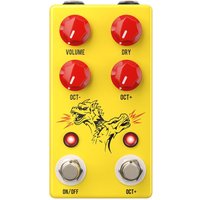
The JHS Pedals Double Dragon Lo-Fi Octave Device is an all-analogue octave pedal built for riffs weight and raw character. Inspired by classic vintage octave divider circuits it looks back to the era before DSP and ultra-clean tracking. The result is a monophonic octave-down and octave-up effect that doesnt aim for clinical perfection. Instead it reacts glitches and fights back in the best possible way giving your playing a thick synth-like edge that feels alive under your fingers. The lower octave delivers classic analogue depth and foundation while the upper octave adds a gritty octave-up distortion that sits somewhere between an Octavia and a Superfuzz. From single-note riffing to unpredictable chord textures the Double Dragon makes your guitar sound huge. With flexible dry blend independent octave controls and boost on tap its a creative tool that feels more like a collaborator than a processor.
JHS Pedals Double Dragon Lo-Fi Octave Device
This is a New JHS Pedals Double Dragon Lo-Fi Octave Device from JHS Pedals its found in our Octave Pedals on the Just Pedals menu. Read More below.
As an affiliate partner, we may earn a small commission when you buy through our links — at no extra cost to you.
Related videos



Brand
JHS Pedals
JHS Pedals grew from Josh Scott’s pedal-modification work in 2007 into a Kansas City effects maker. Scott’s first original designs followed in 2008; the Morning Glory began as his reinvention of the Marshall Bluesbreaker. The JustPedals catalogue carries the Morning Glory V4 and Muffuletta, along with practical tools such as the Little Black Buffer, Buffered Splitter and Little Black Amp Box. JHS describes its guitar pedals as made in Kansas City, USA. The range mixes original drive and fuzz designs with utility pedals, so the current listings show more than a single “boutique overdrive” identity.
Category
Octave Pedals
An octave effect generates notes one or more octaves above or below the input. Analogue circuits often create raw monophonic sub-octaves, while digital pitch tracking can follow chords and provide several intervals with cleaner separation. Tracking speed, polyphonic accuracy, latency and the balance of dry, upper and lower voices determine whether the result feels tight, organ-like, synthetic or deliberately unstable.
Tags
Analogue
The signal is shaped by continuously varying electronic circuitry rather than being converted into a digital effect algorithm. Component choice, operating voltage and circuit tolerances influence headroom, noise, clipping texture and the small variations in response between designs.
Others Just Ordered :
- I Love A Happy Accident… – Animals Pedal

- Animals Pedal Vintage Van Driving is Very Fun Overdrive

- Animals Pedal Sunday Afternoon Is Infinity Bender

- Ninevolt Pedals | Bath Time Reverb (Animals Pedal)
- This Fuzz Pedal Makes No Sense… But It Sounds Incredible

- ANIME Pedals | Animals Pedal Custom Illustrated Series