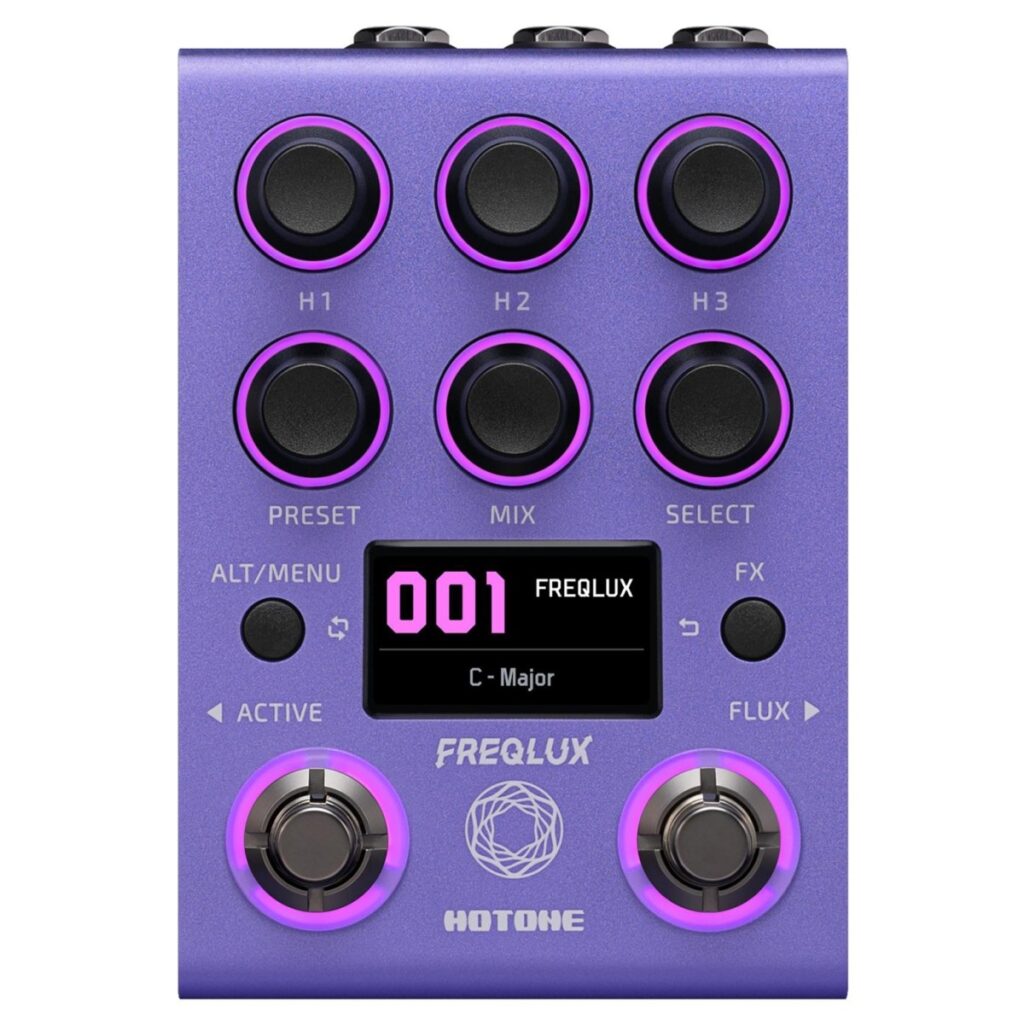
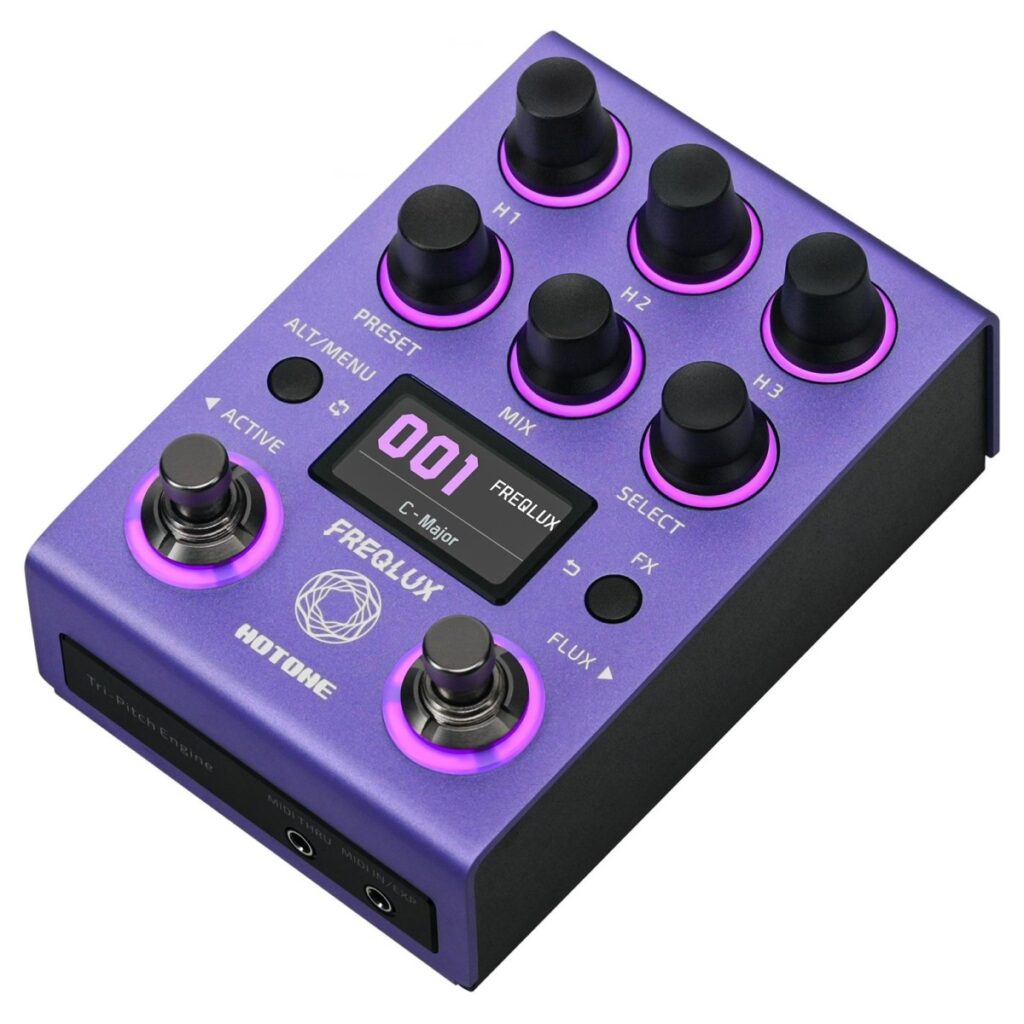
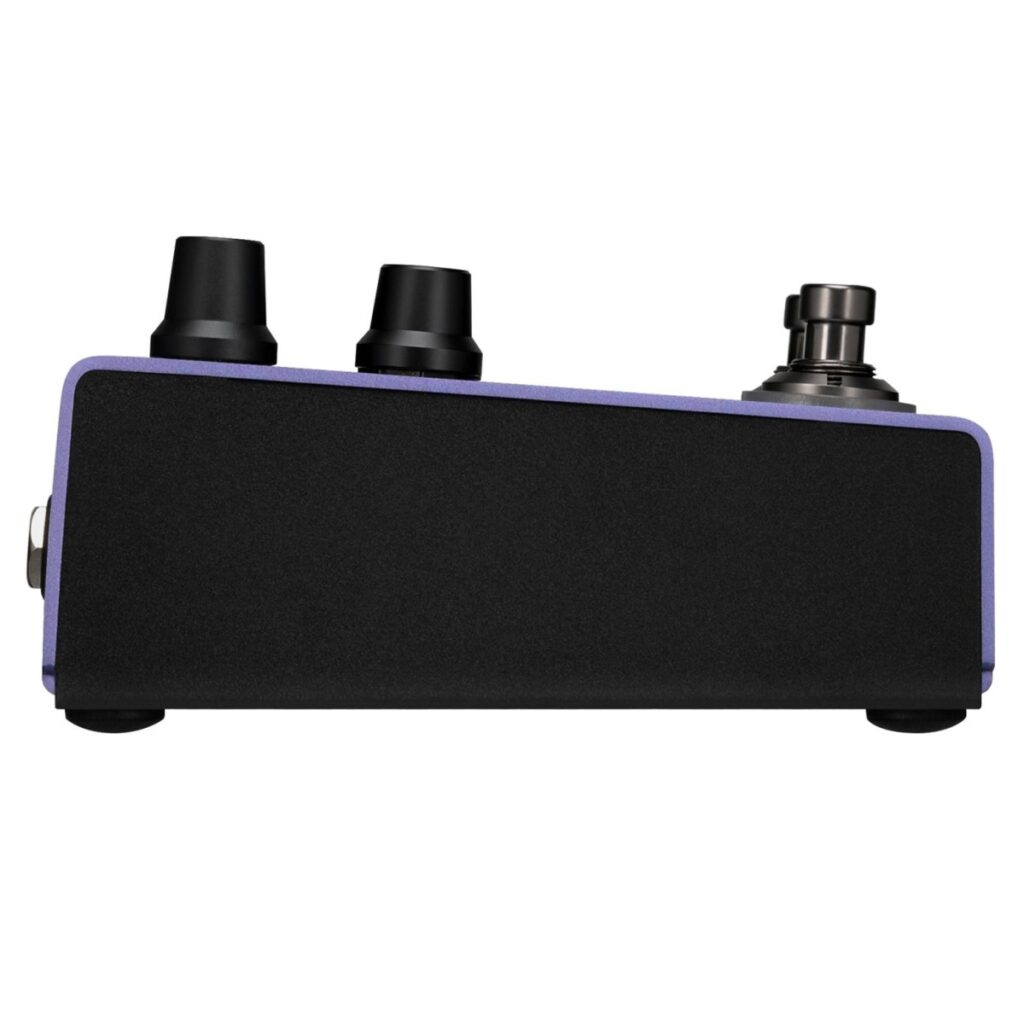
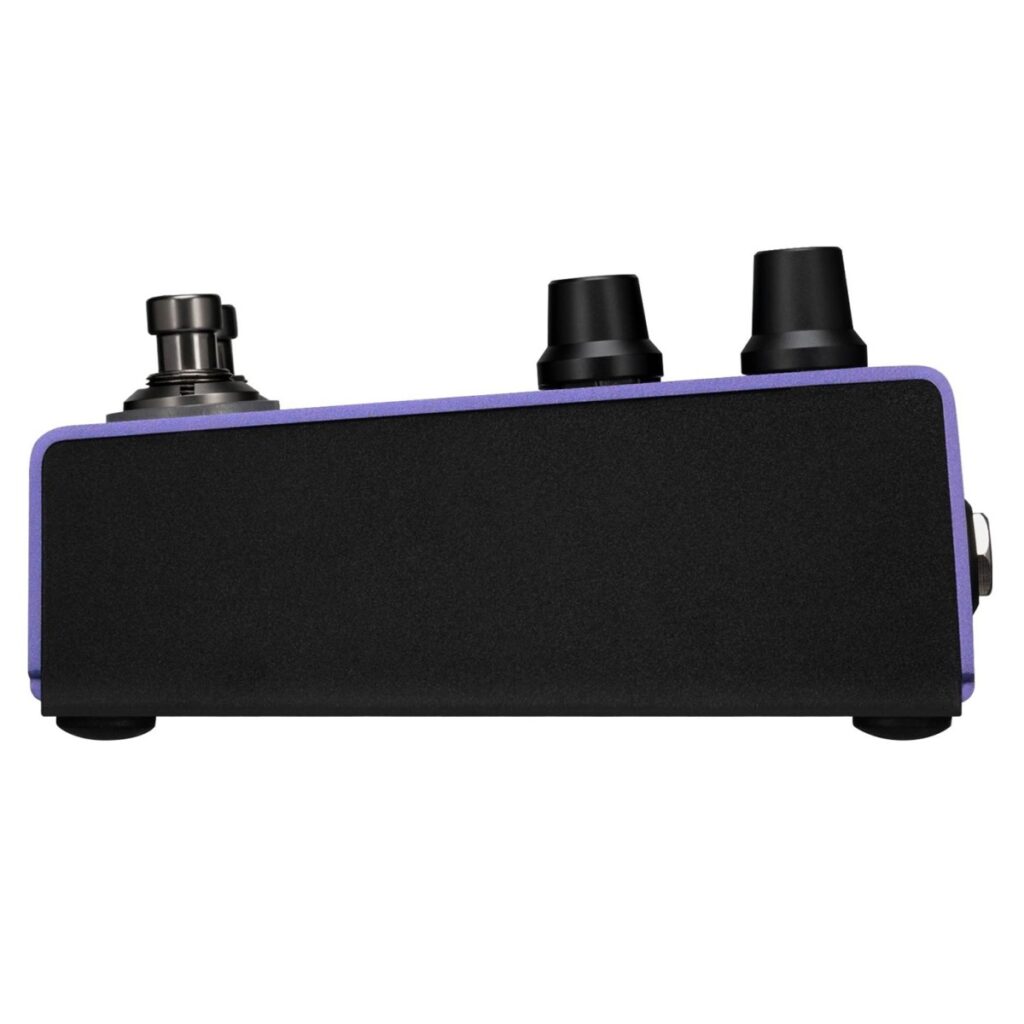
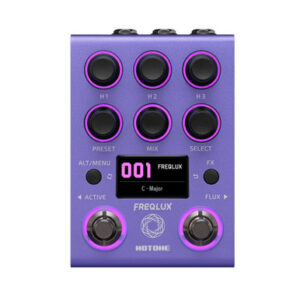
The Hotone Freqlux Tri-Pitch Processing Pedal is an advanced harmony and pitch-shifting workstation built for players who want far more than simple octave effects. Featuring three fully independent pitch engines running simultaneously in real time Freqlux allows you to create huge pitch effects with remarkable precision. Multiple pitch modes provide huge creative flexibility while ultra-fast tracking and low-latency performance ensure every note feels immediate and natural. Designed for deep sound shaping each pitch voice includes independent Pan Level Tone and Attack controls. The Flux footswitch introduces expressive gliding pitch effects with customisable curves while Auto Flux can trigger pitch movement automatically based on your playing dynamics. Built-in modulation feedback and drive processing add movement sustain and harmonic saturation to every voice. With stereo connectivity MIDI and expression support 32-bit processing analogue dry-through circuitry and 200 preset slots Freqlux is a powerful creative tool.
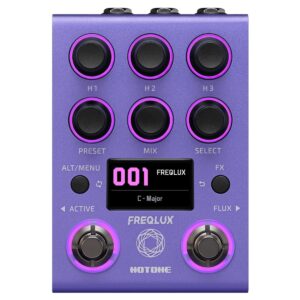
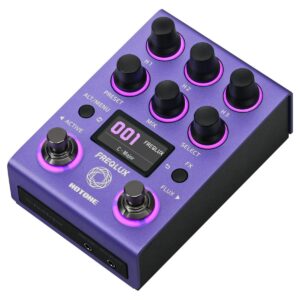
Hotone Freqlux Tri-Pitch Processing Pedal
This is a New Hotone Freqlux Tri-Pitch Processing Pedal from Hotone, listed in Specialist Effects Pedals on Just Pedals. Read More below.
As an affiliate partner, we may earn a small commission when you buy through our links — at no extra cost to you.

Related videos

Brand
HOTONE
Hotone Audio is based in Changsha, Hunan, China, and makes compact pedals, expression and wah tools, multi-effects processors and amp-modelling products. Soul Press combines volume, expression and wah functions in one enclosure, while the Ampero family uses Hotone’s CDCM HD and F.I.R.E. modelling platform. JustPedals listings include Ampero II, Ampero II Stage and Ampero II Stomp, alongside Soul Press II. The range moves from compact performance controls to full digital rigs, so compare the exact Ampero model’s DSP platform, footswitches and signal routing. Changsha is the company address shown by Hotone, not a blanket manufacturing claim.
Category
Specialist Effects Pedals
Specialist effects alter the signal in ways that do not sit cleanly inside one established family. They may use granular processing, frequency shifting, resonators, freeze or sustain, bit reduction, ring modulation, feedback networks or combinations of several techniques. The relevant distinction is the underlying process, its tracking or latency, and how completely the dry signal can be blended or replaced.
Tags
Analogue
The signal is shaped by continuously varying electronic circuitry rather than being converted into a digital effect algorithm. Component choice, operating voltage and circuit tolerances influence headroom, noise, clipping texture and the small variations in response between designs.
MIDI
Sends, receives or responds to Musical Instrument Digital Interface messages rather than carrying the instrument audio itself. Program changes recall presets, continuous controllers move parameters, and MIDI clock or transport messages synchronise timing between devices.
Presets
Stores complete groups of parameter values for later recall. The number of locations, switching time, spillover behaviour and whether presets include routing, expression and MIDI assignments determine how completely one sound can change into another.
Stereo
Processes, creates or passes two audio channels. True stereo preserves separate left and right inputs, while mono-to-stereo effects generate spatial differences internally; routing, phase behaviour and whether trails remain stereo determine the resulting image. Some outputs sum to mono when only one socket is connected, which can change level or modulation depth.
Vocal
Designed for microphone-level signals and the frequency, dynamics and feedback behaviour of the human voice. Input gain, balanced connections, phantom power and pitch tracking may be provided so effects respond correctly before the signal reaches a mixer or PA.
Others Just Ordered :
- I Love A Happy Accident… – Animals Pedal

- Animals Pedal Vintage Van Driving is Very Fun Overdrive
- Animals Pedal Sunday Afternoon Is Infinity Bender

- Ninevolt Pedals | Bath Time Reverb (Animals Pedal)
- This Fuzz Pedal Makes No Sense… But It Sounds Incredible

- ANIME Pedals | Animals Pedal Custom Illustrated Series