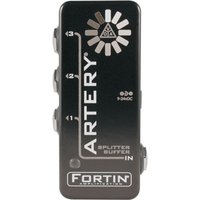
The Fortin Artery Splitter/Buffer Pedal is designed to become the central hub of complex modern guitar rigs delivering pristine signal splitting and buffering without sacrificing tone dynamics or feel. Formerly known as the Roach the Artery uses discrete Class-A buffers to restore clarity and top-end detail. By converting the guitar signal from high impedance to low impedance the Artery helps preserve the full character of your instrument while maintaining strong signal integrity. With three independent outputs the Artery opens up a huge range of routing possibilities. It works perfectly alongside Fortin Zuul noise gates by feeding a clean guitar signal directly to the gates KEY input while routing the main signal through pedals and gain stages separately. The additional outputs can simultaneously feed tuners multiple amplifiers or recording interfaces giving players enormous flexibility when shaping and capturing tones. The Artery operates on anything from 9V to 24V DC and includes MOSFET reverse polarity protection for added reliability.
Fortin Artery Splitter/Buffer Pedal
This is a New Fortin Artery Splitter/Buffer Pedal from Fortin is in our Utility Pedals category on Just Pedals. Read More below.
As an affiliate partner, we may earn a small commission when you buy through our links — at no extra cost to you.

Brand
Fortin
In the current JustPedals catalogue, Fortin is represented by Noise Gate Pedals, Boost Pedals and Preamp & DI Pedals. Current listings include Fuzz, Zuul Blackout and Zuul+ Noise Gate. That makes the range relevant to players looking for drive, gain and clipping, plus modelling, direct rigs and multi-effects. Check each model for its exact circuit or processing platform, controls, power requirements and connections, particularly where the catalogue includes both pedals and supporting gear.
Category
Utility Pedals
Utility pedals solve signal-path tasks rather than imposing one recognisable effect. Buffers restore level and high-frequency response lost through cable capacitance, selectors route between instruments or amplifiers, summing boxes combine paths, and isolators interrupt hum-producing ground loops. Impedance, phase, transformer isolation, active or passive circuitry and switching method determine whether the routing remains quiet and transparent.
Others Just Ordered :
- I Love A Happy Accident… – Animals Pedal

- Animals Pedal Vintage Van Driving is Very Fun Overdrive

- Animals Pedal Sunday Afternoon Is Infinity Bender

- Ninevolt Pedals | Bath Time Reverb (Animals Pedal)

- This Fuzz Pedal Makes No Sense… But It Sounds Incredible

- ANIME Pedals | Animals Pedal Custom Illustrated Series