
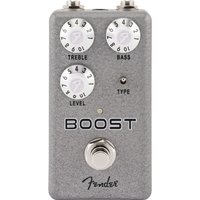
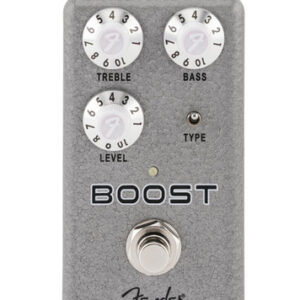
The Fender Hammertone Boost Pedal is a versatile dual-mode boost designed to elevate your tone with precision and character. Featuring both a clean opamp boost and a harmonically rich JFET circuit it gives you the choice between transparent volume increase and a vintage-style flavour with added warmth and compression. With active bass and treble controls you can fine-tune your tone to suit any setup while the top-mounted jacks make it easy to slot into tight pedalboards. True bypass switching ensures your core signal remains untouched when disengaged and 9V or 18V operation offers flexible headroom for more dynamic response.
Fender Hammertone Boost Pedal
£69.00
This is a New Fender Hammertone Boost Pedal from Fender its found in our Boost Pedals on the Just Pedals menu. Read More below.
View Just Fender
As an affiliate partner, we may earn a small commission when you buy through our links — at no extra cost to you.
Related videos

Brand
Fender
Fender’s effects line draws on the company’s Southern California instrument-and-amplifier history. The all-original pedal range Fender introduced in the late 2010s was designed in Southern California with input from gigging and studio musicians. JustPedals listings include The Bends compressor, Marine Layer reverb, Pugilist distortion, Tre-Verb and Smolder Acoustic Overdrive. That range connects familiar Fender amplifier sounds with dedicated stompboxes, while also covering bass and acoustic applications. The brand name does not indicate where every model was manufactured; compare each pedal’s controls, routing and model-specific specifications.
Category
Boost Pedals
A boost raises signal level without deliberately creating a new effect waveform. Clean boosts emphasise level and headroom, while coloured boosts reshape bass, midrange or treble and may add mild clipping at higher settings. Placed before a gain stage, the extra level changes how that stage distorts; placed later, it can provide a volume lift if sufficient headroom remains.
Tags
Bass
Voiced or equipped to retain low-frequency fundamentals and the higher headroom of a bass signal. Clean blends, crossovers and bass-specific filter ranges can preserve weight and articulation while the effected portion adds harmonics, movement or ambience.
True Bypass
Connects input directly to output through mechanical or relay switching when the effect is off, removing the active circuit from the audio path. It avoids buffer colour but leaves cable capacitance and switching design to influence high-frequency loss and possible switching noise.
Others Just Ordered :
- I Love A Happy Accident… – Animals Pedal

- Animals Pedal Vintage Van Driving is Very Fun Overdrive

- Animals Pedal Sunday Afternoon Is Infinity Bender

- Ninevolt Pedals | Bath Time Reverb (Animals Pedal)

- This Fuzz Pedal Makes No Sense… But It Sounds Incredible

- ANIME Pedals | Animals Pedal Custom Illustrated Series
