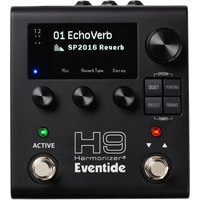
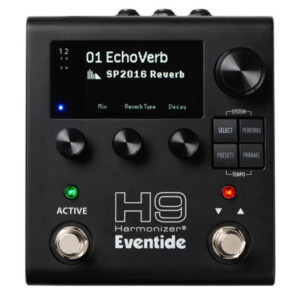
The Eventide H9 Harmonizer Gen 2 is a compact multi-effects pedal for demanding live and studio players. Combining the complete H9 Max collection with the full H90 algorithm lineup it gives you access to 74 effects covering delay reverb pitch shifting granular processing looping and vocal tools. Built on Eventides modern ARM processing platform it delivers improved fidelity alongside seamless preset spillover for smooth transitions during performances. The redesigned interface makes everyday use far quicker than previous H9 models. A larger display three Quick Knobs and dedicated performance modes help you navigate presets and adjust parameters directly from the pedal without relying on external software. SIFT polyphonic pitch technology also brings highly detailed tracking for harmonies and synth-style textures. With stereo I/O MIDI connectivity Bluetooth support and flexible routing options the H9 Gen 2 fits comfortably into pedalboards hybrid rigs and studio setups.
Eventide H9 Harmonizer Gen 2
This is a New Eventide H9 Harmonizer Gen 2 from Eventide its found in our Pitch & Harmoniser Pedals on the Just Pedals menu. Read More below.
As an affiliate partner, we may earn a small commission when you buy through our links — at no extra cost to you.
Brand
Eventide
In the current JustPedals catalogue, Eventide is represented by Multi-Effects Pedals, Overdrive Pedals and Pedal Power Supplies. Current listings include UltraTap Stompbox, H9 Harmonizer Gen 2 and H90 Harmonizer. That makes the range relevant to players looking for drive, gain and clipping, plus modelling, direct rigs and multi-effects. Check each model for its exact circuit or processing platform, controls, power requirements and connections, particularly where the catalogue includes both pedals and supporting gear.
Category
Pitch & Harmoniser Pedals
Pitch processors shift the incoming note to a new interval, while harmonisers add one or more shifted voices alongside it. Digital detection may follow single notes, chords or a selected musical key, and some units allow continuous expression-controlled sweeps. Tracking accuracy, latency, interval range, scale intelligence and formant handling determine how natural or deliberately synthetic the added voices sound.
Tags
Bluetooth
Provides a short-range wireless data or audio connection. Depending on the design it may carry backing audio, editing commands, preset management or MIDI rather than the live instrument signal; codec delay and supported Bluetooth profiles determine what the connection can do.
Hybrid
Combines analogue and digital stages within one signal or control design. A digital section may provide memory, routing or modelling while analogue circuitry supplies clipping, filtering or amplification, so the order and blend of the two domains shape the final response.
MIDI
Sends, receives or responds to Musical Instrument Digital Interface messages rather than carrying the instrument audio itself. Program changes recall presets, continuous controllers move parameters, and MIDI clock or transport messages synchronise timing between devices.
Stereo
Processes, creates or passes two audio channels. True stereo preserves separate left and right inputs, while mono-to-stereo effects generate spatial differences internally; routing, phase behaviour and whether trails remain stereo determine the resulting image. Some outputs sum to mono when only one socket is connected, which can change level or modulation depth.
Vocal
Designed for microphone-level signals and the frequency, dynamics and feedback behaviour of the human voice. Input gain, balanced connections, phantom power and pitch tracking may be provided so effects respond correctly before the signal reaches a mixer or PA.
Others Just Ordered :
- I Love A Happy Accident… – Animals Pedal

- Animals Pedal Vintage Van Driving is Very Fun Overdrive

- Animals Pedal Sunday Afternoon Is Infinity Bender

- Ninevolt Pedals | Bath Time Reverb (Animals Pedal)
- This Fuzz Pedal Makes No Sense… But It Sounds Incredible

- ANIME Pedals | Animals Pedal Custom Illustrated Series