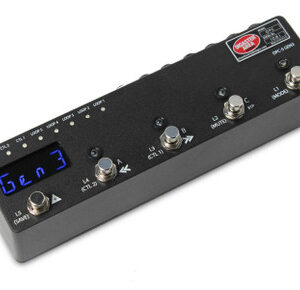
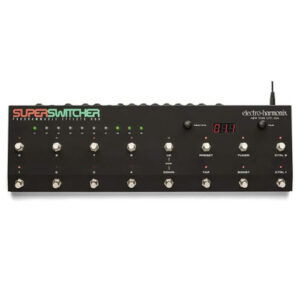
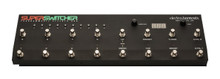
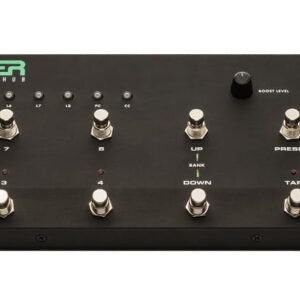
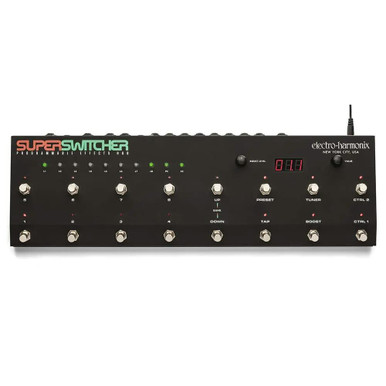
Electro Harmonix Super Switcher Switching Control Center

£399.00

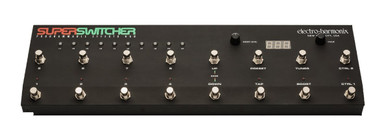
This is a New Electro Harmonix Super Switcher Switching Control Center from Electro Harmonix, listed in Specialist Effects Pedals on Just Pedals. Read More below.

View Just
more
and , , , ,

Here's what Electro-Harmonix say about the Super Switcher:

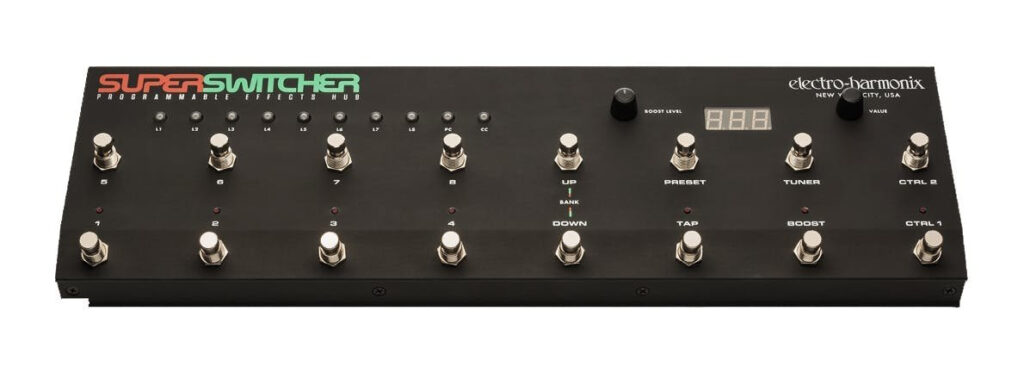
The Super Switcher, as its name implies, offers a powerful solution for players who are tired of “tap dancing” around their pedalboard. In effect, it moves all of your pedals to your pedalboard’s front row while delivering control of them with one button push. The result is that it puts the player back in control of an unruly pedalboard!

It’s also perfect for any guitarist using the “four-cable method” because it makes it easy to properly route effects that should go in front of an amp and those that are best in the effects loop. 

When it comes to live performance, the Super Switcher can efficiently organize presets into banks that are easy to recall and match your show’s set list. If you’re playing to a click track and want to have the presets recalled via MIDI programmed to a song, the Super Switcher can handle that, too. It’s also a great way to sync time-based effects to the same master clock.

Specifications

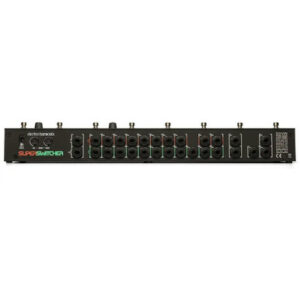
  •  Extensive I/O maximizes flexibility and control.
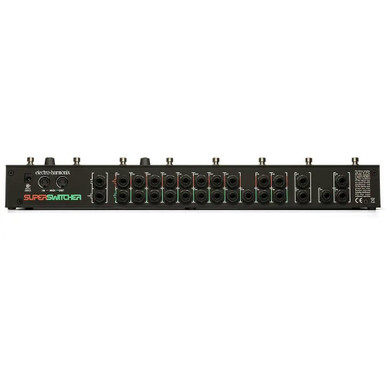
  • Mono and stereo send/return, insert send/return and mono/stereo out
  • Tuner and tap tempo outs, MIDI In & Out and more.
  • Eight mechanical-relay controlled, true bypass loops.
  • 128 presets: 16 banks with 8 presets each.
  • BPM Tap footswitch. Send/receive MIDI clock and tap signals. BPM can be global or per preset.
  • Tuner footswitch
  • Output gain Boost footswitch for both the left and right channels.
  • 9.6VDC-200mA power supply included
  • Current Draw: 150mA @ 9VDC
  • Dimensions in inches: 19(w) x 6(l) x 2.5(h)
Related videos

Brand

Electro Harmonix

Founded by Mike Matthews in New York City in 1968, Electro-Harmonix became known for inventive effects that brought new sounds within reach of guitarists. Its first product was the LPB-1 Linear Power Booster; the company’s long-running catalogue ranges from fuzz and overdrive to delay, modulation, octave and experimental processing. JustPedals listings include the Small Clone chorus, Small Stone phaser, Memory Boy delay, POG 2 octave generator and Micro Q-Tron envelope filter. Check the exact version and power requirements when comparing EHX models, since familiar names often span different generations and formats.

Category

Specialist Effects Pedals

Specialist effects alter the signal in ways that do not sit cleanly inside one established family. They may use granular processing, frequency shifting, resonators, freeze or sustain, bit reduction, ring modulation, feedback networks or combinations of several techniques. The relevant distinction is the underlying process, its tracking or latency, and how completely the dry signal can be blended or replaced.

Tags

MIDI

Sends, receives or responds to Musical Instrument Digital Interface messages rather than carrying the instrument audio itself. Program changes recall presets, continuous controllers move parameters, and MIDI clock or transport messages synchronise timing between devices.

Presets

Stores complete groups of parameter values for later recall. The number of locations, switching time, spillover behaviour and whether presets include routing, expression and MIDI assignments determine how completely one sound can change into another.

Stereo

Processes, creates or passes two audio channels. True stereo preserves separate left and right inputs, while mono-to-stereo effects generate spatial differences internally; routing, phase behaviour and whether trails remain stereo determine the resulting image. Some outputs sum to mono when only one socket is connected, which can change level or modulation depth.

Tap Tempo

Measures repeated foot taps and converts their interval into an effect rate or delay time. Subdivisions translate that pulse into dotted, triplet or other rhythmic values, while averaging and range limits influence how quickly and accurately the tempo settles.

True Bypass

Connects input directly to output through mechanical or relay switching when the effect is off, removing the active circuit from the audio path. It avoids buffer colour but leaves cable capacitance and switching design to influence high-frequency loss and possible switching noise.