
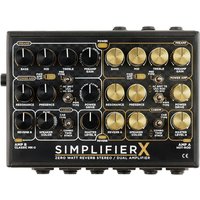
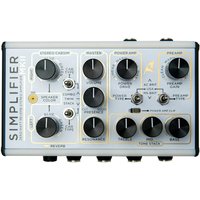
The DSM/Humboldt Simplifier X is a compact analogue amplifier and cabinet simulation pedal built to deliver the feel response and flexibility of a stereo guitar rig without relying on digital modelling. Featuring two independent preamp sections inspired by some of the most respected classic amps ever created the Simplifier X combines authentic amp response with stereo cabinet simulation built-in stereo reverb and advanced routing options in one pedalboard-friendly unit. The Simplifier X includes six distinct amp-inspired voices spanning vintage British chime Bassman-style warmth Plexi crunch hot-rodded American drive and focused JCM800-style aggression. Three flexible operating modes let you run dual mono setups stereo cabinet configurations or fully parallel dual-amp rigs. Add in true stereo operation multi-mode stereo reverb dual FX loops balanced XLR outputs and cabinet bypass functionality and the Simplifier X becomes a complete ampless rig solution for modern players who want analogue tone and straightforward control.
DSM/Humboldt Simplifier X
This is a New DSM/Humboldt Simplifier X from DSM & Humboldt its found in our Specialist Effects Pedals on the Just Pedals menu. Read More below.
As an affiliate partner, we may earn a small commission when you buy through our links — at no extra cost to you.
Brand
DSM & Humboldt
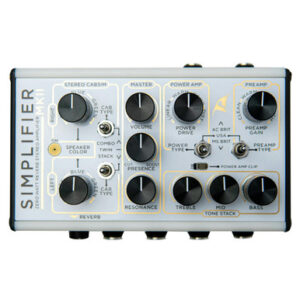
In the current JustPedals catalogue, DSM & Humboldt is represented by Amp & Cab Simulator Pedals, Preamp & DI Pedals and Overdrive Pedals. Current listings include DSM/Humboldt Sub-Atomic, DSM/Humboldt Simplifier X and DSM/Humboldt Simplifier Mk II. That makes the range relevant to players looking for drive, gain and clipping, plus modelling, direct rigs and multi-effects. Check each model for its exact circuit or processing platform, controls, power requirements and connections, particularly where the catalogue includes both pedals and supporting gear.
Category
Specialist Effects Pedals
Specialist effects alter the signal in ways that do not sit cleanly inside one established family. They may use granular processing, frequency shifting, resonators, freeze or sustain, bit reduction, ring modulation, feedback networks or combinations of several techniques. The relevant distinction is the underlying process, its tracking or latency, and how completely the dry signal can be blended or replaced.
Tags
Analogue
The signal is shaped by continuously varying electronic circuitry rather than being converted into a digital effect algorithm. Component choice, operating voltage and circuit tolerances influence headroom, noise, clipping texture and the small variations in response between designs.
Digital
Converts the signal or control process into numerical data for algorithmic processing. Digital designs can provide precise timing, long memory, complex routing and repeatable presets; sample rate, conversion, internal resolution and latency influence fidelity and response.
Stereo
Processes, creates or passes two audio channels. True stereo preserves separate left and right inputs, while mono-to-stereo effects generate spatial differences internally; routing, phase behaviour and whether trails remain stereo determine the resulting image. Some outputs sum to mono when only one socket is connected, which can change level or modulation depth.
Others Just Ordered :
- I Love A Happy Accident… – Animals Pedal

- Animals Pedal Vintage Van Driving is Very Fun Overdrive
- Animals Pedal Sunday Afternoon Is Infinity Bender

- Ninevolt Pedals | Bath Time Reverb (Animals Pedal)
- This Fuzz Pedal Makes No Sense… But It Sounds Incredible

- ANIME Pedals | Animals Pedal Custom Illustrated Series