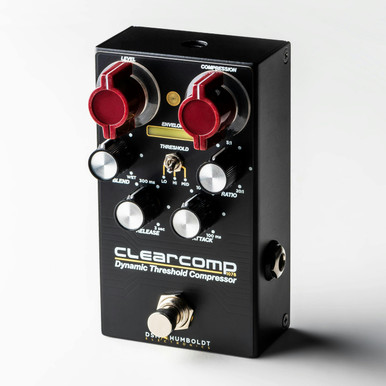
DSM & Humboldt ClearComp 1078 Dynamic Threshold Compressor Pedal

£249.00

Also available on — Andertons, Gear4music, Reverb, Amazon, eBay

Fresh on the menu for 2026 are the DSM & Humboldt Guitar Pedals, freshly added and carefully selected. These New units are available to order online with fast, secure delivery from trusted UK retailers. Read on for full details, specifications, demos, videos, reviews, and the best places to buy the DSM & Humboldt Guitar Pedals today.


Description

Fresh on the menu for 2026 are the DSM & Humboldt Guitar Pedals, freshly added and carefully selected. These New units are available to order online with fast, secure delivery from trusted UK retailers. Read on for full details, specifications, demos, videos, reviews, and the best places to buy the DSM & Humboldt Guitar Pedals today.

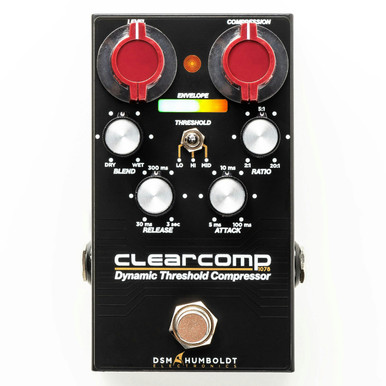
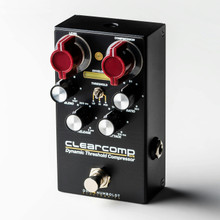
The talented folks at DSM & Humboldt pride themselves on working "restlessly in defining a new standard on analogue pedal fabrication, and bringing some freshness into an overly saturated market." With their latest pedal, the ClearComp 1078, they've done just that — essentially squeezing a versatile, pro-grade studio compressor into a compact pedalboard-friendly unit! It's like having a super-transparent, old-school compressor right at your feet — but with some modern, player-friendly features hidden up its sleeve.

What Makes the ClearComp Special?

The beauty of the ClearComp is its uniquely-engineered 'Dynamic Threshold' topology. What does this mean, though? Well, while most compressors dynamically reduce the gain progressively as the level rises above the threshold, DSM & Humboldt's DT Topology dynamically modifies the threshold with a fixed gain reduction — achieving a natural and transparent compression effect with a lower noise floor, less colouration and a higher dynamic range.

How does the ClearComp Sound?

In our opinion, amazing! The ClearComp's unique topology makes a difference, and while transparent, it really enhances and refines your guitar tone without drastically altering the EQ. The pedal's designer, Daniel Schwartz, has admitted that he didn't use a compressor in 30 years of playing guitar — but while developing the ClearComp, he became addicted and "now, it's always on my board!"

The DSM & Humboldt ClearComp's low-noise concept even makes it usable with drive pedals placed after it in a signal chain, so you can dial-in the unit to behave like a preamp or solo boost. This is something that you can really feel under your fingers, almost "like you're playing a high-gain amp, but with a cleaner tone."

Multicolour 5-Stage LED Bargraph

This vibrant feature visualizes the resulting envelope level in real-time. For example, if you have a high compression setting, then the envelope will be flatter and therefore the light will display more solid and consistent. It doesn't indicate gain reduction like most conventional compressors, so it's more interactive in that respect!

Controls

The ClearComp boasts various tactile knobs that allow you to achieve a flexible array of compressor sounds, just like you'd find on professional studio compressors:

  • Compression: Controls the input gain of the compressor, hence, the resulting overall compression. As you turn it up, the compression effect becomes more pronounced and evident.
  • Ratio: Adjusts the gain reduction ratio, from slight compression (1:2) to full limiting (1:20). If you have this set high, it yields a tight and super-squashed sound — like it's in a "dynamic box".
  • Attack: Controls the attack time, or in other words, the amount of time it takes for the compressor to react to your picking. Ranges from 5ms for spanky funk slaps, to 100ms for a more natural feel that increases sustain.
  • Release: Adjusts the length of time the gain reduction is applied, or rather, how long the the pedal compresses for. This ranges from 30ms to 3s. A quick release setting keeps things sound tight, while a slow release gives a more breathable "TV show"-like compression sound.
  • Blend: Lets you mix the compressed signal with the unaffected input signal. This is a very handy, modern feature that allows you to attain a more natural response at just the twist of a knob.
  • Threshold Switch: A 3-position toggle that lets you set the starting point of the dynamic threshold, so that you can optimise the pedal to the output level of your instrument. Select 'HI' for high-output pickups or active instruments, 'MID' for regular output guitars and basses, and 'LOW' for guitars equipped with vintage single-coils. The lower the threshold, the more the compression! In DSM & Humboldt's own words, they wanted to make a compressor "that will respect your dynamics", which is the exact the point of this cool feature.
  • Level: Sets the output level of the compressor.

Specifications

  • Voltage: 9-18V, Centre Negative DC Power Supply (Not Included)
  • Current Draw: 100mA
  • Dimensions (L x H x W): 120 x 57 x 65 mm
  • Weight: 380g

Additional information

Weight 1 kg

Brand

DSM & Humboldt

DSM & Humboldt blends analogue warmth with advanced digital control, creating compact, forward-thinking pedals built for modern players. Known for powerful amp-in-a-box designs, cab simulation, and detailed tone shaping, the brand focuses on delivering studio-quality sound in pedalboard-friendly formats.

Choose DSM & Humboldt when you want a complete, flexible rig without carrying a full amp and cabinet. From rich valve-style breakup to direct-ready cabinet emulation, their pedals offer clarity, depth, and serious tonal control — ideal for recording, fly gigs, and streamlined live setups.

Category

Guitar Pedals

Tags

Boost

A boost pedal does one simple thing brilliantly — it makes your signal louder, stronger, and more alive. Whether you’re pushing a valve amp into natural breakup, lifting a solo above the band, or adding a touch more presence to your core tone, a clean boost gives you extra headroom without changing your character.

Use it at the front of your chain to drive other pedals harder, or after your gain stages to raise volume without adding distortion. Subtle or powerful, transparent or slightly coloured, a boost is one of the most useful tools on any pedalboard — small box, big difference.

Compressor

A compressor pedal evens out your dynamics, smoothing peaks and lifting quieter notes so everything feels tighter and more controlled. It adds sustain, clarity, and balance — making clean chords ring longer, country licks snap with precision, and funk rhythms pop with consistency. Subtle or pronounced, compression shapes the feel of your playing as much as the sound.

Use it at the front of your chain to tighten your core tone, add sustain to leads, or keep complex passages sitting neatly in the mix. From gentle polish to unmistakable squash, a compressor is one of those foundational tools that quietly makes everything sound more professional and dialled in.

envelope filter

An envelope filter reacts to your playing dynamics, opening and closing its sweep based on how hard you pick. Dig in and it quacks, ease off and it softens — delivering that unmistakable funk snap, auto-wah bounce, and touch-sensitive groove that feels alive under your fingers. It’s expressive, rhythmic, and full of character.

Use it to bring movement to clean riffs, add vocal-like sweeps to bass lines, or inject serious funk into your rhythm playing. From subtle shimmer to full-on 70s squelch, an envelope filter turns your picking hand into the control knob.

EQ

While Ed Sheeran primarily relies on the natural sound of his acoustic guitar and vocals, he occasionally uses EQ (Equalization) to shape and enhance his tone during live performances or in the studio. EQ pedals or onboard preamps can allow him to adjust the frequency response of his guitar signal to suit the acoustics of different venues or to achieve specific tonal characteristics. Here’s how EQ might be utilized in Ed Sheeran’s setup:

1. **Tonal Shaping**: EQ can be used to adjust the balance of frequencies in the guitar signal, allowing Ed Sheeran to shape his tone to his liking. For example, he might boost the midrange frequencies to bring out the warmth and presence of his acoustic guitar, or cut certain frequencies to reduce any harshness or mud in the sound.

2. **Feedback Control**: In a live setting, EQ can help control feedback by notching out problematic frequencies that might cause the guitar signal to feed back through the amplification system. This can be particularly useful when performing in venues with challenging acoustics or high volume levels.

3. **Room Correction**: In situations where the venue’s acoustics are less than ideal, EQ can be used to compensate for any deficiencies in the sound. By adjusting the EQ settings, Ed Sheeran can tailor the guitar tone to sound more balanced and natural, regardless of the room’s acoustic properties.

4. **Matching Gear**: EQ can also be used to match the tone of Ed Sheeran’s guitar to the sound of other instruments or equipment in his setup. For example, he might adjust the EQ to complement the tonal characteristics of his vocal microphone or to blend seamlessly with backing tracks or other instruments.

Overall, while EQ may not be a central component of Ed Sheeran’s guitar effects setup, it can still play a valuable role in shaping his tone and ensuring that he achieves the desired sound in different performance environments. Whether used subtly for tonal shaping or more aggressively for feedback control, EQ allows Ed Sheeran to tailor his guitar tone to suit his musical vision and performance needs.

New

This is brand new, fresh in, and a UK warranty is included. New Gear always comes from trusted UK music retailers.

Preamp

A preamp pedal shapes and boosts your guitar’s signal before it reaches your amp or recording interface, giving you control over tone, gain, and headroom. It acts as the first stage of amplification, adding warmth, clarity, and character while preparing your signal for the next part of the chain. Some preamps emulate the response of classic valve circuits, while others offer clean, transparent tone shaping ideal for acoustic instruments or direct recording setups.

Used on its own, a preamp pedal can serve as the foundation of your tone, providing a consistent core sound wherever you play. When combined with other effects, it enhances dynamics and helps each pedal sound more defined and natural. Whether you’re looking to push your amp harder, bring life to a dull signal, or refine your sound for the studio, a good preamp pedal adds presence, punch, and musicality to any rig.