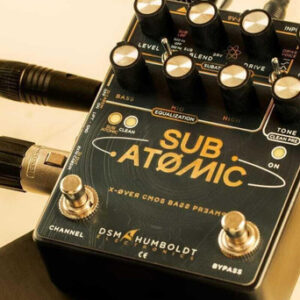
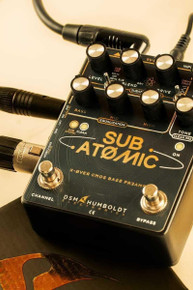
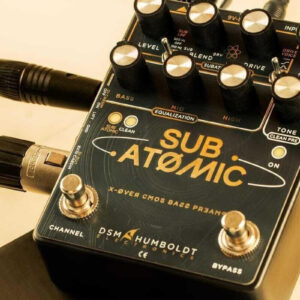
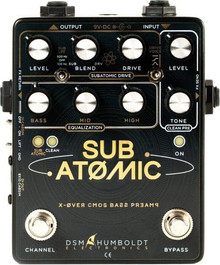
DSM and Humboldt Sub Atomic Bass Preamp Pedal

£269.00

This is a New DSM and Humboldt Sub Atomic Bass Preamp Pedal from DSM & Humboldt, listed in Preamp & DI Pedals on Just Pedals. Read More below.

View Just
more
and , ,

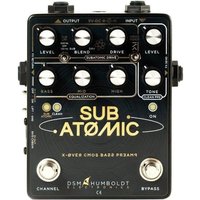
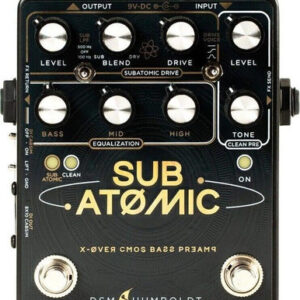
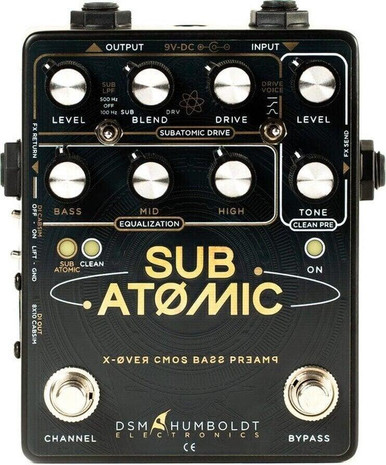
The Subatomic preamp is an all-analogue 2-channel preamp designed to bring the most brutal bass tones. Cascading CMOS stages with parallel processing for natural low frequencies makes it an effective tool for playing distorted bass tones with definition and full-bodied response.

Key Features

  • Versatile Tones – 2-channel preamp “clean” and “Sub Atomic”.
  • Cab Sim – The Sub Atomic features an optional analogue 8×10 Cab Sim with effects loop to ensure shaping your ultimate bass tone is always at hand.
  • No Menu Diving – Change settings on the fly with full control, and no menus for ease of use!

2 Channels

The clean channel brings the subtle compression and tube-like response of CMOS stages to warm up your tone, and the Subatomic drive channel has a very aggressive distortion with a clean blend. Both channels share the 3-band passive EQ to get the most ample range of tones out of this versatile device.

XLR & Cab Sim

But that’s not all. We included an XLR DI out with switchable analogue cabinet simulation of a huge 8×10 fridge and an FX loop, so you won’t need an external DI box when using post-drive effects.

Specifications

  • Clean Channel Controls: Gain and Tone
  • Subatomic Channel Controls: Gain, Voicing Switch, Sub Blend, Sub Low-pass filter switch (Off, 100Hz, 500Hz) and Level
  • EQ: 3 Band EQ with 80Hz, 500Hz and 2kHz
  • Output: ¼” or XLR balanced Output with optional analogue cabinet simulator
  • Bypass: soft footswitch
  • Channel: soft footswitch
  • Power: 9v DC

Brand

DSM & Humboldt

In the current JustPedals catalogue, DSM & Humboldt is represented by Amp & Cab Simulator Pedals, Preamp & DI Pedals and Overdrive Pedals. Current listings include DSM/Humboldt Sub-Atomic, DSM/Humboldt Simplifier X and DSM/Humboldt Simplifier Mk II. That makes the range relevant to players looking for drive, gain and clipping, plus modelling, direct rigs and multi-effects. Check each model for its exact circuit or processing platform, controls, power requirements and connections, particularly where the catalogue includes both pedals and supporting gear.

Category

Preamp & DI Pedals

Preamp and DI pedals shape an instrument signal and can feed a mixer, interface, PA, recorder or amplifier with a more controlled level and impedance. They may add EQ, gain, cabinet simulation, balanced output, ground lift or instrument-specific voicing. A bass, acoustic or electric-guitar preamp can solve very different problems, so check the input headroom, output format, phantom-power behaviour and routing. Decide whether the pedal should drive an amp, replace one for direct use or perform both roles.

Tags

Analogue

Analogue products use continuous audio circuitry for some or all of the signal path, so clipping, filtering or modulation arises from physical components rather than sampled algorithms. The label does not guarantee a particular tone; component choice, headroom, bias, noise and the surrounding gain stages still matter. Check whether the switching, presets, control section or cabinet stage is digital when the exact signal path is important.

Bass

Bass products are designed or voiced to retain low-frequency information and usable headroom with bass guitar or other low-register sources. Controls may centre on clean blend, low-end EQ, compression, crossover points or drive character. A guitar pedal can sometimes work well on bass, but it may remove the fundamental or compress the transient. Check the frequency response, input impedance, output level and dry-signal path with the intended tuning and amplifier.

Cab Simulator

Cabinet simulator products apply speaker and cabinet filtering, often from an impulse response or modelled curve, to make a direct signal behave more like a miked cabinet. They are useful after an amp or preamp into an interface, mixer or headphones. File format, sample rate, memory, microphone options, bypass routing and stereo support vary, so check those details before sending the signal to a real guitar cabinet or a full-range monitoring system.