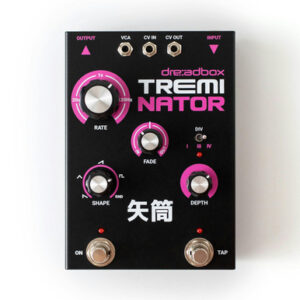
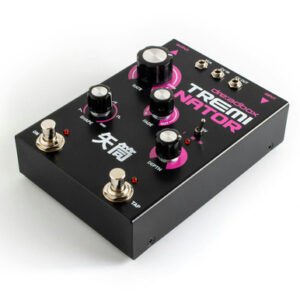
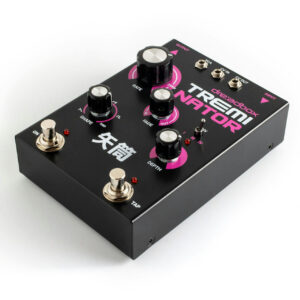
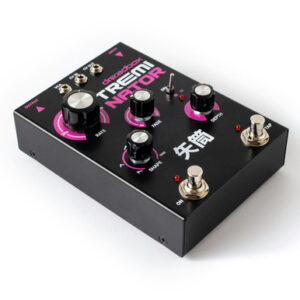
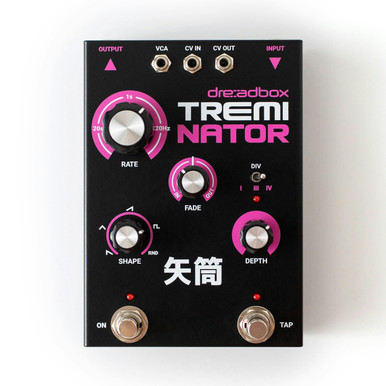
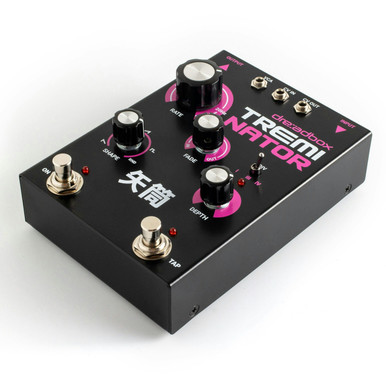
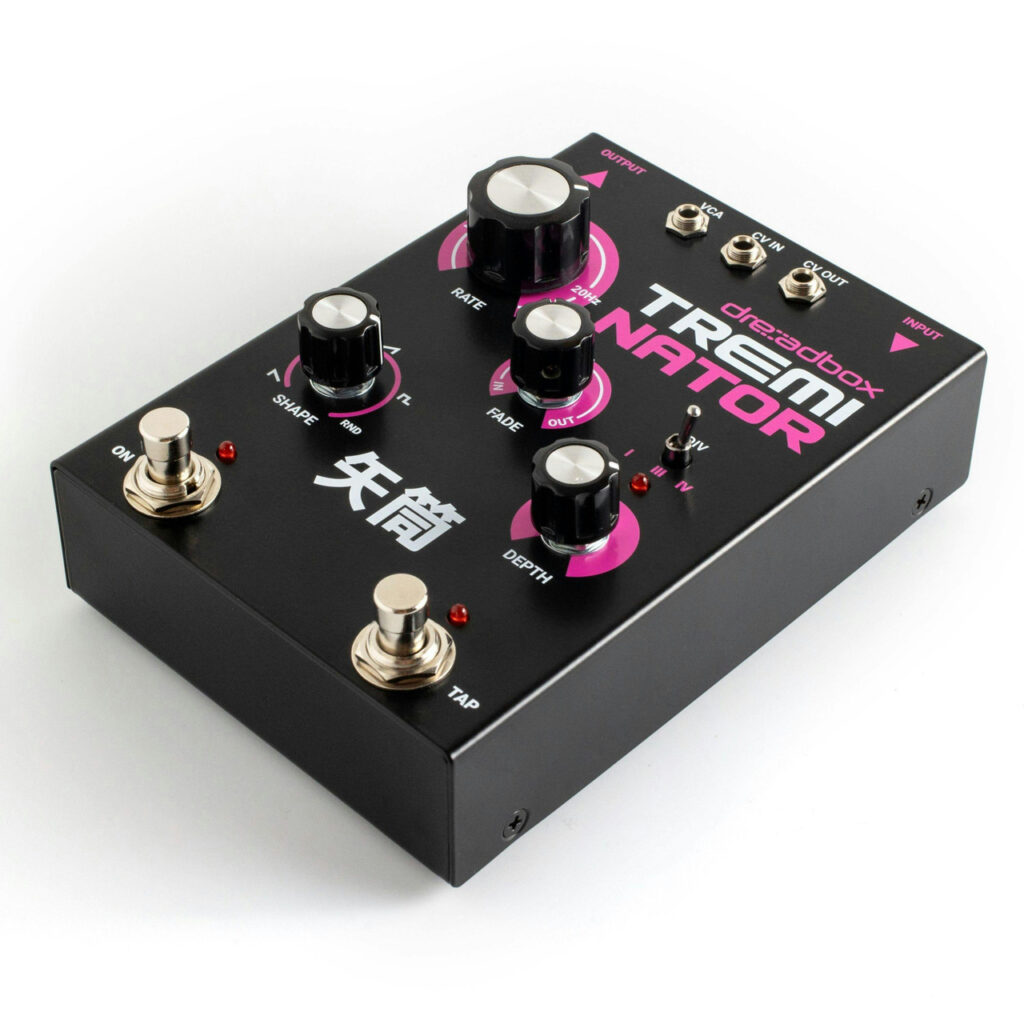
Dreadbox Treminator Expressive Analogue Tremolo Pedal

£169.99

This is a New Dreadbox Treminator Expressive Analogue Tremolo Pedal from Dreadbox, listed in Tremolo & Vibrato Pedals on Just Pedals. Read More below.

View Just
more
and , ,

Here's what Dreadbox say about the Treminator

Dreadbox Treminator has its roots from a synthesizer last signal flow stage, called the VCA (voltage controlled amplifier). We took this simple circuit and adapted it into a really expressive guitar pedal combined with an LFO that is controlled by envelope generators. The result was Treminator. Forget everything you knew about tremolos. Prepare to be amazed.

Key Features

  • Expressive analogue tremolo
  • VCA circuit straight out of a synthesizer
  • Wide range LFO (20 sec – 220 hz)
  • Tap tempo with multiple division settings
  • 2 x envelope generators to control LFO behaviour
  • 3 patch points to interact with CV and modular gear

Common Uses

  • Standard/classic triangle tremolo pedal
  • Sound chopper
  • LFO accelerator/decelerator
  • Fade in/out LFO
  • Volume pedal (requires external CV)
  • LFO generator for other CV gear)

Specifications

  • Circuit: Analogue signal, digital modulations
  • Bypass: Buffered OpAmp
  • Audio: Mono
  • In/Out: TS unbalanced 6.4mm jack
  • Power: 9VDC BOSS style centre pin negative 2.1mm (NOT INCLUDED)
  • Dimensions (cm): 14x10x5.6
  • Current Draw: 80mA

Brand

Dreadbox

In the current JustPedals catalogue, Dreadbox is represented by Delay & Reverb Pedals, Fuzz Pedals and Tremolo & Vibrato Pedals. Current listings include Disorder Analogue Filter Fuzz, Darkness Digital Stereo Reverb and Kinematic VCA-Based Compressor. That makes the range relevant to players looking for drive, gain and clipping, plus time-based effects and ambience. Check each model for its exact circuit or processing platform, controls, power requirements and connections, particularly where the catalogue includes both pedals and supporting gear.

Category

Tremolo & Vibrato Pedals

Tremolo varies amplitude, making volume rise and fall; vibrato varies pitch, making the note move sharp and flat. Some circuits combine both or derive them from modulation systems that blur the boundary. Rate, depth, waveform and stereo phase determine whether the motion is smooth, pulsing, choppy, seasick or spatial, while tap tempo can lock the cycle to a rhythm.

Tags

Analogue

The signal is shaped by continuously varying electronic circuitry rather than being converted into a digital effect algorithm. Component choice, operating voltage and circuit tolerances influence headroom, noise, clipping texture and the small variations in response between designs.

Digital

Converts the signal or control process into numerical data for algorithmic processing. Digital designs can provide precise timing, long memory, complex routing and repeatable presets; sample rate, conversion, internal resolution and latency influence fidelity and response.

Tap Tempo

Measures repeated foot taps and converts their interval into an effect rate or delay time. Subdivisions translate that pulse into dotted, triplet or other rhythmic values, while averaging and range limits influence how quickly and accurately the tempo settles.