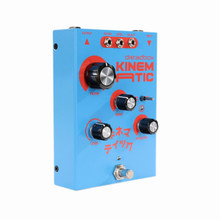
Dreadbox Kinematic VCA-Based Compressor Pedal

£169.99

This is a New Dreadbox Kinematic VCA-Based Compressor Pedal from Dreadbox, listed in Compressor Pedals on Just Pedals. Read More below.

View Just
more
and

Greek synth wizards Dreadbox have taken their first step into the realm of effects pedals, with their retro-styled Lethargy, Darkness & Kinematic stompboxes!

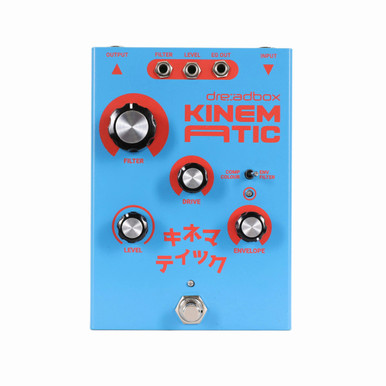
The Kinematic is a VCA-based compressor and envelope filter suitable for guitars, basses, synthesisers and even drum machines — with eurorack patch compatibility too. Embellishing your tones with vintage-esque analogue squeeze, the Dreadbox Kinematic's built-in overdrive circuit also allows you to dramatically distort any dry or anaemic-sounding signal with saturated, hair-raising gain!

Key Features

  • Fully-analogue, VCA-based compressor with band-boost filter and extreme compression ratio.
  • Envelope filter and low-pass filter with slow envelope curve.
  • Post-diode overdrive circuit adds musical grit to any instrument signal.
  • Level boost — up to +18dB on tap!
  • 3 patch points make this unit perfect for modular synth fans.

Specifications

  • Circuit: Analogue
  • Bypass: CMOS
  • Audio: Mono
  • Power: 9VDC (center pin negative, 2.1mm)
  • Current Draw: 85mA
  • Dimensions (cm): 14 x 10 x 5.6

Inputs & Outputs

  • In/Out: TS unbalanced 6.4mm jack
  • Filter/Level/EG Out: 3.5mm mini jack
Brand

Dreadbox

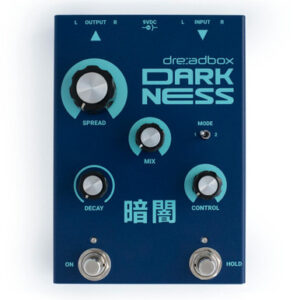
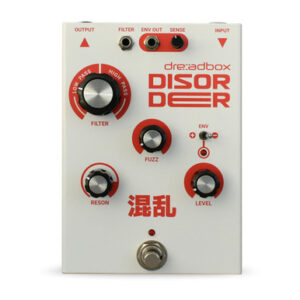
In the current JustPedals catalogue, Dreadbox is represented by Delay & Reverb Pedals, Fuzz Pedals and Tremolo & Vibrato Pedals. Current listings include Disorder Analogue Filter Fuzz, Darkness Digital Stereo Reverb and Kinematic VCA-Based Compressor. That makes the range relevant to players looking for drive, gain and clipping, plus time-based effects and ambience. Check each model for its exact circuit or processing platform, controls, power requirements and connections, particularly where the catalogue includes both pedals and supporting gear.

Category

Compressor Pedals

Compression reduces the difference between louder and quieter parts of the signal. It can restrain peaks, lift decaying notes and make picking feel more even, but strong settings also change the attack and add audible sustain or pumping. Threshold, ratio, attack, release and blend determine when gain reduction begins, how firmly it acts and how much natural transient detail remains.

Tags

Analogue

The signal is shaped by continuously varying electronic circuitry rather than being converted into a digital effect algorithm. Component choice, operating voltage and circuit tolerances influence headroom, noise, clipping texture and the small variations in response between designs.