
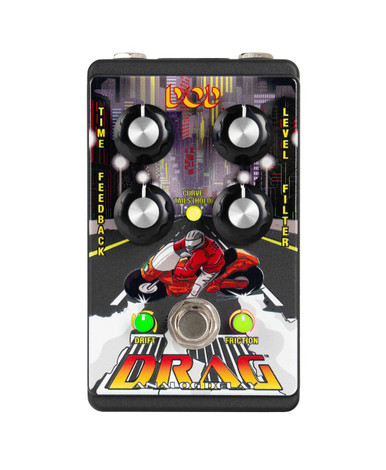
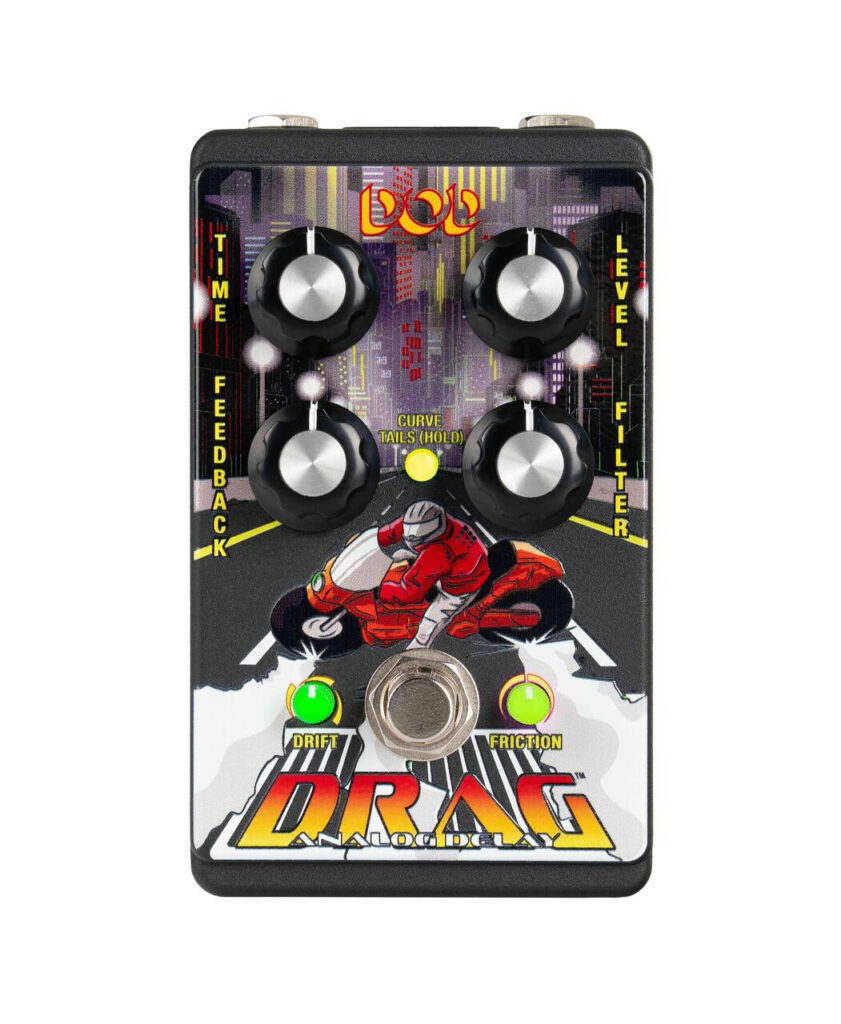



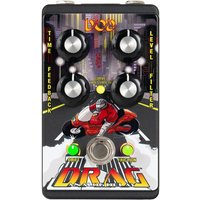
The DOD Drag Analogue Delay is a wildly expressive bucket brigade delay pedal that takes classic echo tones and twists them into something completely new. With up to 750 ms of rich analogue repeats, extending to 1.5 seconds in Rubberneck mode, plus patent-pending Friction time warping and a suite of performance tricks under your feet, it is built for players who want their delay to be an instrument in its own right. At its core, Drag delivers warm, musical repeats with controllable runaway oscillation and intuitive Delay Time, Repeats and Level controls. Around that, DOD have wrapped a powerful Drift modulation section, multiple waveform options and a clever footswitch system that lets you bend pitch, freeze your signal, warp time and trigger stutter-like effects without touching a knob. Top-mounted jacks and a reversible StagePlate make it equally at home on a busy pedalboard or straight on the floor. Analogue Bucket Brigade Delay With Attitude Drag is built around an analogue Bucket Brigade Device delay engine, giving you the saturated, organic repeats that digital units struggle to match. Up to 750 ms of delay time covers everything from tight slapback to spacious ambience, with the natural high-frequency roll-off and gentle compression that make BBD delays sit beautifully in a mix. Push the Repeats control and you can coax controllable self-oscillation for drones, swells and feedback-laden soundscapes. Rubberneck Mode and Friction Time Warping Engage Rubberneck mode and the maximum delay time stretches out to a cavernous 1.5 seconds, opening the door to huge, atmospheric echoes and experimental textures. The patent-pending Friction system lets you warp delay time on the fly via the footswitch, creating pitch dives, rises and glitchy time shifts without touching the knobs. It is a powerful way to add drama to transitions, punctuate phrases or turn simple lines into evolving, animated parts. Creative Footswitch Performance Tools The Drag footswitches unlock a suite of performance-focused tricks including SlideStop signal freeze, Rubberneck pitch bending, HopStop and Slide-n-Go Evade effects. These modes let you momentarily grab and hold your sound, stutter it rhythmically or duck in and out of delay for dynamic, DJ-like manipulation. Because they are all under your feet, you can treat the pedal as a live performance tool, reacting in real time to the band and the crowd. Drift Modulation and Pedalboard-Friendly Design The Drift control adds modulation to your repeats with four selectable waveforms: sine, reverse saw, square and random. From subtle tape-like wobble to choppy, lo-fi warble and unpredictable pitch scatter, it lets you tailor the movement and character of your echoes. Top-mounted jacks keep your board tidy, while the reversible StagePlate allows you to configure the pedal for either floor use or snug pedalboard mounting. An external FS3X input also gives you access to tap tempo and remote control when you need even more hands-free flexibility. Key Features Analogue BBD Delay Engine – The Bucket Brigade Device circuit delivers warm, musical repeats with natural high-end roll-off, perfect for vintage slapback, lush ambience and expressive self-oscillation that blends effortlessly with your dry tone. Rubberneck Mode up to 1.5 Seconds – Standard operation offers up to 750 ms of delay, while Rubberneck mode extends this to 1.5 seconds, giving you huge echo tails and expansive soundscapes ideal for post-rock, ambient and cinematic playing. Friction Time Warping and Performance Footswitch Modes – Patent-pending Friction time warping, plus SlideStop, Rubberneck, HopStop and Slide-n-Go Evade effects, let you bend pitch, freeze notes and create stutter-like textures on the fly, turning the pedal into a powerful live performance tool. Drift Modulation with Four Waveforms – The Drift control offers sine, reverse saw, square and random modulation, so you can dial in anything from gentle tape-style wobble to aggressive, g…



DOD Drag Analogue Delay Pedal
This is a New DOD Drag Analogue Delay Pedal from DOD its found in our Delay Pedals on the Just Pedals menu. Read More below.
As an affiliate partner, we may earn a small commission when you buy through our links — at no extra cost to you.
Related videos
Brand
DOD
In the current JustPedals catalogue, DOD is represented by Delay Pedals, Wah & Filter Pedals and Preamp & DI Pedals. Current listings include Mini Volume, Bifet Boost 410 and Mini Expression. That makes the range relevant to players looking for drive, gain and clipping, plus time-based effects and ambience. Check each model for its exact circuit or processing platform, controls, power requirements and connections, particularly where the catalogue includes both pedals and supporting gear.
Category
Delay Pedals
Delay records the incoming signal for a chosen interval and repeats it after the original note. Feedback returns repeats to the delay line, while tone, filtering, modulation and saturation determine whether echoes remain clear, darken progressively, wobble like tape or degrade like analogue bucket-brigade circuits. Delay time and rhythmic subdivisions govern the spacing and musical pattern of the repeats.
Tags
Analogue
The signal is shaped by continuously varying electronic circuitry rather than being converted into a digital effect algorithm. Component choice, operating voltage and circuit tolerances influence headroom, noise, clipping texture and the small variations in response between designs.
Digital
Converts the signal or control process into numerical data for algorithmic processing. Digital designs can provide precise timing, long memory, complex routing and repeatable presets; sample rate, conversion, internal resolution and latency influence fidelity and response.
Others Just Ordered :
- I Love A Happy Accident… – Animals Pedal

- Animals Pedal Vintage Van Driving is Very Fun Overdrive
- Animals Pedal Sunday Afternoon Is Infinity Bender
- Ninevolt Pedals | Bath Time Reverb (Animals Pedal)
- This Fuzz Pedal Makes No Sense… But It Sounds Incredible

- ANIME Pedals | Animals Pedal Custom Illustrated Series