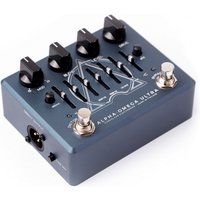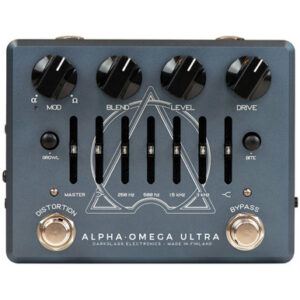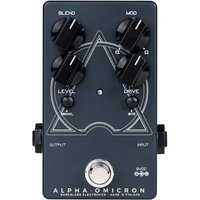
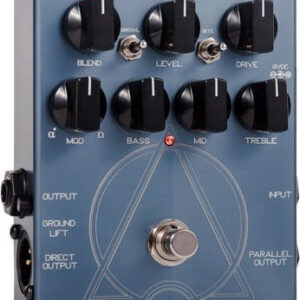
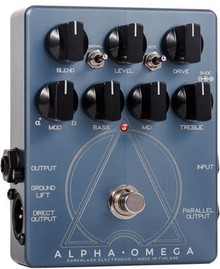

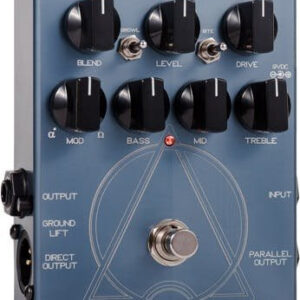
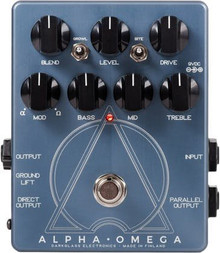
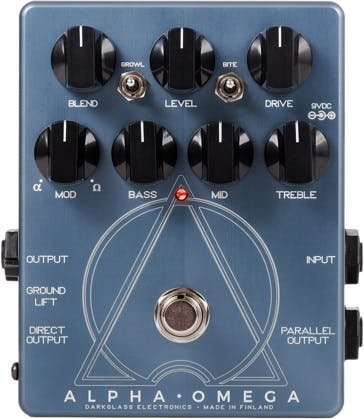
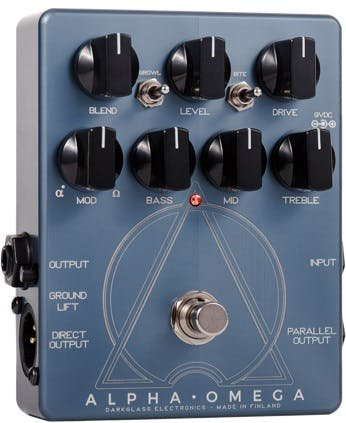
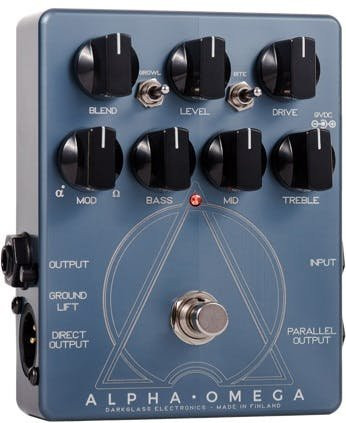
I hear bass players rejoice with the announcement of the Alpha Omega designed in conjunction with Karnivool bassist Jon Stockman.
This is a brand new circuit from Darkglass that doesn’t have any sign of their Microtubes circuits on-board. After spending months designing this new pedal, the Darkglass guys ended up with 2 circuits they all loved. And because they couldn’t choose which one to include on the pedal, they just used both!
2 Channels
You can use the Mod knob dial between the 2 channels. And because this is a knob rather than a toggle switch, you can blend the channels as much as you want.
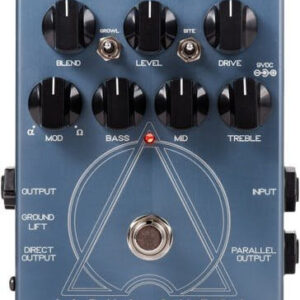
With a powerful 3 band EQ you can maximise the response of the pedal to your bass and use the mini toggles to add low-end or top-mid saturation. When you don’t use these toggles, the pedal will have a very natural flat response.
It’s also worth mentioning that though this is a distortion/preamp pedal that nails those Darkglass sounds, you can use it as a flat boost to enhance your current bass sound. Darkglass themselves have said they believe this to be their most versatile pedal.
Outputs
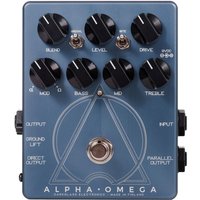
You’ve got all the outputs you’d need on the Alpha Omega with a direct out (With ground lift to prevent any noise) to go directly to the PA or interface. It even has a Parallel output to run into a bass amp on-stage or if you want to put it through some effects and mix them into your dry signal.
Here’s what Darkglass say about the Alpha Omega
Besides being an amazing composer, producer and bassist, Jon Stockman is amazing at crafting some of the most devastating bass tones in the world. We got together in our then Helsinki headquarters 18 months ago and after endless tweaking and tens of prototypes we are finally ready to announce our first co-designed creation: Alpha · Omega.
This creation differs greatly from our previous preamplifiers and overdrives: it is fully operational amplifier based and has two distinct distortion circuits (Alpha and Omega) which can be selected or blended using our Mod knob. This unusual control, in conjunction with the toggle switches and 3 active band equilizer makes Alpha · Omega the most flexible among our designs.
Specifications
- Blend – Mixes the clean and processed signals. The clean signal remains at unity gain while the volume of the overdriven signal is set by the Level knob, allowing for fine mix tuning.
- Level – Sets the volume of the overdriven signal.
- Drive -Sets the amount of gain in the overdriven signal.
- Bite – Boosts High Mids (2.8kHz) for additional presence and definition.
- Growl – Shelving Bass Boost for a fatter tone and increased low end saturation.
- Mod – Selects or mixes between the two distinct distortion circuits: Alpha is punchy, tight with a lot of definition, whereas Omega is simply brutal and raw.
- Bass – +-12dB @ 80Hz
- Mid – +-12dB @ 500Hz
- Treble – +-12dB @ 5kHz
- Parallel Output – Hardwired copy of your input signal, useful for getting a clean signal in recording and live situations
- Direct Output – A balanced version of the ¼” output, useful for running into PA’s or studio mixing consoles.