
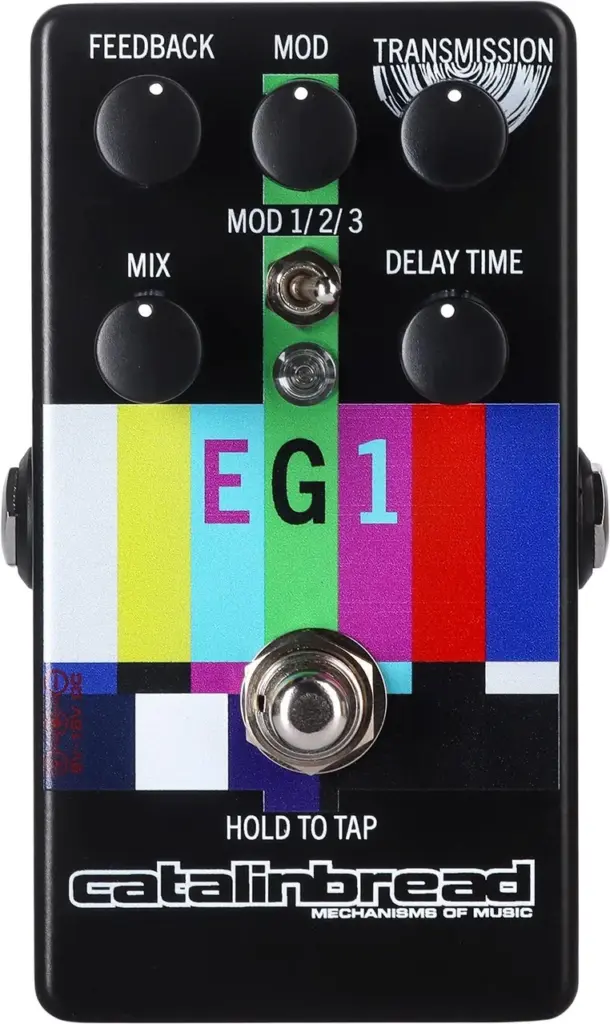
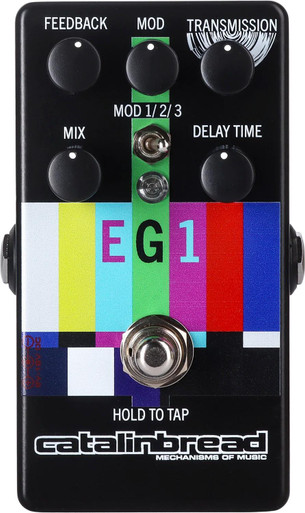



Weird, degraded and unstable – no, it’s not your uncle at the family get-together, it’s the sounds of the Catalinbread EG1 lo-fi delay. The EG1 is a premium, specialised effects pedal intent on making your repeats nice and crunchy, wobbly and broken across three unique algorithms: vintage radio, cassette tape, and digital television. You’ve got standard delay controls like mix and delay time up to ~900 milliseconds, but it’s these three specially flavoured modes combined with MOD, feedback and transmission (mode depth) controls governing the core tones sure to put a unique spin on your music. Whether you’re into wall of sound shoegaze, electronica or traditional guitar-based genres, the EG1 is going to find a home in your setup by making you sound like nobody else. Vintage Radio Mode You know how vintage radios sound all thin and crackly? That’s what we’re going for here with this mode – the amount of hi-pass and lo-fi filtering is dependent on the mod control and you’ll get some artifact simulation in there too. The transmission knob adjusts the dry-wet mix of the filtered and unfiltered repeats. Cassette Tape Mode The beauty (or downside) of cassette tapes is that they age and get all wobbly. This quirk is represented on this mode by imprinting a modulation rate and distortion depth. You may have seen this called “wow and flutter” elsewhere. The mod knob introduces a higher rate of modulation that sits comfortably in the mix at all settings while transmission adjusts the depth of this effect. Digital Television Mode Not shying away from the fully digital algorithm here, digital television recreates the stuttering glitches of Nyquist error (A.K.A aliasing, where high frequencies are misinterpreted as low frequencies) and digital downsampling (a loss of signal information) with some slight bitcrushing. The mod control adjusts the Nyquist error ratio, while the transmission control mixes that effect into the repeats. Tap tempo magic Sync up with your song using the tap tempo across three modes: Red: Classic mode, which operates the same as a standard delay using the delay time knob to manually set the delay time. Turn the delay time knob to enter this mode from any other mode. Green: Tap input mode, which lets you rhythmically tap the footswitch to set the delay time hands-free. Hold the footswitch to enter this mode from any other mode. Blue: Tap bypass mode, which uses the tempo entered in Tap Input Mode, and allows you to bypass the pedal with this time saved. Press and hold the footswitch while in Tap Input Mode to enter this mode.Key Features Three brilliant modulation modes for different flavours of lo-fi delay: vintage radio, cassette tape, and digital television Flutter, filter, distort, downsample and degrade your way into premium delay sounds Tactile mix, mod, feedback, transmission and delay time controls for highly curated sonic customisation A tasty delay time up to ~900 milliseconds Tap tempo to sync up with your music quickly and easily SpecificationsThe EG1 accepts a center-negative power supply capable of supplying 9VDC with at least 200mA of current (over 200mA is fine).



Catalinbread EG1 Lo-Fi delay pedal
This is a New Catalinbread EG1 Lo-Fi delay pedal from Catalinbread is in our Delay Pedals category on Just Pedals. Read More below.
As an affiliate partner, we may earn a small commission when you buy through our links — at no extra cost to you.
Related videos
Brand
Catalinbread
Catalinbread began in 2003 when Nic Harris built a pedal on his kitchen table; the company has made its pedals in Portland, Oregon since 2006, building more than 30 designs by hand. Its catalogue often reworks characterful studio and amplifier circuits for a pedalboard. JustPedals listings include the Adineko oil-can delay, Echorec multi-tap echo, Epoch Bias preamp and Sinkhole reverb. These models show the brand’s interest in distinctive delay, preamp and ambience sounds, with each product built around a particular vintage reference or circuit idea.
Category
Delay Pedals
Delay records the incoming signal for a chosen interval and repeats it after the original note. Feedback returns repeats to the delay line, while tone, filtering, modulation and saturation determine whether echoes remain clear, darken progressively, wobble like tape or degrade like analogue bucket-brigade circuits. Delay time and rhythmic subdivisions govern the spacing and musical pattern of the repeats.
Tags
Digital
Converts the signal or control process into numerical data for algorithmic processing. Digital designs can provide precise timing, long memory, complex routing and repeatable presets; sample rate, conversion, internal resolution and latency influence fidelity and response.
Others Just Ordered :
- I Love A Happy Accident… – Animals Pedal

- Animals Pedal Vintage Van Driving is Very Fun Overdrive
- Animals Pedal Sunday Afternoon Is Infinity Bender

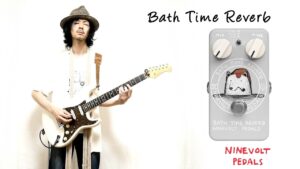
- Ninevolt Pedals | Bath Time Reverb (Animals Pedal)
- This Fuzz Pedal Makes No Sense… But It Sounds Incredible

- ANIME Pedals | Animals Pedal Custom Illustrated Series