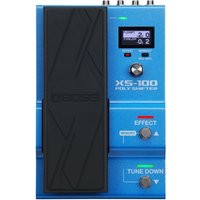
The Boss XS-100 Poly Shifter is a flagship pitch-shifting pedal built to deliver polyphonic harmony with a natural feel and rock-solid tracking. It handles chords and single notes with equal ease keeping your tone intact while adding layers of octaves harmonies or detuned textures. With up to four octaves of shift range ultra-low latency and a brand-new algorithm for seamless response the XS-100 makes pitch effects feel more musical than ever. A built-in expression pedal puts sweeping shifts right under your foot and the bright LCD display makes it simple to dial in and store up to 30 custom patches for stage or studio use. Practical and versatile the XS-100 includes a dedicated Tune Down switch for instant retunes or subtle detune effects plus dual pitch-shift control for fast creative changes mid-performance. Its rugged metal chassis is built to handle regular gigging while USB-C MIDI and extra control jacks give you modern connectivity and expansion options. From huge octave riffs to subtle harmonic colour the XS-100 is a road-ready pitch-shifting powerhouse that inspires new ideas every time you plug in.
Boss XS-100 Poly Shifter
This is a New Boss XS-100 Poly Shifter from Boss its found in our Specialist Effects Pedals on the Just Pedals menu. Read More below.
As an affiliate partner, we may earn a small commission when you buy through our links — at no extra cost to you.
Related videos

Brand
Boss
BOSS began in Osaka in 1973 as MEG Electronics, a company dedicated to effects. Its first BOSS-branded effect was the CE-1 Chorus Ensemble in 1976; the OD-1, SP-1 and PH-1 launched the compact-effects series in 1977. The JustPedals catalogue includes familiar overdrives and distortions such as the OD-3, SD-1, BD-2, DS-1 and MT-2 Metal Zone, as well as utility items such as the PCS-20A cable. BOSS now spans compact pedals, multi-effects, loopers, tuners and controllers. Manufacturing origin should be checked by model rather than inferred from the brand’s Japanese history.
Category
Specialist Effects Pedals
Specialist effects alter the signal in ways that do not sit cleanly inside one established family. They may use granular processing, frequency shifting, resonators, freeze or sustain, bit reduction, ring modulation, feedback networks or combinations of several techniques. The relevant distinction is the underlying process, its tracking or latency, and how completely the dry signal can be blended or replaced.
Tags
MIDI
Sends, receives or responds to Musical Instrument Digital Interface messages rather than carrying the instrument audio itself. Program changes recall presets, continuous controllers move parameters, and MIDI clock or transport messages synchronise timing between devices.
USB
Provides a Universal Serial Bus connection for power, audio, MIDI, firmware or editing data. The supported USB class and connector do not by themselves show its purpose; channel count, sample format, host compatibility and power demand define the actual function.
Others Just Ordered :
- I Love A Happy Accident… – Animals Pedal

- Animals Pedal Vintage Van Driving is Very Fun Overdrive

- Animals Pedal Sunday Afternoon Is Infinity Bender

- Ninevolt Pedals | Bath Time Reverb (Animals Pedal)
- This Fuzz Pedal Makes No Sense… But It Sounds Incredible

- ANIME Pedals | Animals Pedal Custom Illustrated Series