
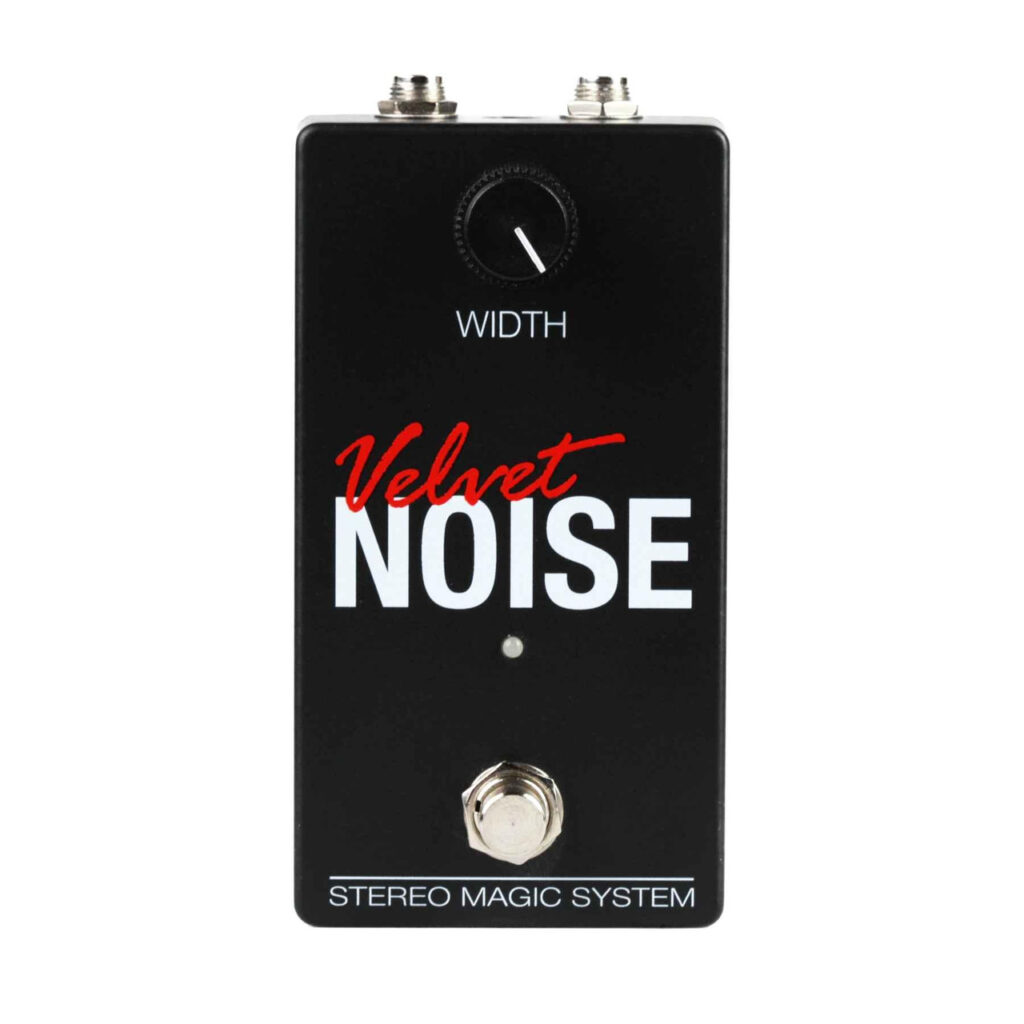



The Alexander Pedals Velvet Noise is a compact stereo widener designed to make your guitar, synth or mix feel bigger, deeper and more immersive without wrecking your tone. Using a velvet-noise decorrelation algorithm rather than traditional phase tricks, it creates a wide, airy stereo image that still holds together when summed to mono and keeps your centre image rock solid. At its heart is a single Width control that takes you from your untouched dry signal through natural-sounding stereo expansion and into gently animated movement at higher settings. Whether you are widening a mono pedalboard into a lush stereo rig, adding space to a synth or giving your mix bus a subtle 3D lift, Velvet Noise delivers studio-style spatial processing in a simple, pedalboard-friendly box. Unlike many stereo wideners, Velvet Noise is designed to preserve transients and avoid the obvious comb filtering and pitch artefacts that can make wide sounds feel artificial. The Spin Semiconductor FV-1 DSP runs independent random sequences on each channel, while a discrete JFET input stage and carefully tuned analogue circuitry keep your signal clean, quiet and responsive underfoot. With top-mounted jacks, buffered bypass and the ability to accept mono or stereo input while always outputting stereo, Velvet Noise drops neatly into modern pedalboard layouts and studio setups alike. From subtle width on your always-on board to dramatic stereo separation for ambient soundscapes, it is an elegant solution for anyone chasing a wider, more spacious sound. Velvet-noise decorrelation Velvet Noise uses a decorrelation algorithm to make the left and right channels genuinely less similar, rather than simply shifting phase or EQ. This gives you a convincing sense of width that stays stable when summed to mono and does not hollow out the centre of your sound, making it ideal for live rigs and recording. Simple, musical Width control The single Width knob keeps operation fast and intuitive. At minimum you hear your dry signal, the middle of the control delivers maximum decorrelation for natural stereo spread, and higher settings introduce subtle modulation for extra movement. You can quickly dial in anything from a barely-there widening to dramatic stereo separation. Flexible mono or stereo integration Velvet Noise accepts either mono or stereo input via its 1/4″ TRS jack, with the factory configuration set for Mono In, Stereo Out. This makes it easy to place after mono drives, compressors or filters and before stereo delays or reverbs, or to process full stereo rigs and synths while always delivering a spacious stereo output. Clean, low-noise digital processing A Spin Semiconductor FV-1 DSP runs the velvet-noise algorithm with independent random sequences per channel, while the discrete JFET input preamp and tailored analogue section keep noise low and transients intact. Minimal latency helps preserve the immediate feel of your playing, so the effect feels like part of your core sound rather than an added layer.Key Features Velvet-noise stereo widening – The decorrelation algorithm widens the stereo image by making the left and right channels less similar, maintaining a solid centre and avoiding the phasey, comb-filtered sound of many traditional wideners. Single Width control with modulation – One knob moves from dry through maximum decorrelation into gentle modulation, letting you set subtle enhancement or animated width in seconds without menu diving or complex tweaking. Mono in, stereo out flexibility – The pedal processes mono or stereo sources and always outputs stereo, so you can turn a mono pedal chain into a spacious stereo rig or enhance existing stereo setups with extra depth and dimension. Low-noise, pedalboard-friendly design – Discrete JFET input, buffered bypass, top-mounted jacks and compact dimensions make Velvet Noise quiet, reliable and easy to integrate into modern pedalboards and studio workflows. SpecificationsGeneral Pedal Type: Stereo / Utility …



Alexander Pedals Velvet Noise Stereo Widener Pedal
This is a New Alexander Pedals Velvet Noise Stereo Widener Pedal from Alexander Pedals is in our Specialist Effects Pedals category on Just Pedals. Read More below.
As an affiliate partner, we may earn a small commission when you buy through our links — at no extra cost to you.

Related videos
Brand
Alexander Pedals
In the current JustPedals catalogue, Alexander Pedals is represented by Delay Pedals and Reverb Pedals. Current listings include Space Force Reverb, Syntax Error XP Lofi and Velvet Noise Stereo Widener. That makes the range relevant to players looking for time-based effects and ambience. Check each model for its exact circuit or processing platform, controls, power requirements and connections, particularly where the catalogue includes both pedals and supporting gear.
Category
Specialist Effects Pedals
Specialist effects alter the signal in ways that do not sit cleanly inside one established family. They may use granular processing, frequency shifting, resonators, freeze or sustain, bit reduction, ring modulation, feedback networks or combinations of several techniques. The relevant distinction is the underlying process, its tracking or latency, and how completely the dry signal can be blended or replaced.
Tags
Analogue
The signal is shaped by continuously varying electronic circuitry rather than being converted into a digital effect algorithm. Component choice, operating voltage and circuit tolerances influence headroom, noise, clipping texture and the small variations in response between designs.
Buffered Bypass
Keeps an active buffer in the signal path when the effect is bypassed. The buffer converts a high-impedance input to a lower-impedance output, helping long cables and multiple pedals retain level and high frequencies, although its headroom and noise remain part of the path.
Stereo
Processes, creates or passes two audio channels. True stereo preserves separate left and right inputs, while mono-to-stereo effects generate spatial differences internally; routing, phase behaviour and whether trails remain stereo determine the resulting image. Some outputs sum to mono when only one socket is connected, which can change level or modulation depth.
Others Just Ordered :
- I Love A Happy Accident… – Animals Pedal

- Animals Pedal Vintage Van Driving is Very Fun Overdrive

- Animals Pedal Sunday Afternoon Is Infinity Bender

- Ninevolt Pedals | Bath Time Reverb (Animals Pedal)

- This Fuzz Pedal Makes No Sense… But It Sounds Incredible

- ANIME Pedals | Animals Pedal Custom Illustrated Series