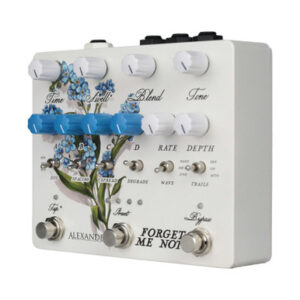
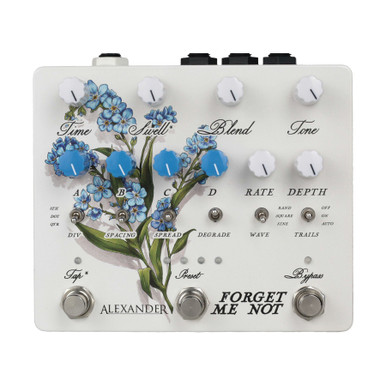
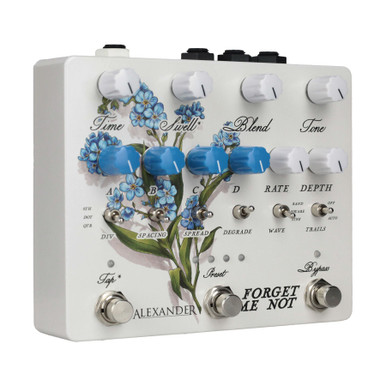
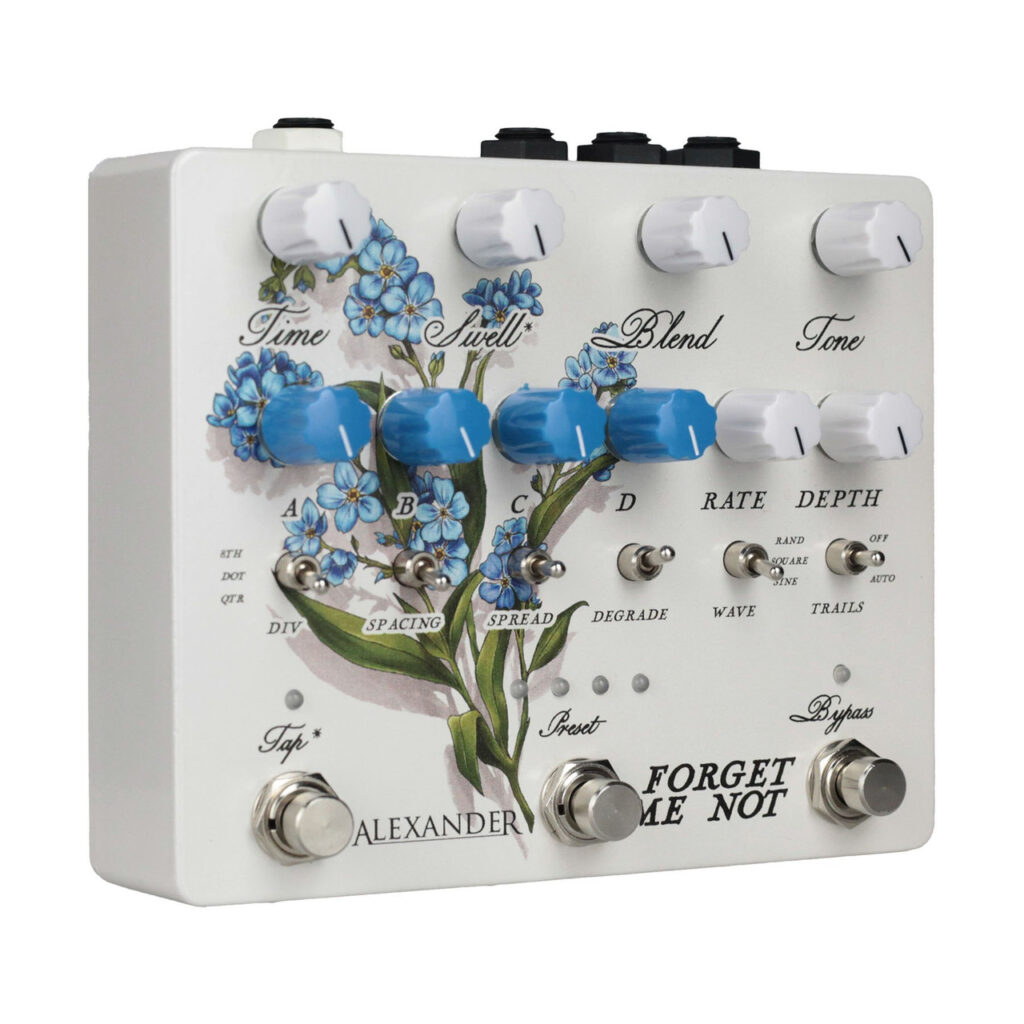
Alexander Pedals Forget Me Not Stereo Multi-Tap Delay Pedal

£379.00

This is the Alexander Pedals Forget Me Not Stereo Multi-Tap Delay Pedal from Alexander Pedals, listed in Delay Pedals on Just Pedals. Read More below.

View Just
more
and , , ,

The Forget Me Not can either be an echo or a reverb unit. Dial it in to create inspiring tonal harmony, or an incredibly broken soundscape! This pedal is based on a rare piece of rack gear that simulated reverberation by using a tapped delay line, and delivers a warm, old-school feel.

Forget Me Not lives partially in the reverb world while living comfortably in the world of delay. It can do either or both at once depending on how you would like to use it.

Key Features

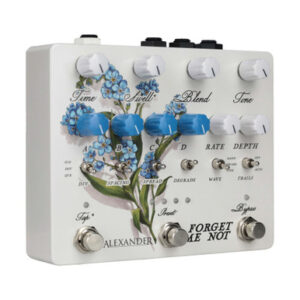
  • No Hidden Controls – Featuring a tactile interface, every parameter, option and setting has its own control for a hands-on experience.
  • Saveable Presets – Save up to 32 of your own masterpieces!
  • MIDI & Expression Control – By using the multiJack, you can use switchable expression, tap tempo, or use as a MIDI input.
  • Mono or Stereo – Flexible between mono and stereo, you can choose exactly how the Forget Me Not fits within your signal chain.
  • Alter the Feedback – With the tap control, you can tap twice to set the delay time, or hold it down to swell the feedback into pure bliss.

Controls

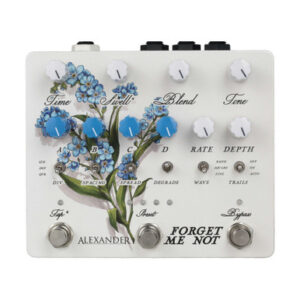
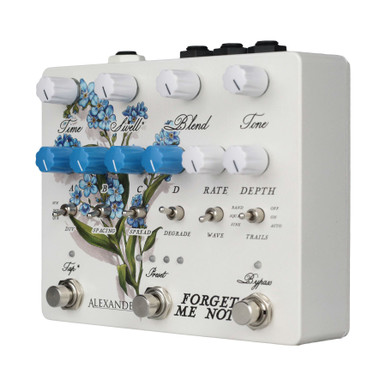
  • Time: Sets delay time from 5-900ms
  • Swell: Sets delay repeat level
  • Blend: Mixes between direct and delay
  • Tone: Controls delay tone filter
  • A B C D: Sets the volume level for each delay tap
  • Rate: Sets the speed of the modulation effect
  • Depth: Sets the intensity of the modulation effect
  • DIV: Sets tap tempo subdivision Up: 8th, Mid: Dot 8th, Down: Quarter
  • SPACING: Sets spacing between delay heads Up: Near, Mid: Far Down: Equal
  • SPREAD: Sets the stereo width Up: Wide, Mid: Narrow, Down: Mono
  • DEGRADE: Sets the echo fidelity Up: Trash Mid: Grit, Down: Clean
  • WAVE: Sets the modulation wave Up: Random, Mid: Square, Down: Sine
  • TRAILS: Sets the bypass trails level Up: Off, Mid: Forever, Down: Faded
  • Tap: Tap twice to set delay time Hold to swell feedback.
  • Preset: Tap to select preset 1-4 or Live Mode. Hold to save preset.
  • Bypass: Tap to turn effect on or off

Connections

Forget-Me-Not features all connections on the top side panel.

  • Input (TRS STEREO) – Switchable between mono and TRS stereo. In mono mode, input is taken from the jack tip. In stereo mode, the left input is the tip and right is the ring.
  • Output R – right-channel output.
  • Output L (TRS STEREO) – left-channel output. If Output R is not used, this jack also carries both output channels with Left as tip and Right as ring.
  • Power: Center-negative, 9V DC only. Forget-Me-Not requires 250mA minimum, isolated power required. Do not use a power supply with an output higher than 9V.
  • USB: Mini-B connection for USB MIDI and firmware updates.
  • MultiJack: Switchable between Expression, Tap Tempo Footswitch, and MIDI input.
 

Related videos

Brand

Alexander Pedals

Alexander Pedals is a renowned manufacturer of guitar effects pedals, known for its innovative and high-quality products. Founded by Matthew Farrow in North Carolina, the company has gained a reputation for blending cutting-edge digital technology with classic analogue tones. Alexander Pedals offers a wide range of effects, including delays, reverbs, overdrives, and modulation effects, catering to musicians seeking versatile and creative sound options. Each pedal is crafted with attention to detail, featuring intuitive controls and sturdy construction, making them a popular choice among professional and amateur musicians alike. The company’s pedals are often praised for their unique soundscapes and user-friendly interfaces, allowing musicians to experiment with a wide variety of tones and effects.

One of the standout features of Alexander Pedals is the inclusion of the Neo Series, which incorporates digital control over analogue signal paths, allowing for presets, MIDI functionality, and expression control. This innovation enables musicians to easily switch between different settings and integrate the pedals seamlessly into complex setups. Alexander Pedals is also known for its commitment to continuous improvement and customer feedback, regularly updating firmware and introducing new models to meet the evolving needs of guitarists. The company has built a loyal community around its products, with musicians appreciating the blend of creativity, quality, and versatility that Alexander Pedals consistently delivers.

Category

Delay Pedals

Delay records the incoming signal for a chosen interval and repeats it after the original note. Feedback returns repeats to the delay line, while tone, filtering, modulation and saturation determine whether echoes remain clear, darken progressively, wobble like tape or degrade like analogue bucket-brigade circuits. Delay time and rhythmic subdivisions govern the spacing and musical pattern of the repeats.

Tags

MIDI

Sends, receives or responds to Musical Instrument Digital Interface messages rather than carrying the instrument audio itself. Program changes recall presets, continuous controllers move parameters, and MIDI clock or transport messages synchronise timing between devices.

Presets

Stores complete groups of parameter values for later recall. The number of locations, switching time, spillover behaviour and whether presets include routing, expression and MIDI assignments determine how completely one sound can change into another.

Stereo

Processes, creates or passes two audio channels. True stereo preserves separate left and right inputs, while mono-to-stereo effects generate spatial differences internally; routing, phase behaviour and whether trails remain stereo determine the resulting image. Some outputs sum to mono when only one socket is connected, which can change level or modulation depth.

Tap Tempo

Measures repeated foot taps and converts their interval into an effect rate or delay time. Subdivisions translate that pulse into dotted, triplet or other rhythmic values, while averaging and range limits influence how quickly and accurately the tempo settles.