
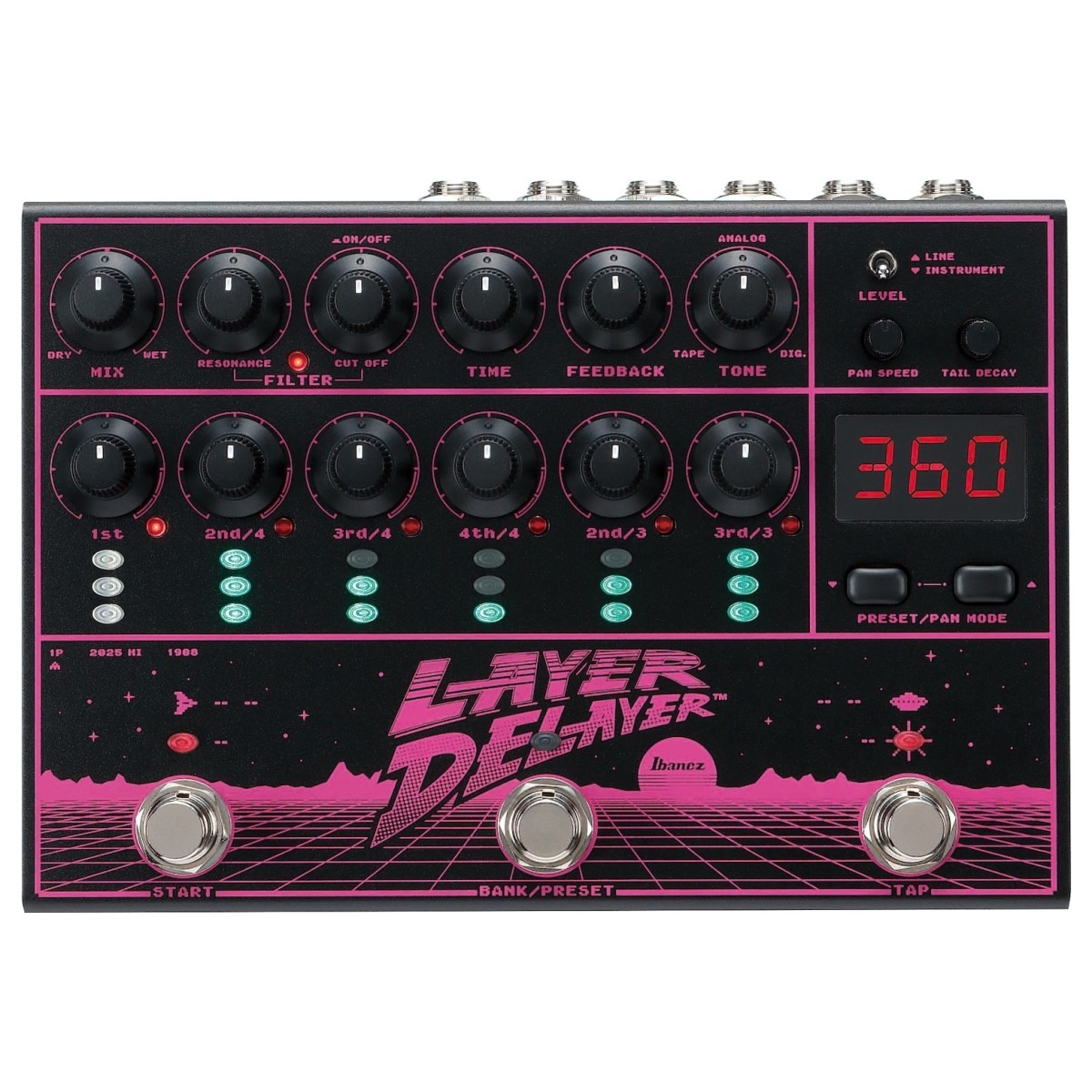
The Ibanez LD303 Layer Delay is an innovative stereo delay pedal designed to go far beyond traditional echo effects. Built around a rhythmic multi-layer concept it generates a quarter-note delay alongside 16th-note and triplet repeats each with its own independent volume control. This opens up complex rhythmic textures and evolving patterns that feel musical and expressive rather than static. Powerful tone-shaping tools let you sculpt everything from clean digital repeats to darker analogue and tape-style echoes while advanced stereo features and MIDI integration make it ideal for modern pedalboards and studio setups. With deep control preset storage and creative routing options the Layer Delay is a forward-thinking delay for players and producers who want to explore new rhythmic and spatial possibilities.
Ibanez LD303 Layer Delayer
This is a New Ibanez LD303 Layer Delayer from Ibanez, listed in Delay Pedals on Just Pedals. Read More below.
As an affiliate partner, we may earn a small commission when you buy through our links — at no extra cost to you.
Related videos

Brand
Ibanez
In the current JustPedals catalogue, Ibanez is represented by Overdrive Pedals, Wah & Filter Pedals and Delay Pedals. Current listings include WH10V3 Wah, TS9 Tube Screamer and Tube Screamer Mini. That makes the range relevant to players looking for drive, gain and clipping, plus time-based effects and ambience. Check each model for its exact circuit or processing platform, controls, power requirements and connections, particularly where the catalogue includes both pedals and supporting gear.
Category
Delay Pedals
Delay records the incoming signal for a chosen interval and repeats it after the original note. Feedback returns repeats to the delay line, while tone, filtering, modulation and saturation determine whether echoes remain clear, darken progressively, wobble like tape or degrade like analogue bucket-brigade circuits. Delay time and rhythmic subdivisions govern the spacing and musical pattern of the repeats.
Tags
Analogue
The signal is shaped by continuously varying electronic circuitry rather than being converted into a digital effect algorithm. Component choice, operating voltage and circuit tolerances influence headroom, noise, clipping texture and the small variations in response between designs.
Digital
Converts the signal or control process into numerical data for algorithmic processing. Digital designs can provide precise timing, long memory, complex routing and repeatable presets; sample rate, conversion, internal resolution and latency influence fidelity and response.
MIDI
Sends, receives or responds to Musical Instrument Digital Interface messages rather than carrying the instrument audio itself. Program changes recall presets, continuous controllers move parameters, and MIDI clock or transport messages synchronise timing between devices.
Presets
Stores complete groups of parameter values for later recall. The number of locations, switching time, spillover behaviour and whether presets include routing, expression and MIDI assignments determine how completely one sound can change into another.
Stereo
Processes, creates or passes two audio channels. True stereo preserves separate left and right inputs, while mono-to-stereo effects generate spatial differences internally; routing, phase behaviour and whether trails remain stereo determine the resulting image. Some outputs sum to mono when only one socket is connected, which can change level or modulation depth.
Others Just Ordered :
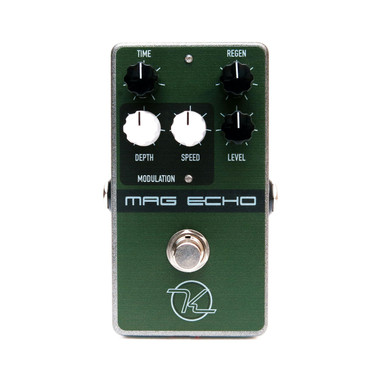
- Mooer Meta FX – Review
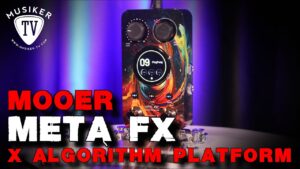
- MOOER META FX Review: 3 Effects in 1—but Here’s the Problem

- I Wasn’t Expecting To Be Impressed – But What Is The Mooer Meta FX?

- Mooer // META FX Stereo Multi-Effect Platform (Demo)

- A NEW GENERATION OF PEDALS IS HERE – Mooer Meta FX Reverb Review

- Mooer META FX | All the REVERBS from subtle to WILD!