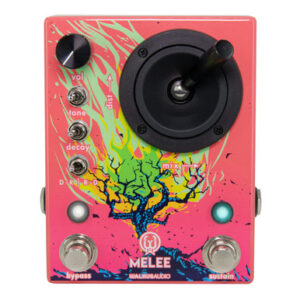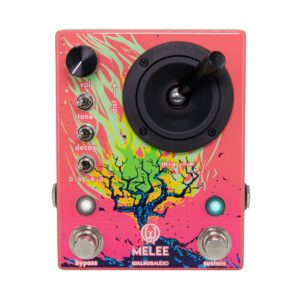
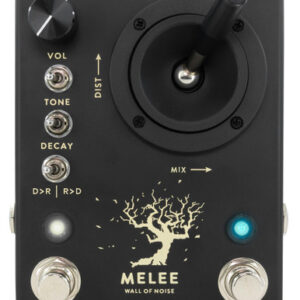
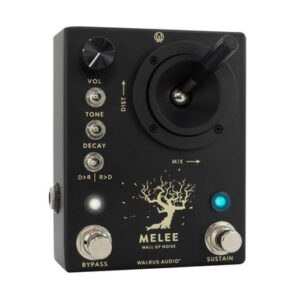

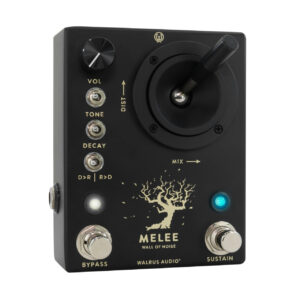
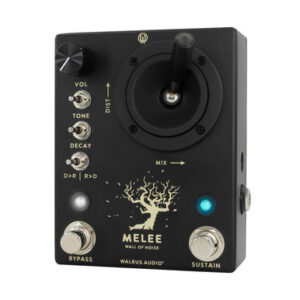
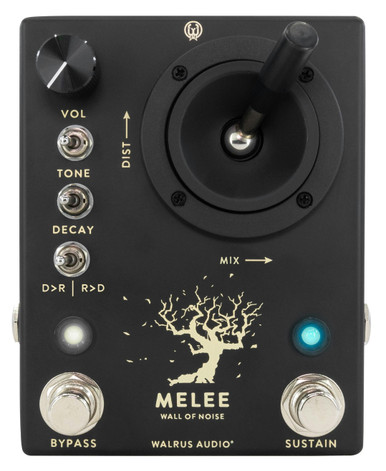
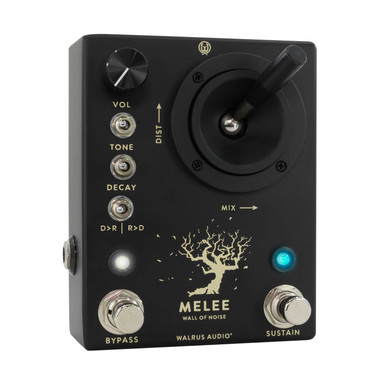
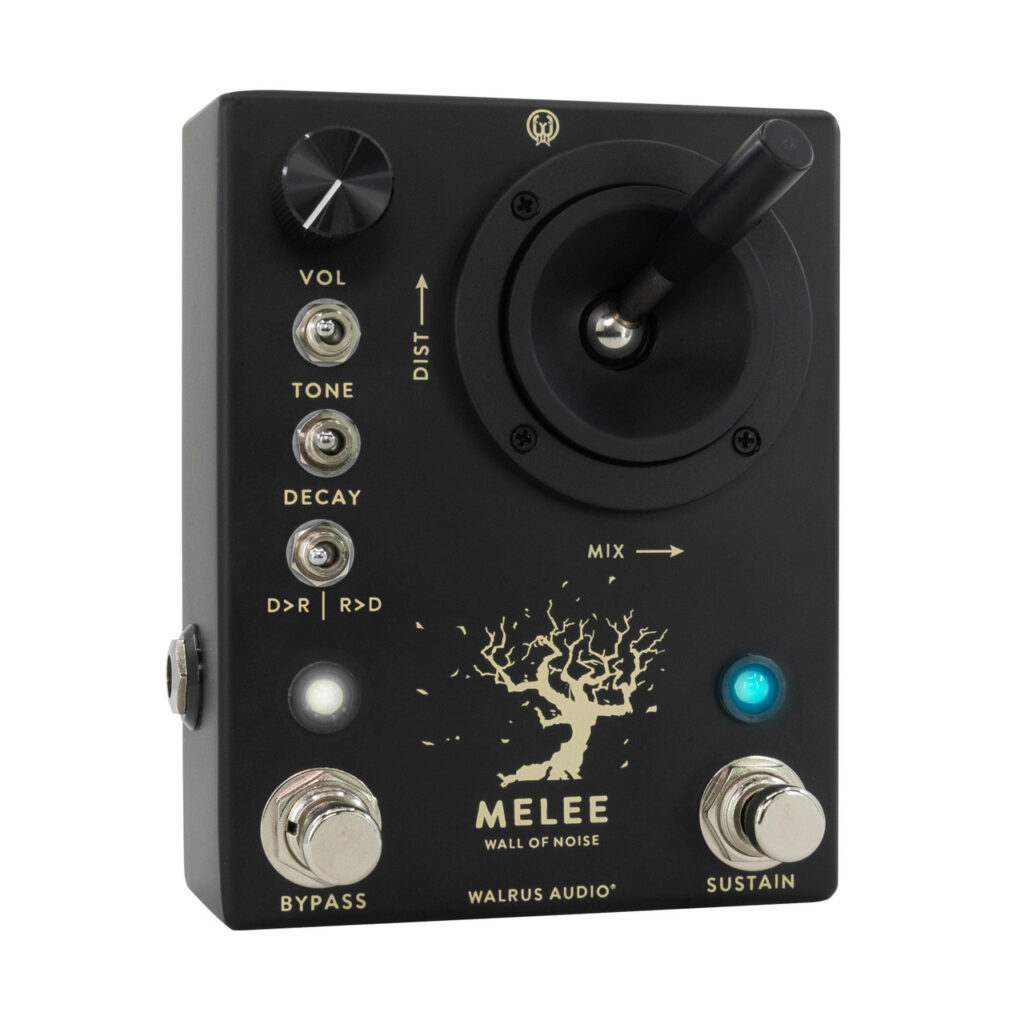
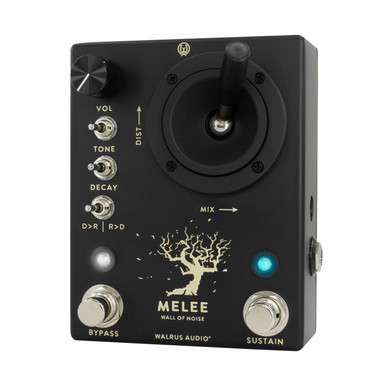
With their unique Melee “Wall of Noise” pedal, Walrus Audio give you the two most quintessential effects that yield unruly amounts of power and influence to an instrumentalist: reverb and distortion. They have been harnessed and woven together for an eternity of ethereal sonic bliss. The Melee unapologetically uses a joystick to meld reverb and distortion into one massive blaze of sound. With the flip of the order switch, run the distortion into the reverb or the reverb into distortion — the signal chain is your call now. For the explorer, the Melee can run one of three different reverb programs: Ambient, Octave, and Reverse.
In a “less is more” approach, Walrus Audio has intentionally decided on controls that are fun to use and will inspire a wealth of creative output. Use the joystick to influence the amount of distortion by moving it up and down, while leaning the joystick left and right will adjust your reverb mix. The tone and decay toggles have low, medium, and high settings, and even modulation can be added to the wet signal by holding down the bypass switch and moving the decay toggle. The left position is no modulation, the middle is a slight modulation, and the right is a high modulation.
Reverb Algorithms
The Walrus Audio Melee pedal is equipped with three different reverb programs, which can be changed by simultaneously pressing the bypass and sustaining stomp switches. Experiment with the order toggle switches to hear how differently these all react in front and after the distortion!
- Ambient Reverb (Pink LED) – Huge reverb capable of massive trails and engulfing your chords into an angry wash of sound. Great for soaring melodic lines or shoegaze-driven chord progressions.
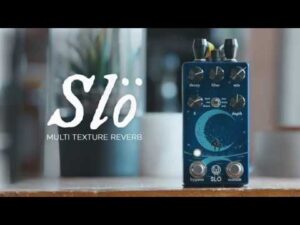
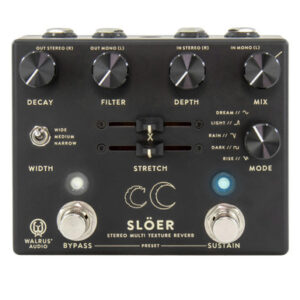
- Octave Down Reverb (Yellow LED) – Similar to the Dark mode in Walrus Audio’s popular Slö reverb pedal, you’ll find an eerie lower octave hovering in the reverb trail for an engulfing atmospheric touch.
- Reverse Reverb with Feedback (Blue LED) – Add reversed reverb trails back into your signal, create gentle melodies, or push into reverse feedback overload. Big, slow, and sad chords love to hang out here!
Momentary Function
Press and hold the sustain switch to ramp up the reverb trails. Release and the trails will ramp back down to where the decay switch is currently set. The sustain switch can also latch in all three programs. Press and release the sustain switch to capture and sustain the current reverb decay for long, pad-like sounds in your wet mix. Press again to release the latch, and the reverb trail will taper off based on the position of the decay knob.
Specifications
- Controls: Volume, Tone, Decay, D>R|R>D (determines order of effects), Joystick (distortion level & reverb
- mix), Bypass, Sustain Switch
- 3 Bypass Modes: DSP Bypass, DSP & True Bypass, True Bypass
- Dimensions: 3.62″ x 4.79″ x 3.14″ (including joystick height)
- Power: 9V DC, centre negative, 200mA minimum (power supply not included)