
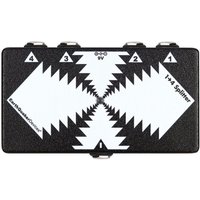
The EarthQuaker Devices One to Four Splitter Pedal is a compact utility pedal designed to send one input to four independent buffered outputs without any loss of tone or clarity. Each output features a unity gain buffer with a flat frequency response ensuring your signal remains clean punchy and consistent across all connections. With a high 1 M? input impedance and low 100 ? output impedance its ideal for preserving tone integrity even over long cable runs. Built for demanding setups this splitter is perfect for sending your signal to multiple amps pedal chains or recording paths all while keeping your core sound intact.
EarthQuaker Devices One to Four Splitter Pedal
£109.99
This is a New EarthQuaker Devices One to Four Splitter Pedal from EarthQuaker Devices its found in our Specialist Effects Pedals on the Just Pedals menu. Read More below.
View Just EarthQuaker Devices
As an affiliate partner, we may earn a small commission when you buy through our links — at no extra cost to you.
Related videos
Brand
EarthQuaker Devices
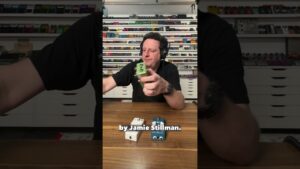
Musician Jamie Stillman founded EarthQuaker Devices in 2004 after moving from pedal repair into circuit design. The first full-production release was the Hoof fuzz in 2007. The company develops its pedals in-house in Akron, Ohio, where it hand-builds and hand-tests them and backs them with a lifetime guarantee. Current JustPedals examples show the range’s practical and exploratory sides: Ghost Echo reverb, Data Corrupter harmonizer, Avalanche Run delay and reverb, and Rainbow Machine pitch shifting. EarthQuaker’s own design philosophy pairs usable controls with sounds that can move well beyond conventional effects.
Category
Specialist Effects Pedals
Specialist effects alter the signal in ways that do not sit cleanly inside one established family. They may use granular processing, frequency shifting, resonators, freeze or sustain, bit reduction, ring modulation, feedback networks or combinations of several techniques. The relevant distinction is the underlying process, its tracking or latency, and how completely the dry signal can be blended or replaced.
Others Just Ordered :
- I Love A Happy Accident… – Animals Pedal

- Animals Pedal Vintage Van Driving is Very Fun Overdrive

- Animals Pedal Sunday Afternoon Is Infinity Bender

- Ninevolt Pedals | Bath Time Reverb (Animals Pedal)

- This Fuzz Pedal Makes No Sense… But It Sounds Incredible

- ANIME Pedals | Animals Pedal Custom Illustrated Series
