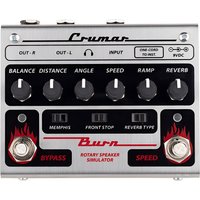
The Crumar BURN is designed for organ keyboard and guitar players who require a versatile rotary speaker simulator with easy front-panel control. Its compact design suits live rigs and studio setups alike offering a rich rotary effect paired with selectable spring or digital reverb. With controls for microphone balance angle and distance players can shape the stereo spread to match personal taste or room acoustics. An input gain switch optimises the signal for either guitar or keyboard while the cabinet simulation ensures an authentic tone when connected to amps or PA systems. Practice quietly using the built-in stereo headphone output or switch speeds instantly with the footswitches. The BURN integrates smoothly with Crumars SORRENTO using the ONE-CORD system that handles audio and power through one cable keeping setups neat. This updated model refines a beloved effect offering direct control and satisfying rotary sound in a robust gig-ready box that fits easily into pedalboards or keyboard stands.
Crumar BURN Rotary Simulator Pedal
This is a New Crumar BURN Rotary Simulator Pedal from CRUMAR is in our Modulation Pedals category on Just Pedals. Read More below.
As an affiliate partner, we may earn a small commission when you buy through our links — at no extra cost to you.
Brand
CRUMAR
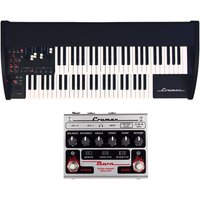
In the current JustPedals catalogue, CRUMAR is represented by Modulation Pedals. Current listings include BURN Rotary Simulator and SORRENTO Organ. That makes the range relevant to players looking for modulation and movement. Check each model for its exact circuit or processing platform, controls, power requirements and connections, particularly where the catalogue includes both pedals and supporting gear.
Category
Modulation Pedals
Modulation changes a signal through a continuously moving control source. This broad category covers effects that alter delay time, phase, pitch, amplitude or filtering to create rotation, movement and evolving texture when no narrower effect family is dominant. Waveform, rate, depth, stereo phase and control routing determine the shape and spatial behaviour of that movement.
Tags
Digital
Converts the signal or control process into numerical data for algorithmic processing. Digital designs can provide precise timing, long memory, complex routing and repeatable presets; sample rate, conversion, internal resolution and latency influence fidelity and response.
Stereo
Processes, creates or passes two audio channels. True stereo preserves separate left and right inputs, while mono-to-stereo effects generate spatial differences internally; routing, phase behaviour and whether trails remain stereo determine the resulting image. Some outputs sum to mono when only one socket is connected, which can change level or modulation depth.
Others Just Ordered :
- I Love A Happy Accident… – Animals Pedal

- Animals Pedal Vintage Van Driving is Very Fun Overdrive
- Animals Pedal Sunday Afternoon Is Infinity Bender

- Ninevolt Pedals | Bath Time Reverb (Animals Pedal)
- This Fuzz Pedal Makes No Sense… But It Sounds Incredible

- ANIME Pedals | Animals Pedal Custom Illustrated Series