
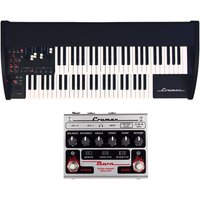
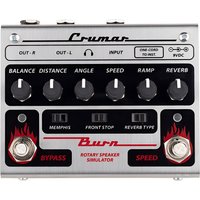
The Crumar SORRENTO Organ with Rotary Simulator Pedal is perfect for gigging keyboardists recording artists and anyone who loves vintage organ tone without heavy lifting or complex rigs. This clever instrument packs authentic tonewheel spinet and transistor organ sounds into a compact dual manual setup offering two 49-note synth-action keyboards that feel natural for classic playing styles. Onboard you also get a powerful bass synth for rich low-end making this a self-contained performance unit that covers a huge sonic range. What makes the SORRENTO stand out is its focus on flexibility and quality. Instead of building in fixed rotary and reverb effects Crumar includes the advanced BURN pedal. This studio-grade pedal connects with a single cable to supply power and audio at once delivering lush rotary speaker simulation spring or digital reverb and fine control settings like front-stop and Memphis-style modes. Dedicated mono outputs for organ and bass make it easy to split your sound on stage or in the studio matching vintage workflows with modern reliability. Plug in dial up your drawbars and shape your tone exactly how you want it then take it on the road with confidence and minimal hassle.
Crumar SORRENTO Organ with Rotary Simulator Pedal
This is a New Crumar SORRENTO Organ with Rotary Simulator Pedal from CRUMAR its found in our Modulation Pedals on the Just Pedals menu. Read More below.
As an affiliate partner, we may earn a small commission when you buy through our links — at no extra cost to you.
Brand
CRUMAR
In the current JustPedals catalogue, CRUMAR is represented by Modulation Pedals. Current listings include BURN Rotary Simulator and SORRENTO Organ. That makes the range relevant to players looking for modulation and movement. Check each model for its exact circuit or processing platform, controls, power requirements and connections, particularly where the catalogue includes both pedals and supporting gear.
Category
Modulation Pedals
Modulation changes a signal through a continuously moving control source. This broad category covers effects that alter delay time, phase, pitch, amplitude or filtering to create rotation, movement and evolving texture when no narrower effect family is dominant. Waveform, rate, depth, stereo phase and control routing determine the shape and spatial behaviour of that movement.
Tags
Bass
Voiced or equipped to retain low-frequency fundamentals and the higher headroom of a bass signal. Clean blends, crossovers and bass-specific filter ranges can preserve weight and articulation while the effected portion adds harmonics, movement or ambience.
Digital
Converts the signal or control process into numerical data for algorithmic processing. Digital designs can provide precise timing, long memory, complex routing and repeatable presets; sample rate, conversion, internal resolution and latency influence fidelity and response.
Others Just Ordered :
- I Love A Happy Accident… – Animals Pedal

- Animals Pedal Vintage Van Driving is Very Fun Overdrive

- Animals Pedal Sunday Afternoon Is Infinity Bender

- Ninevolt Pedals | Bath Time Reverb (Animals Pedal)

- This Fuzz Pedal Makes No Sense… But It Sounds Incredible

- ANIME Pedals | Animals Pedal Custom Illustrated Series
