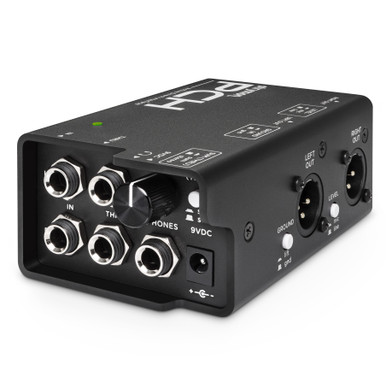
PCH is an ultra-premium stereo active direct interface with a hidden superpower – an onboard console-quality headphone amplifier. Now you can rest easy knowing that the sound of your pedalboard won’t change even a little when passing through PCH, and the headphone amp means you won’t have to ask anyone how you sound. You’ll know.
PCH has a recording console-quality headphone amplifier onboard, making it easy to monitor or practice listening to the sound of your entire rig or pedalboard in full stereo, no matter the pedal order or the components.
No matter what instrument or genre of music you play, if you need to connect unbalanced outputs to a PA, recording interface or flat response speaker system, PCH is the ultimate choice for an absolutely transparent stereo direct interface – and it’s the only one that you can listen to locally via the headphone amp.
Key Features
- Two channel design – use in stereo or dual mono, whichever fits your setup
- Runs on 9VDC – internally converted to 24V to be virtually unclippable
- Onboard headphone amplifier powerful enough to drive high impedance headphones
- Switchable Mic/Line level operation for the XLR outputs
- Defeatable ground lift for the XLR outputs
- Defeatable Sum for the Thru outputs
- Internal supply uses a custom transformer for galvanic isolation
- Basically, PCH runs off of a modified internal mini Ojai power supply
- Flat frequency response with Extremely low THD (Total Harmonic Distortion)
Specifications
In
- Input Impedance: 1 MΩ
- Max Input Level: +20dBu
Thru
- Output Impedance: 100 Ω
- SNR: +135dB (A-Weight)
- Noise Floor: -115dBV (10-22kHz no A-Weight)
- Gain Relative to Inputs: +0dB
- Frequency Response: +/- 0.25dB, 10Hz – 80kHz+
HP
- Output Impedance: 2 Ω
- Frequency Response: +/- 0.25dB, 10Hz – 80kHz
XLR, Line Setting
- Output Impedance: 275 Ω
- SNR: +130dB (A-Weight)
- Noise Floor: -110dBV (10-22kHz no A-Weight)
- Gain Relative to Inputs: +0dB
- Maximum Output Level:+20dBu
- Frequency Response: +/- 0.25dB, 10Hz – 80kHz+
XLR, Mic Setting
- Output Impedance: 100 Ω
- Gain Relative to Inputs: -20dB
- Maximum Output Level: +0.0dBu
- SNR: +125dB
- Noise Floor: -125 dBV (10-22kHz no A-Weight)
- Frequency response: +/- 0.25dB, 10Hz – 80kHz+
Power Supply
- Input Voltage: 9VDC
- Current Requirement: 500mA
- Generated Supply: +/- 12V