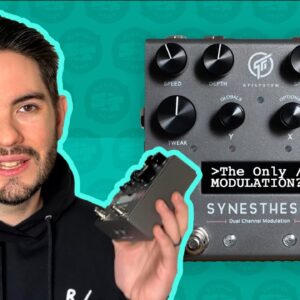
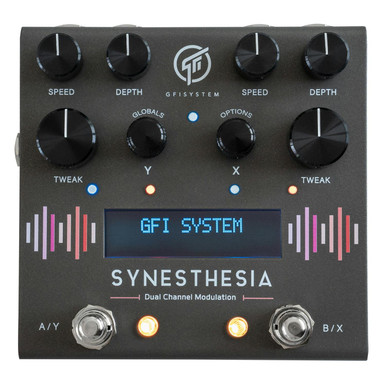
GFI System Synesthesia Dual Channel Modulation Pedal

£399.00

This is a New GFI System Synesthesia Dual Channel Modulation Pedal from GFI System, listed in Modulation Pedals on Just Pedals. Read More below.

View Just
more
and , , ,

GFI System are renowned for their digital time-based pedals, most notably the powerful Specular Reverb and Clockwork Delay. The Synesthesia, however, represents GFI System's first foray into the world of modulation.

With a flexible dual-channel design allowing you to use two effects simultaneously in parallel (Mixtures), series (Cascade) or stereo (LR-Split), you can of course use any of the GFI System Synesthesia's 30 algorithms as standalone effects too. Boasting MIDI connectivity, 32 preset slots and other powerful modern features — the GFI System Synesthesia does more than simply embellish your core amp tones!

Key Features

  • Dual-engine, multi-modulation processor in a compact pedal
  • 32 presets
  • 30 algorithms
  • Flexible DSP Routing: Cascade, Mixtures and LR Split
  • Flexible Modes: Preset and Stompbox
  • Flexible Setup: Stereo Output or Pre/Post
  • Multi-Purpose A.C.E jack accepts Aux Switches, Control Voltage (CV) or Expression Pedal
  • MIDI In and MIDI Thru
  • Works with SymmLab software for preset management, library update, firmware update and factory reset
  • Bright LEDs and LCD display

Here's what GFI System says about the Synesthesia Dual Channel Modulation Pedal:

Synesthesia is an advanced, yet user friendly dual-channel multi-modulation engines, capable of running two modulation algorithms simultaneously. Packed with 22 classic and modern algorithms (expandable to 30 with future updates) and 3 different DSP routing schemes Synesthesia offers limitless sonic possibilities.

Synesthesia is not just another modulation pedal. By marrying a powerful dual-engine architecture with rich and deep algorithms, we provide players with immersive and 'colourful' modulation effects experience, hence the name: Synesthesia. Up to 30 on-board algorithms — more will be made accessible via the 'SymmLab' editor.

Amplitude

  • Tremolo
  • Dynamic Tremolo
  • Harmonic Tremolo
  • Chopper
  • Slow Volume

Filters

  • Filter
  • Envelope Filter
  • Sample & Hold Filter
  • Formant

Swirls

  • Dimension
  • Chorus
  • Tri-Chorus
  • Detune
  • Dyane Flanger
  • Tape Flanger
  • Sample & Hold Flanger

Phase

  • Phaser
  • Envelope Phaser
  • Sample & Hold Phaser
  • Univibe

Miscellaneous

  • Octave Shifter
  • Vibrato
  • Rotary
  • Ring Modulator
  • Double Tracker

Sequencers

  • Arp Tremolo
  • Arp Filter
  • Arp Formant
  • Arp Flanger
  • Arp Phaser
  • Arp RingMod
  • Arpeggiator

Specifications

  • Input Impedance: 1 MOhm
  • Output Impedance: 500 Ohm
  • DAC / ADC Resolution: 24 Bits
  • Current Consumption: ~240 mA
  • Weight: 0.8 Kg (1.6 lbs)
  • Dimensions: 12 (L) x 12 (W) x 5.5 (H) cm
  • Power Source: 9VDC (Negative Center)
Related videos

Brand

GFI System

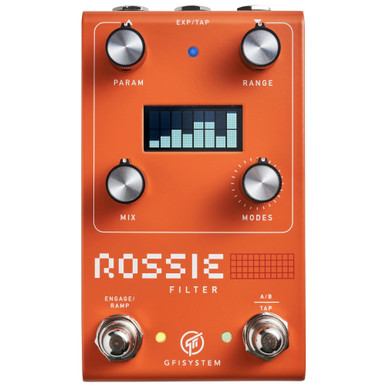
In the current JustPedals catalogue, GFI System is represented by Delay & Reverb Pedals, Reverb Pedals and EQ Pedals. Current listings include Skylar Reverb, Rossie Multi-Filter and s ENIEQMA Dual Channel EQ. That makes the range relevant to players looking for time-based effects and ambience, plus modulation and movement. Check each model for its exact circuit or processing platform, controls, power requirements and connections, particularly where the catalogue includes both pedals and supporting gear.

Category

Modulation Pedals

Modulation pedals vary pitch, time, amplitude or phase to create movement around the dry sound. Chorus, flanger, phaser, tremolo, vibrato and rotary-style effects all sit in this broad group, but their controls and signal behaviour differ. Rate sets speed; depth, feedback, waveform, mix and stereo routing determine intensity and space. Decide whether the pedal should sit before or after drive and ambience, then check headroom, tap or MIDI control, mono compatibility and whether the effect leaves the dry signal intact.

Tags

Digital

Digital products use conversion and processing to create, store or control the effect. This can provide presets, complex routing, repeatable algorithms, USB, MIDI and firmware features, but conversion, latency, power requirements and clocking depend on the design. Check the input and output levels, sample or impulse-response support, bypass behaviour and current draw when combining a digital unit with analogue pedals or a direct recording setup.

MIDI

MIDI sends, receives or responds to Musical Instrument Digital Interface messages rather than carrying instrument audio itself. Program changes can recall presets, continuous controllers can move parameters and MIDI clock or transport messages can synchronise timing. Check the connector or USB method, channel and message support, clock direction, latency and whether the device needs a separate MIDI host or adapter. MIDI control is powerful, but compatibility depends on the exact messages each product understands.

Presets

Preset-capable products can store and recall effect settings, signal paths or control assignments. The useful differences are the number of locations, whether footswitches or MIDI can recall them, what parameters are saved, how quickly they change and whether trails continue between settings. Check editing, backup, firmware, expression and USB requirements, and confirm that the preset system covers the parameters you need rather than assuming every control is recalled.

Stereo

Stereo products provide separate left and right audio paths, which may widen modulation, preserve independent delays or route a pedalboard into two amplifiers or a mixer. Input and output behaviour is not always symmetrical: some units sum a stereo input, while others create stereo from a mono source. Check whether the effect collapses safely to mono, how the dry signal is routed, the socket format and the destination’s panning and phase requirements.