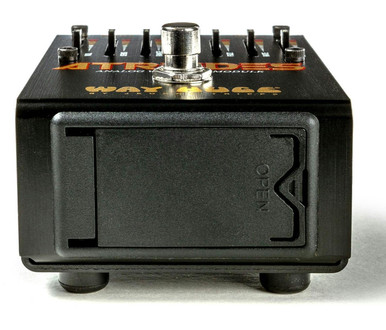
Way Huge Atreides Analog Weirding Module Pedal

£209.00

On the Menu for January 2026 are the Way Huge Guitar Pedals. These are fresh in, hand picked by the chef, & cooked to perfection. A tasty number we can deliver straight to your door, serving orders quickly and securely. For more info on Way Huge New Guitar Pedals, please read on for full details, demos, videos, reviews & to order online


Spread the love

Description

Spread the love

The Way Huge Guitar Pedals are fresh in for Jan. The Just Pedals Chef is dishing up hot gear all over the UK, served straight to your door, quickly and securely, For more info on tasty Way Huge New Guitar Pedals, please read on for full details, ingredients, reviews and where to order in the UK.

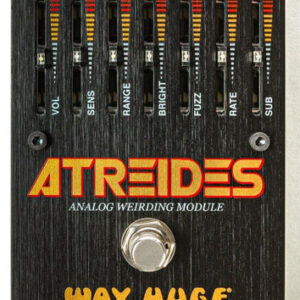
What a weird pedal. And honestly, that's a great thing. The Way Huge Atreides is a synth/fuzz/sub octave/envelope filter/phase shifter pedal (yes, it does a lot) with its name and concept inspired by sci-fi novel Dune character Paul Atreides. In practice, the tonal characteristics are a heavy nod towards the 1980s Electro-Harmonix Mini Synthesiser keyboard, which was used most notably by Van Halen.

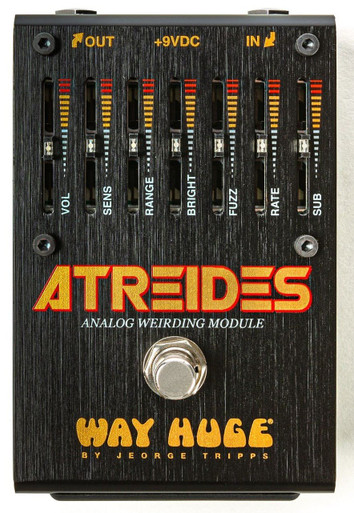
The all-slider interface is quite unique for a pedal this size and absolutely changes the way you approach the Atreiedes over other synth stompboxes. Way Huge have gone way big on the late '70s-into-'80s aesthetic in both style and sound.

Controls

There's loads of fuzz on tap and loads of old school space-y noises to explore. Things get wild with the Atreides if you push the settings to the max. 

Sense and range are the two controls altering the envelope filter and give you either compressed or open textures. Bright is akin to a standard tone control, and volume oversees the master volume. The fuzz in the Atreides is intense and gives you a vintage adaptation for modern experimental uses. Rate sets the phase shifter; there's also an option to tinker with the feedback control inside the pedal. Sub adds the sub octave for even greater presence with another internal trim pot to select either one or two octaves down.

Key Features

  • Inspired by 20th century sci-fi and EHX synth
  • Fuzz, sub octave, phase shifting and envelope filter effects
  • Sliders to adjust each parameter
  • Internal switch sets sub at one or two octaves down
  • Internal pot adjusts phaser feedback
  • Runs on 9V DC

Ingredient Allergy Warning : Product may contain nuts.

Additional information

Weight0.5 kg

Tasty Pedals made by Way Huge

Way Huge Electronics, founded by Jeorge Tripps in 1992, has established itself as a standout name in the world of boutique guitar pedals. The company quickly garnered attention with its distinctive designs, including the popular Swollen Pickle and Green Rhino.What sets Way Huge apart is its successful blend of classic tones with contemporary reliability. Their pedals, ranging from overdrives to fuzzes, offer a rich variety of sounds that cater to both traditional and modern preferences.Known for their sturdy build and intuitive controls, Way Huge pedals have become a favourite among musicians looking for unique and dependable effects to enhance their sound.

Just Pedal Ingredients.

envelope filter. Filter. Fuzz — A fuzz pedal is one of the earliest and most aggressive forms of distortion, turning your clean guitar signal into a thick, saturated wall of sound. It works by clipping the waveform almost flat, creating a compressed, gritty tone full of harmonic overtones. The result is raw, unruly, and unmistakable — from the sputtering breakup of vintage germanium circuits to the searing sustain of modern silicon designs. Fuzz pedals react strongly to your guitar’s volume and pickup choice, making them dynamic tools for expressive players.Whether you’re chasing the classic tones of Hendrix and the Smashing Pumpkins or exploring heavy, experimental textures, fuzz remains a favourite for its personality and unpredictability. It can sound smooth and sustaining, or wild and velcro-like, depending on how it’s set up. A good fuzz pedal cuts through the mix while adding thickness and attitude, turning any riff or lead line into something bold and unmistakably alive.. Guitar Pedals — Your pedal is like a signature dish for your sound — a flavour-packed creation that transforms the bland ingredients of your guitar into something unforgettable. Each one adds its own seasoning, texture, and heat, turning a simple meal into a feast of tone.These tasty little boxes sit in a row, like plates on a buffet, letting you mix and match flavours as you play. With one tap of your foot, you can swap sweet for spicy, subtle for smoky, and serve up something completely new. From the comfort food of warm overdrive to the fiery kick of fuzz, from smooth jazz sauce to heavy-metal spice, pedals give players a full menu of options to express their taste.  And just like with food, once you’ve tried one dish, you’ll want to sample them all.Collecting, trading, and discovering new flavours soon becomes part of the joy of being a tone-loving gourmet geek with a guitar.. New — This is brand new, fresh in, and a UK warranty is included. New Gear always comes from trusted UK music retailers.. Octave — An octave pedal shifts your guitar signal up or down by one or more octaves, blending the altered pitch with your original sound to create a fuller, more complex tone. It can add a deep, bass-like layer underneath your playing or a shimmering high octave on top for lead lines and solos. Classic analogue octave pedals often produce slightly gritty, organic sounds, while modern digital versions track more precisely and can offer multiple octave ranges.Octave pedals are great for thickening single-note riffs, creating synth-style textures, or even mimicking bass parts when playing alone. They pair well with fuzz or overdrive pedals for massive, harmonically rich tones. Whether you’re after vintage Hendrix-style octave fuzz or a modern polyphonic sound that tracks chords cleanly, an octave pedal opens up a world of creative possibilities and adds real weight and character to your tone.. Phaser — A phaser is a type of guitar effects pedal that creates a swirling, sweeping sound by modulating the phase of the audio signal. It works by splitting the incoming signal into two paths, shifting the phase of one path, and then recombining them. This creates peaks and troughs in the frequency spectrum, resulting in a distinctive, “phasing” effect characterized by moving notches in the frequency response.Here’s how a phaser pedal typically works and some common features:1. **Rate**: The rate control adjusts the speed at which the phase-shifting effect oscillates. Increasing the rate produces faster modulation, creating a more pronounced swirling effect, while decreasing the rate slows down the modulation for a smoother, more subtle effect.2. **Depth**: The depth control adjusts the intensity or depth of the phase-shifting effect. Higher depth settings result in more pronounced peaks and troughs in the frequency response, while lower settings produce a more subtle modulation.3. **Feedback (or Regeneration)**: Some phaser pedals feature a feedback control that determines the amount of modulated signal fed back into the effect. Increasing the feedback creates more pronounced peaks and troughs in the frequency spectrum, resulting in a more intense and resonant phasing effect.4. **Stages**: Phasers typically have multiple stages (usually four, six, or eight), each of which contributes to the overall phase-shifting effect. More stages generally result in a more complex and textured phasing sound.5. **Sweep (or Manual)**: The sweep control adjusts the center frequency of the phase-shifting effect. This allows you to focus the phasing effect on specific frequency ranges, altering the tonal character of the modulation.6. **Resonance (or Feedback)**: Some phaser pedals feature a resonance control that emphasizes the peaks and troughs in the frequency response, creating a more pronounced and resonant effect. This control can add richness and depth to the phasing sound.Phaser pedals are commonly used in various music genres, including rock, funk, and psychedelic music, to add movement, depth, and texture to guitar tones. They can be used to create swirling, swirling effects on rhythm parts, add dynamics to lead lines, or create atmospheric textures for ambient music. Overall, phaser pedals offer guitarists a versatile tool for shaping their tone and adding expressive modulation effects to their playing.. Synth — A synth pedal transforms your guitar signal into rich, layered tones that mimic the sounds of a synthesiser. Using pitch tracking and waveform generation, it can produce everything from deep bass lines to shimmering pads and futuristic leads. Synth pedals open up a wide creative range, blending the expressiveness of guitar playing with electronic textures, making them ideal for experimental sounds, ambient music, or adding a modern edge to classic riffs.. used. Volume — Volume pedals control the output level of a guitar signal using a foot-operated treadle. They allow smooth volume swells, dynamic control during playing, and easy muting between songs. Volume pedals can be placed at different points in the signal chain to either control overall loudness or adjust gain and drive behaviour when positioned before distortion or overdrive pedals..

Available for Amazon Prime