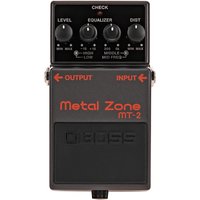
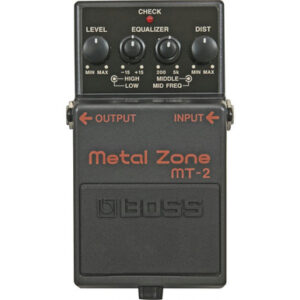
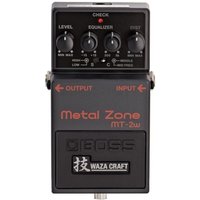
The Boss MT-2 Metal Zone is a pedal whose reputation precedes it. Every metalhead across the land has come across this name and for good reason – these fiery gain-breathing monsters deliver some of the heaviest tones around. With a responsive Distortion dial you can unleash waves of gain into your riffs making them sound thunderously powerful. Or you can dial it back tame it and add some light crunch and bite to your sound – perfect for rock or even blues! But youll never go short of inspiration as a metal guitarist with this monster at your feet. Shape your sound with laser-like precision using the detailed three-band EQ. Featuring concentric controls which help to pack even more tonal shaping into a small intuitive interface youll be able to carve out your midrange and tame or boost the highs and lows. With this you can define your own distortion voicing and take it to the masses. Theres also a dual-stage gain circuit for thick tight sounds which scream with sustain. Dont listen to naysayers – this pedal sounds spectacular.
Boss MT-2 Metal Zone Guitar Effects Pedal
This is a New Boss MT-2 Metal Zone Guitar Effects Pedal from Boss its found in our Specialist Effects Pedals on the Just Pedals menu. Read More below.
As an affiliate partner, we may earn a small commission when you buy through our links — at no extra cost to you.
Related videos

Brand
Boss
BOSS began in Osaka in 1973 as MEG Electronics, a company dedicated to effects. Its first BOSS-branded effect was the CE-1 Chorus Ensemble in 1976; the OD-1, SP-1 and PH-1 launched the compact-effects series in 1977. The JustPedals catalogue includes familiar overdrives and distortions such as the OD-3, SD-1, BD-2, DS-1 and MT-2 Metal Zone, as well as utility items such as the PCS-20A cable. BOSS now spans compact pedals, multi-effects, loopers, tuners and controllers. Manufacturing origin should be checked by model rather than inferred from the brand’s Japanese history.
Category
Specialist Effects Pedals
Specialist effects alter the signal in ways that do not sit cleanly inside one established family. They may use granular processing, frequency shifting, resonators, freeze or sustain, bit reduction, ring modulation, feedback networks or combinations of several techniques. The relevant distinction is the underlying process, its tracking or latency, and how completely the dry signal can be blended or replaced.
Others Just Ordered :
- I Love A Happy Accident… – Animals Pedal

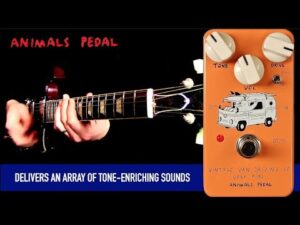
- Animals Pedal Vintage Van Driving is Very Fun Overdrive
- Animals Pedal Sunday Afternoon Is Infinity Bender
- Ninevolt Pedals | Bath Time Reverb (Animals Pedal)
- This Fuzz Pedal Makes No Sense… But It Sounds Incredible

- ANIME Pedals | Animals Pedal Custom Illustrated Series