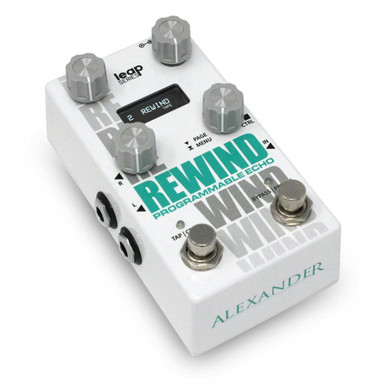
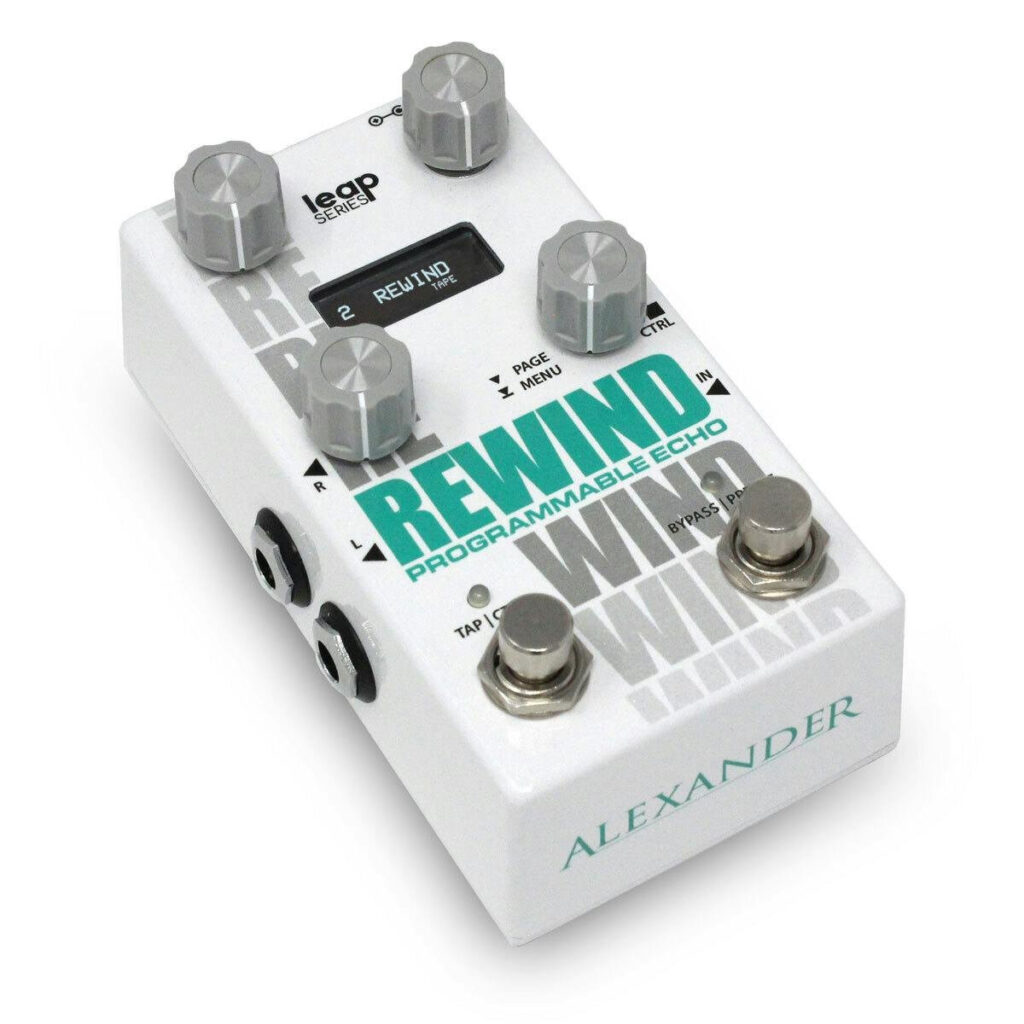
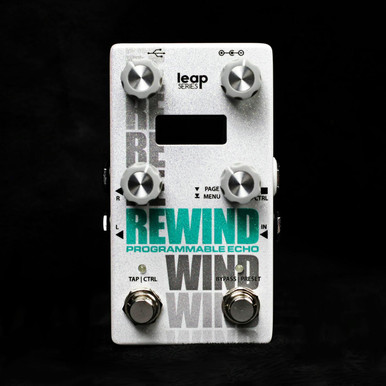
Alexander Pedals Rewind Programmable Echo Delay Pedal

£239.00

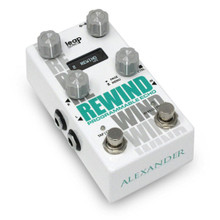
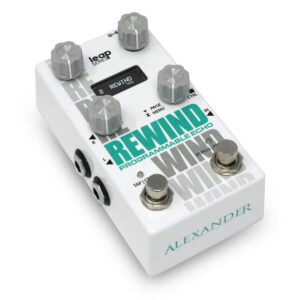
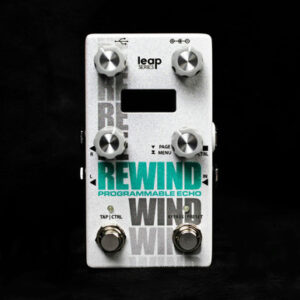
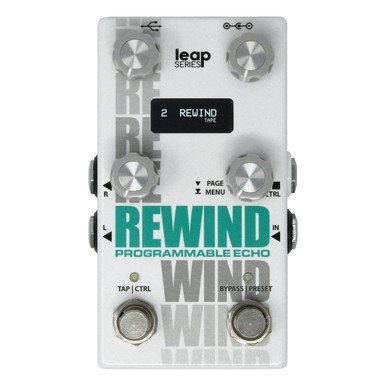
This is the Alexander Pedals Rewind Programmable Echo Delay Pedal from Alexander Pedals, listed in Delay Pedals on Just Pedals. Read More below.

View Just
more
and , , , ,

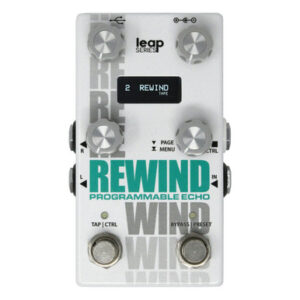
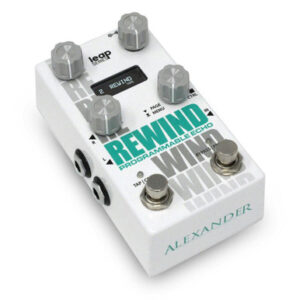
The Rewind Programmable Echo is a reimagining of Alexander Pedals' flagship echo, full of reverse repeats, filtered delays, dirty, lo-fi ambience, and pristine digital delay with lush modulation — all rendered in expansive true stereo!

It features 10 distinct modes and has full MIDI and expression capabilities for storing and instantly accessing innumerable presets. Editing and creating presets is so easy and intuitive, you probably won't even need the manual, and the new OLED display makes everything very easy to see on a dark stage or rehearsal room.

Sound Modes

  • Tape: Magnetic mash up based on Alexander's favourite tape echo units. Set HEAD to A for a classic single tape echo, or experiment for multi-tap madness.
  • Analog: Classic 1970s electronic solid-state echo, based on Alexander's collection of vintage delay pedals. They've added a multi-waveform modulation section for analog-style chorus and vibrato textures.
  • Digital: 1980s computer magic lives here, digital delay with modulation. Use the BITS control to dial in low-resolution "early digital" sounds, set it low for clean repeats.
  • Pitch: Clean digital delay with a flexible pitch transposer for the ultimate in shifty business. Set the MODE to PRE or POST for traditional pitch shifting, or engage the ARP modes for arpeggio patterns.
  • Dual: Double delay lines in parallel. Set TYPE to MONO for classic dual delay, STER for independent left/right echo, or PONG for panning ping-pong delay. Each delay has 625ms of echo time. Set TIM2 to LOCK to synchronize delay times.
  • Diffuse: Cloudy day delay, combines a single echo with a reverb-style diffusion filter to smear and wash the delay repeats. Alexander have incorporated digital bit crushing as well as two-band EQ to fine tune your ambient experience.
  • Reverse: Alexander named the pedal "Rewind", so you knew this one had to be in here. They've upped the delay time to a whopping 2.5 seconds to make your reverse echoes sound cooler, at the cost of a bit of high-end and fidelity.
  • Dynamic: Clean digital delay with a flexible audio gate and swell generator. MODE selects GATE (delay is cut off sharply,) BLOM (delay blooms in behind dry signal) or SWEL (delay and dry signal swell in over time).
  • Filter: Delay with synth-style resonant low-pass filter. MOD selects filter modulation source, SIN and SQU LFO, ENV- and ENV+ envelope follower, RAND random sample and hold, or FIXD parked filter.
  • Lo-Fi: Filthy and gorgeous dirty delay. This mode stacks a digital distortion after the delay pedal for unique textures. Also includes triangle-wave modulation on the delay effect.

Specifications

  • Input: Mono or stereo (TRS)
  • Output: Mono or stereo (use either TRS or dual TS)
  • Input Impedance: 1M ohms
  • Output Impedance: 560 ohms
  • Power Requirements: DC 9V only, 250mA or greater
  • Requires isolated DC power supply
  • Dimensions: 2.4" x 4.7" x 1.6" W x H x D not including knobs (67 x 120 x 42mm)
  • 32 user presets, selectable on-device without additional controllers
  • MultiJack enables expression pedal, foot switch, expander switch, or MIDI input
  • Full MIDI control over every knob and setting
  • EXP Morph allows controlling all knobs from expression or MIDI
  • Automated ramping function for expression without external pedal
  • CTL foot switch for tap tempo or ramp trigger
  • USB port for firmware updates and USB MIDI
  • Buffered bypass (hybrid analog + digital)
Related videos

Brand

Alexander Pedals

Alexander Pedals is a renowned manufacturer of guitar effects pedals, known for its innovative and high-quality products. Founded by Matthew Farrow in North Carolina, the company has gained a reputation for blending cutting-edge digital technology with classic analogue tones. Alexander Pedals offers a wide range of effects, including delays, reverbs, overdrives, and modulation effects, catering to musicians seeking versatile and creative sound options. Each pedal is crafted with attention to detail, featuring intuitive controls and sturdy construction, making them a popular choice among professional and amateur musicians alike. The company’s pedals are often praised for their unique soundscapes and user-friendly interfaces, allowing musicians to experiment with a wide variety of tones and effects.

One of the standout features of Alexander Pedals is the inclusion of the Neo Series, which incorporates digital control over analogue signal paths, allowing for presets, MIDI functionality, and expression control. This innovation enables musicians to easily switch between different settings and integrate the pedals seamlessly into complex setups. Alexander Pedals is also known for its commitment to continuous improvement and customer feedback, regularly updating firmware and introducing new models to meet the evolving needs of guitarists. The company has built a loyal community around its products, with musicians appreciating the blend of creativity, quality, and versatility that Alexander Pedals consistently delivers.

Category

Delay Pedals

Delay records the incoming signal for a chosen interval and repeats it after the original note. Feedback returns repeats to the delay line, while tone, filtering, modulation and saturation determine whether echoes remain clear, darken progressively, wobble like tape or degrade like analogue bucket-brigade circuits. Delay time and rhythmic subdivisions govern the spacing and musical pattern of the repeats.

Tags

Analogue

The signal is shaped by continuously varying electronic circuitry rather than being converted into a digital effect algorithm. Component choice, operating voltage and circuit tolerances influence headroom, noise, clipping texture and the small variations in response between designs.

Digital

Converts the signal or control process into numerical data for algorithmic processing. Digital designs can provide precise timing, long memory, complex routing and repeatable presets; sample rate, conversion, internal resolution and latency influence fidelity and response.

MIDI

Sends, receives or responds to Musical Instrument Digital Interface messages rather than carrying the instrument audio itself. Program changes recall presets, continuous controllers move parameters, and MIDI clock or transport messages synchronise timing between devices.

Presets

Stores complete groups of parameter values for later recall. The number of locations, switching time, spillover behaviour and whether presets include routing, expression and MIDI assignments determine how completely one sound can change into another.

Stereo

Processes, creates or passes two audio channels. True stereo preserves separate left and right inputs, while mono-to-stereo effects generate spatial differences internally; routing, phase behaviour and whether trails remain stereo determine the resulting image. Some outputs sum to mono when only one socket is connected, which can change level or modulation depth.