
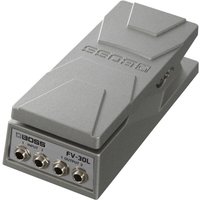
The Boss FV30L is a compact foot volume pedal thats been specially created for saving space on your pedalboard while maintaining the trusted Boss standard for sound quality reliability and durability. This pedal is 100 percent professional grade aluminium die-cast and features a smooth pivot action that supports subtle changes in volume control. Thanks to its small size the FV-30L offers a huge advantage for traveling musicians and gigging players who need to maximise pedalboard space. The Boss FV30L is a low-impedance pedal equipped with stereo input/output for stompboxes keyboards and other digital instruments.
Boss FV-30L Low Impedance Volume Pedal
£102.00
This is a New Boss FV-30L Low Impedance Volume Pedal from Boss its found in our Volume Pedals on the Just Pedals menu. Read More below.
View Just Boss
As an affiliate partner, we may earn a small commission when you buy through our links — at no extra cost to you.
Related videos

Brand
Boss
BOSS began in Osaka in 1973 as MEG Electronics, a company dedicated to effects. Its first BOSS-branded effect was the CE-1 Chorus Ensemble in 1976; the OD-1, SP-1 and PH-1 launched the compact-effects series in 1977. The JustPedals catalogue includes familiar overdrives and distortions such as the OD-3, SD-1, BD-2, DS-1 and MT-2 Metal Zone, as well as utility items such as the PCS-20A cable. BOSS now spans compact pedals, multi-effects, loopers, tuners and controllers. Manufacturing origin should be checked by model rather than inferred from the brand’s Japanese history.
Category
Volume Pedals
A volume pedal places a foot-controlled attenuator in the audio path, varying level without changing the instrument itself. Potentiometer value and active or passive design determine impedance compatibility, sweep shape and high-frequency retention. Placement before gain changes both loudness and distortion response; placement later behaves more like a master level. Minimum-volume, tuner and stereo connections extend the basic function.
Tags
Digital
Converts the signal or control process into numerical data for algorithmic processing. Digital designs can provide precise timing, long memory, complex routing and repeatable presets; sample rate, conversion, internal resolution and latency influence fidelity and response.
Stereo
Processes, creates or passes two audio channels. True stereo preserves separate left and right inputs, while mono-to-stereo effects generate spatial differences internally; routing, phase behaviour and whether trails remain stereo determine the resulting image. Some outputs sum to mono when only one socket is connected, which can change level or modulation depth.
Others Just Ordered :
- I Love A Happy Accident… – Animals Pedal

- Animals Pedal Vintage Van Driving is Very Fun Overdrive

- Animals Pedal Sunday Afternoon Is Infinity Bender

- Ninevolt Pedals | Bath Time Reverb (Animals Pedal)

- This Fuzz Pedal Makes No Sense… But It Sounds Incredible

- ANIME Pedals | Animals Pedal Custom Illustrated Series
