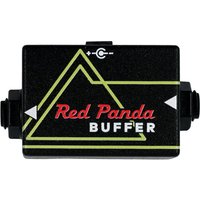
The Red Panda Bit Buffer is a super small footprint buffer that uses a high-quality Burr-Brown OP amp for ultra-low distortion and noise. Always engaged when power is connected the Bit Buffer is the ideal solution to place at the beginning of your pedal chain or right before a long cable to prevent high-frequency signal loss. This means that the natural tone of your set up will be retained at all times allowing you to create a crystal-clear signal upon which you can build your own unique sound. An internal LED below the power jack will display whether the Bit Buffer is engaged or not so you always know where youre at on stage. With a super small ground footprint this handy device will take up next to no space on your pedalboard leaving you more room to explore and build your rig. Made in the USA with high-quality components the Panda Bit Buffer is complete with a rugged durable exterior that ensures a long-lasting performance on stage at home or in the studio.
Red Panda Bit Buffer
This is a New Red Panda Bit Buffer from Red Panda its found in our Utility Pedals on the Just Pedals menu. Read More below.
As an affiliate partner, we may earn a small commission when you buy through our links — at no extra cost to you.

Related videos



Brand
Red Panda
In the current JustPedals catalogue, Red Panda is represented by Pitch & Harmoniser Pedals, Modulation Pedals and Looper Pedals. Current listings include Bitmap 2, Bit Buffer and 3 Input Bit Mixer. That makes the range relevant to players looking for time-based effects and ambience, plus modulation and movement. Check each model for its exact circuit or processing platform, controls, power requirements and connections, particularly where the catalogue includes both pedals and supporting gear.
Category
Utility Pedals
Utility pedals solve signal-path tasks rather than imposing one recognisable effect. Buffers restore level and high-frequency response lost through cable capacitance, selectors route between instruments or amplifiers, summing boxes combine paths, and isolators interrupt hum-producing ground loops. Impedance, phase, transformer isolation, active or passive circuitry and switching method determine whether the routing remains quiet and transparent.
Others Just Ordered :

- I Love A Happy Accident… – Animals Pedal

- Animals Pedal Vintage Van Driving is Very Fun Overdrive

- Animals Pedal Sunday Afternoon Is Infinity Bender

- Ninevolt Pedals | Bath Time Reverb (Animals Pedal)

- This Fuzz Pedal Makes No Sense… But It Sounds Incredible

- ANIME Pedals | Animals Pedal Custom Illustrated Series