
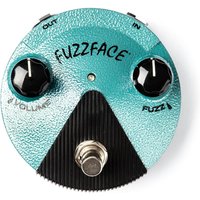
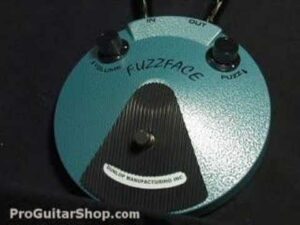
The Jim Dunlop Fuzz Face Mini Hendrix Turquoise delivers a legendary tone utilising the same circuit as the original JHF1 pedal but just in smaller housing. Obtain that same iconic Fuzz Face tone that was made famous by Jimi Hendrix. The compact version features modern appointments including a bright status LED an AC power jack and a convenient battery door. If you want to preserve your tone then a true bypass ensures that every nuance is kept. Housed in a distinctive metal chassis this easy-to-use pedal is the perfect addition to any player wanting to recreate that iconic tone.
Dunlop Fuzz Face Mini Hendrix Turquoise FFM3
£175.03
This is a New Dunlop Fuzz Face Mini Hendrix Turquoise FFM3 from Dunlop its found in our Fuzz Pedals on the Just Pedals menu. Read More below.
View Just Dunlop
As an affiliate partner, we may earn a small commission when you buy through our links — at no extra cost to you.
Related videos
Brand
Dunlop
In the current JustPedals catalogue, Dunlop is represented by Wah & Filter Pedals, Fuzz Pedals and Delay Pedals. Current listings include DVP4 Volume X Mini, CryBaby Wah-Wah 95Q and JD4S Rotovibe. That makes the range relevant to players looking for drive, gain and clipping, plus time-based effects and ambience. Check each model for its exact circuit or processing platform, controls, power requirements and connections, particularly where the catalogue includes both pedals and supporting gear.
Category
Fuzz Pedals
Fuzz drives the signal into extreme clipping, often flattening the waveform and generating a thick spectrum of harmonics. Transistor type, bias, input loading and tone filtering create markedly different responses, from loose and velvety to gated, spluttering or octave-rich. Some circuits interact strongly with pickup impedance and guitar volume, while others include buffers or blends for a more consistent response.
Tags
True Bypass
Connects input directly to output through mechanical or relay switching when the effect is off, removing the active circuit from the audio path. It avoids buffer colour but leaves cable capacitance and switching design to influence high-frequency loss and possible switching noise.
Others Just Ordered :
- I Love A Happy Accident… – Animals Pedal

- Animals Pedal Vintage Van Driving is Very Fun Overdrive

- Animals Pedal Sunday Afternoon Is Infinity Bender

- Ninevolt Pedals | Bath Time Reverb (Animals Pedal)

- This Fuzz Pedal Makes No Sense… But It Sounds Incredible

- ANIME Pedals | Animals Pedal Custom Illustrated Series
