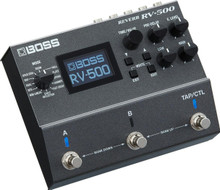

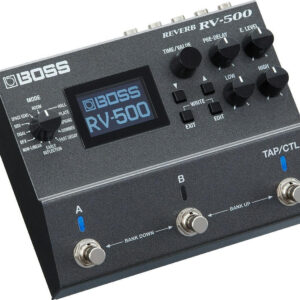
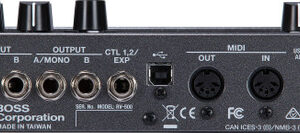
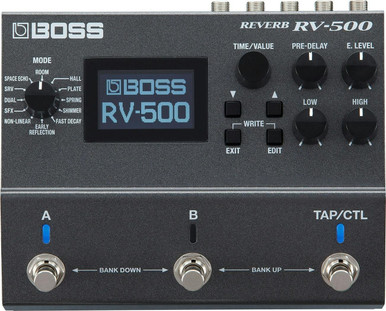
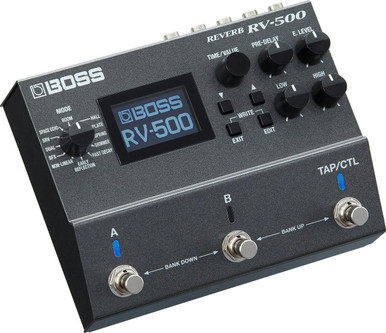
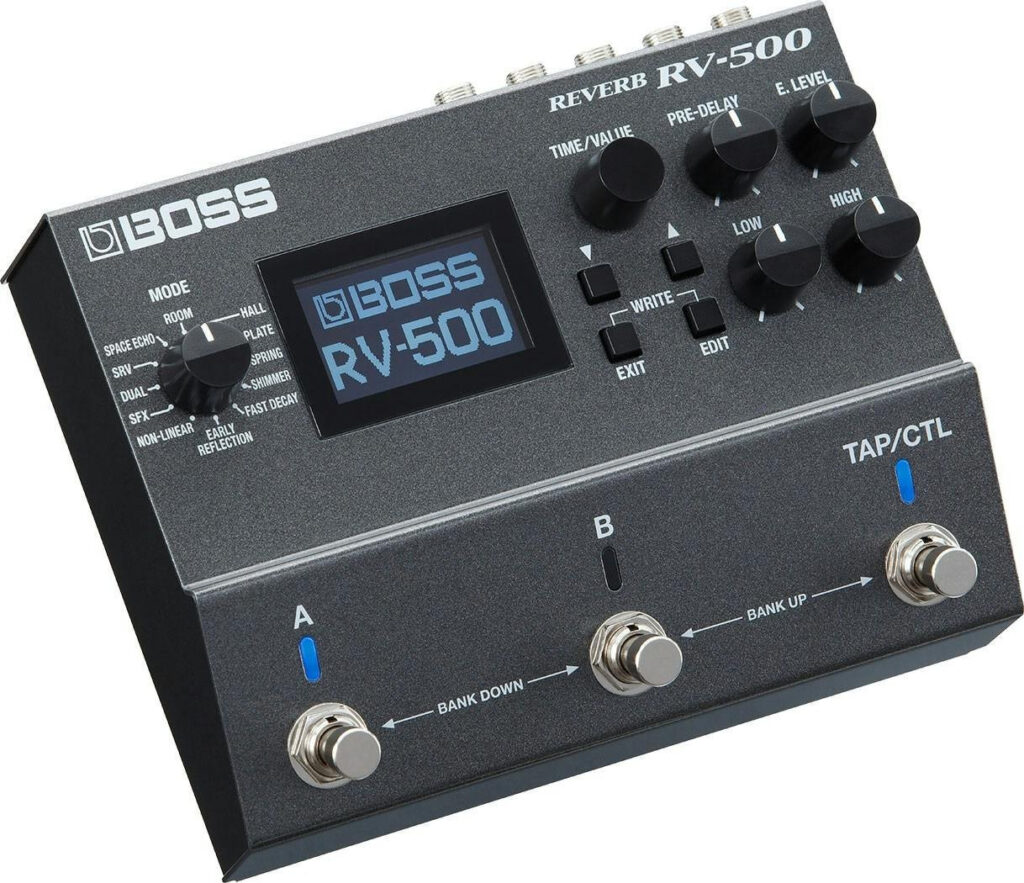
Journey to new dimensions of time and space with the RV-500, the most powerful and versatile reverb processor BOSS has ever produced. This multifaceted creation machine features class-defying 32-bit AD/DA along with 32-bit/96 kHz floating point processing and immense programmability, putting pro-level studio reverb and more at your feet.
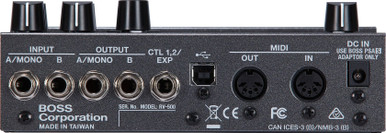
Twelve modes and 21 newly developed reverb algorithms deliver a huge range of textures, from complementary ambience to deep, immersive sonic atmospheres. And thanks to the RV-500’s high-octane DSP, you can access a full-featured digital delay along with every reverb patch, and even run two reverb patches at once! Adding in MIDI I/O, support for external footswitch/expression control, and USB for connection to the free RV-500 Editor/Librarian software, the RV-500 is simply the most advanced reverb pedal available, bar none.
- Studio-level sound with first-in-class 32-bit AD/DA, 32-bit floating point processing, and 96 kHz sampling rate
- 12 modes with 21 reverb types, all with deep editing parameters
- Includes a wide range of reverb types from standard to advanced, plus Roland classics such as the SRV-2000 Reverb and RE-201 Space Echo
- A/B Simul mode allows you to use two reverb patches at once
- Selectable carryover function allows reverb tails to continue with patch change or effect bypass
- Powerful DSP provides independent digital delay with modulation along with each reverb patch
- Graphic LCD and intensive real-time control options
- 297 onboard patch memories and hands-on controls
- Selectable buffered-bypass or true-bypass operation
- MIDI I/O for interfacing with MIDI control devices
- USB-MIDI for connecting to the RV-500 Editor/Librarian or a DAW (to be available in early July 2017)
- Runs on four AA-size batteries or PSA-series AC adapter
Twelve Modes and 21 Unique Reverb Types
Inside the RV-500 are 21 top-quality reverb algorithms that enable you to shape any kind of space you can imagine. Each includes a massive range of adjustable parameters, from decay, density, and modulation to EQ, ducking, and more. Every algorithm has been newly developed specifically for this pedal, leveraging BOSS’s decades of expertise in advanced reverb design. On tap is everything from standards like room, hall, and plate to advanced reverbs like shimmer, non-linear, SFX, and many more. Also included are all-new recreations of the RE-201 Space Echo and SRV-2000 Digital Reverb, two revered Roland classics from the ‘70s and ‘80s.
Simultaneous Reverbs and Independent Digital Delay
With its powerhouse DSP engine, the RV-500 is far more than a one-effect device. To start, the pedal’s Dual mode provides two independent reverbs at once; you can feed them both with a full-range input, or with divided frequency ranges on each input to build rich, multi-range sounds. And when you employ A/B Simul mode, you can use any two RV-500 reverb patches at the same time, with your choice of series or parallel connection order and mixed or split A/B output. What’s more, each patch also includes a digital delay with a full set of parameters including modulation and EQ, plus the ability to set the reverb and delay effects for series or parallel operation on a per-patch basis.
Extraordinary Sound
The RV-500 features 32-bit/96 kHz AD/DA, exceeding all industry standards for pedal-based effects. All internal processing is 32-bit floating point and runs at a 96 kHz sampling rate as well, delivering pristine sonic quality that goes beyond the highest-level digital processors used in top pro studios. If you wish, you can run your analog dry tone straight through so it’s completely untouched with digital processing. You’re also able to select true-bypass or buffered-bypass operation to suit the needs of your setup.
Advanced Interface, Intuitive Operation
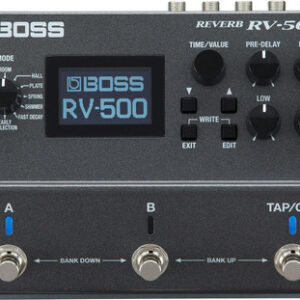
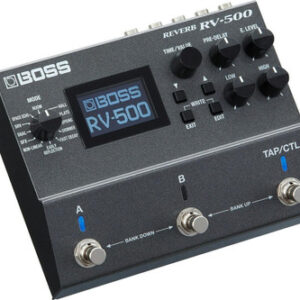
The RV-500 is equipped with a large LCD that clearly shows the patch name, delay time, and other vital performance information. It also makes it easy to view and adjust the unit’s deep editing parameters and advanced control features. With the grab-and-go panel knobs, you have top-level access to essential parameter adjustments like pre-delay, high and low EQ, and effect level. And via USB, you can connect with the free RV-500 Editor/Librarian on your computer for remote editing, patch backup, and more.
Intensive Real-Time Control
With its freely assignable switches and extensive support for real-time control, the RV-500 delivers unmatched creative expression and performance flexibility. By default, the A, B, and TAP/CTL switches offer intuitive control for patch/bank selection and bypass, plus tap tempo and real-time adjustment of various effect parameters. If you like, the switches can be customized to access three different reverbs patches, A/B Simul mode, and other functions. MIDI I/O opens the door to even more creative possibilities, offering deep control options with advanced setups.
RV-500 Modes and Algorithms
- Room—Four types: small, medium, large, and ambience.
- Hall—Three different hall sizes.
- Plate—Classic studio-style reverberation.
- Spring—Choose from one to three springs.
- Shimmer—Two voices of pitch-shifted reverb.
- Fast Decay—Unique reverb with quick decay for increased clarity.
- Early Reflection—Four types with envelope parameters to shape unique sounds.
- Non-Linear—Includes gate, reverse, and granular types.
- SFX—Three characterful reverb types for special effects: Lo-Fi, Slowverb, and Storm.
- Dual—Two independent reverbs that can accept a full-range or frequency-divided input.
- SRV—Recreates the Roland SRV-2000, a classic rack reverb from the 1980s.
- Space Echo—Recreates the Roland RE-201 Space Echo, one of the most coveted tape echo units ever made.
Specifications
- Sampling Frequency: 96 kHz
- AD/DA Conversion: 32 bits
- Processing: 32-bit floating point
12 modes
- ROOM
- HALL
- PLATE
- SPRING
- SHIMMER
- FAST DECAY
- EARLY REFLECTION
- NON-LINEAR
- SFX
- DUAL
- SRV
- SPACE ECHO
- Memory: 198 (99 banks x 2 [A] [B]), 297 (99 banks x 3 [A] [B] [C])
- Nominal Input Level: INPUT A/MONO, B: -10 dBu
- Maximum Input Level: INPUT A/MONO, B: +8 dBu
- Input Impedance: INPUT A/MONO, B: 1 M ohm
- Nominal Output Level: OUTPUT A/MONO, B: -10 dBu
- Maximum Output Level: OUTPUT A/MONO, B: +8 dBu
- Output Impedance: OUTPUT A/MONO, B: 2 k ohms
- Recommended Load Impedance: OUTPUT A/MONO, B: 20 k ohms or greater
- Bypass: Buffered bypass or True bypass (with relays)
- Controls: A switch, B switch, TAP/CTL switch DOWN button, UP button, EXIT button, EDIT button MODE knob, TIME/VALUE knob, PRE-DELAY knob, E.LEVEL knob, LOW knob, HIGH knob
- Display: Graphic LCD (128 x 64 dots, backlit LCD)
- Power Supply: Alkaline battery (AA, LR6) x 4, AC adaptor (sold separately)
- Current Draw: 225 mA
Options (sold separately)
- AC adaptor: PSA-S series
- Footswitch: FS-5U, FS-5L
- Dual Footswitch: FS-6, FS-7
- Expression Pedal: FV-500H, FV-500L, EV-30, Roland EV-5