
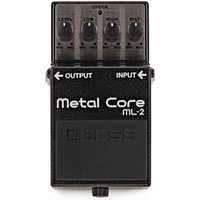
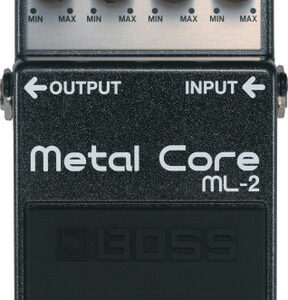
The Boss ML-2 Metal Core Effects Pedal finally offers the grinding thick distortion that is so necessary for metal. Many metal distortion pedals simply offer an excessive amount of gain and slap the metal moniker on the pedal- not the ML-2. This pedal has been designed with the sole intention of being heavier and fatter than any distortion pedal previously and that includes more than just increasing the gain. The tone and attack of the whole pedal has been shaped to be razor sharp to cut through even the most congested mix with ease the tone control is incredibly responsive however and its possible to dial this back all the way for sludgier doomier tones. Of course the ML-2 does have gain on tap and can get ridiculously hot at higher levels but its the attention given to the rest of the design being tailored just to metal players and heavier musical styles that makes the ML-2 so special
Boss ML-2 Metal Core Effects Pedal
This is a New Boss ML-2 Metal Core Effects Pedal from Boss its found in our Specialist Effects Pedals on the Just Pedals menu. Read More below.
As an affiliate partner, we may earn a small commission when you buy through our links — at no extra cost to you.
Related videos
Brand
Boss
BOSS began in Osaka in 1973 as MEG Electronics, a company dedicated to effects. Its first BOSS-branded effect was the CE-1 Chorus Ensemble in 1976; the OD-1, SP-1 and PH-1 launched the compact-effects series in 1977. The JustPedals catalogue includes familiar overdrives and distortions such as the OD-3, SD-1, BD-2, DS-1 and MT-2 Metal Zone, as well as utility items such as the PCS-20A cable. BOSS now spans compact pedals, multi-effects, loopers, tuners and controllers. Manufacturing origin should be checked by model rather than inferred from the brand’s Japanese history.
Category
Specialist Effects Pedals
Specialist effects alter the signal in ways that do not sit cleanly inside one established family. They may use granular processing, frequency shifting, resonators, freeze or sustain, bit reduction, ring modulation, feedback networks or combinations of several techniques. The relevant distinction is the underlying process, its tracking or latency, and how completely the dry signal can be blended or replaced.
Others Just Ordered :
- I Love A Happy Accident… – Animals Pedal

- Animals Pedal Vintage Van Driving is Very Fun Overdrive
- Animals Pedal Sunday Afternoon Is Infinity Bender

- Ninevolt Pedals | Bath Time Reverb (Animals Pedal)
- This Fuzz Pedal Makes No Sense… But It Sounds Incredible

- ANIME Pedals | Animals Pedal Custom Illustrated Series