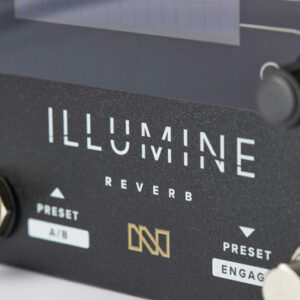

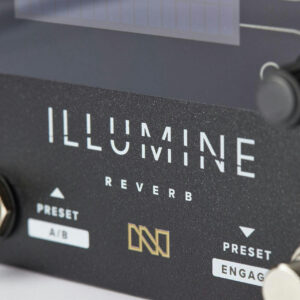
Here's what Neunaber say about the Illumine Reverb Pedal
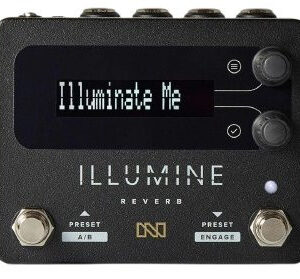
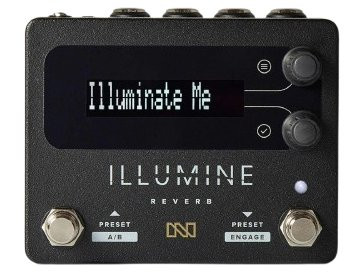
Illumine packs 17 studio-quality reverbs, 50 presets, MIDI and powerful expression control in a low-power, pedalboard-friendly package with top jacks. Regardless of your instrument or style of music, Illumine has the flexibility and tone you desire. Your creativity is the only limit.
Key Features
- 17 stellar stereo reverb effects – cover all of your reverb needs.
- 50 professionally-crafted factory presets – for superb tones right out of the box.
- 50 user presets – to customize and save your favorite settings.
- MIDI input & thru/out – Controller mode replaces a simple MIDI controller.
- Powerful, flexible expression control engine – Use an external expression pedal or the built-in A/B switch with adjustable transition times.
- Analog dry signal – for low noise and zero latency maintains the integrity of your source tone.
- Adjustable gain structure – works with instrument or line-level inputs.
- High contrast, wide viewing angle display – easy to read from a distance.
- Small footprint with top jacks – easy to incorporate into your pedalboard.
- Stereo in & out – Connect stereo outputs for a huge, immersive sounding reverb.
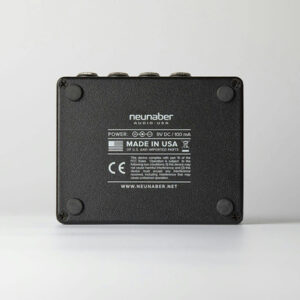
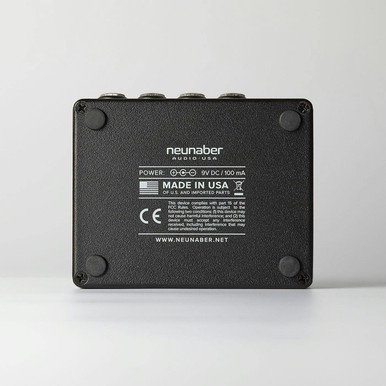
- Power with a standard 9V @ 100mA – No need to run a separate power adapter or free up a high-current power port.
- Made in the USA – in Orange County, California. Family owned and operated, Neunaber Audio is dedicated to bringing you the highest quality audio effects on the market.
Effects
- Wet Plugin — As close to the Neunaber Wet Reverberator software plugin we can get in pedal form. Open sound.
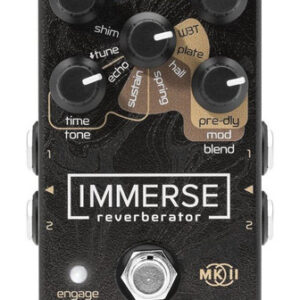
- Wet v3 — Same as the popular W3T effect in the Immerse Mk II.
- Wet v1 — The original reverb from the Wet Stereo Reverb pedal. Like all of the Wet Reverb algorithms, it is known for its open, natural sound, which complements the source signal without masking it.
- Plate – Bright and diffuse like a studio plate reverb.
- Hall – Emulating the sound of a well-designed concert hall, this reverb is large and expansive.
- Vintage Digital – Designed in the style of a vintage rack unit, this reverb sounds diffuse and synthetic, but not metallic like a plate.
- Spring – A spring reverb consists of springs suspended between transducers, and its sound has a distinctive “twerp.”
- Shimmer – Reminiscent of a synth pad that follows what your instrument plays, this is version 2 of our shimmer reverb algorithm.
- Rumble – Rumble creates a low-frequency drone for a deep, cavernous reverb sound. It sounds neat on synths.
- Octaves – This effect combines the Wet v3 Reverb with a dual octave generator, one up and one down.
- Wet+Echo – Combines the Wet v3 Reverb with stereo echo.
- Wet+Detune – This effect adds the Wet v3 Reverb and a detune effect.
- Bloom – This reverb is based on our Vintage Digital algorithm. It builds more slowly than a typical reverb.
- Swell – This reverb places a slow-attack, fast-release gate before a Wet v3 Reverb. This emulates placing a volume pedal before a reverb to swell in reverb pads.
- Infinite Hold – Combines the Wet v3 Reverb with a hold (“freeze”) function.
- Sustain – Built on the Wet v3 Reverb, Sustain is a magical effect that can be configured as a sustain effect or virtually infinite reverb.
- Gated Plate – This is our Plate reverb with infinite depth and gated by the input level.