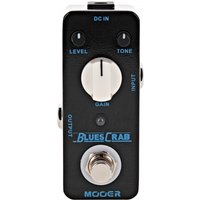
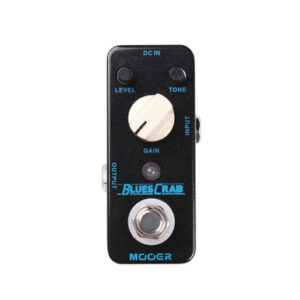
The Mooer MBD1 Blues Crab Blues Drive Pedal is the perfect addition to any performance rig. With its compact size this pedal wont take up too much space and can easily fit on crowded pedalboards. Despite its size it delivers a powerful punch that will change your tone for the better. The MBD1 is capable of delivering a blues breaker sound that is characteristic of classic overdrive. From subtle riffs to shredding solos this pedal delivers rich full-bodied harmonics that are sure to impress. You can easily adjust your output level high-end frequencies and overdrive and distortion with the three simple and intuitive control knobs on the Mooer MBD1 Blues Crab Blues Drive Pedal. These include level tone and gain and allow you to create your desired sonic with ease. Additionally the MBD1 is true bypass ensuring that your signal remains strong and unaffected when the pedal is not in use. A must-have for any guitarist looking to enhance their sound with a classic blues overdrive pedal.
Mooer MBD1 Blues Crab Blues Drive Pedal
This is a New Mooer MBD1 Blues Crab Blues Drive Pedal from Mooer Audio its found in our Specialist Effects Pedals on the Just Pedals menu. Read More below.
As an affiliate partner, we may earn a small commission when you buy through our links — at no extra cost to you.

Related videos

Brand
Mooer Audio
In the current JustPedals catalogue, Mooer Audio is represented by Multi-Effects Pedals, Looper Pedals and Wah & Filter Pedals. Current listings include Baby Bomb 30, ABY and X2 Preamp. That makes the range relevant to players looking for drive, gain and clipping, plus time-based effects and ambience. Check each model for its exact circuit or processing platform, controls, power requirements and connections, particularly where the catalogue includes both pedals and supporting gear.
Category
Specialist Effects Pedals
Specialist effects alter the signal in ways that do not sit cleanly inside one established family. They may use granular processing, frequency shifting, resonators, freeze or sustain, bit reduction, ring modulation, feedback networks or combinations of several techniques. The relevant distinction is the underlying process, its tracking or latency, and how completely the dry signal can be blended or replaced.
Tags
True Bypass
Connects input directly to output through mechanical or relay switching when the effect is off, removing the active circuit from the audio path. It avoids buffer colour but leaves cable capacitance and switching design to influence high-frequency loss and possible switching noise.
Others Just Ordered :
- I Love A Happy Accident… – Animals Pedal

- Animals Pedal Vintage Van Driving is Very Fun Overdrive

- Animals Pedal Sunday Afternoon Is Infinity Bender

- Ninevolt Pedals | Bath Time Reverb (Animals Pedal)

- This Fuzz Pedal Makes No Sense… But It Sounds Incredible

- ANIME Pedals | Animals Pedal Custom Illustrated Series