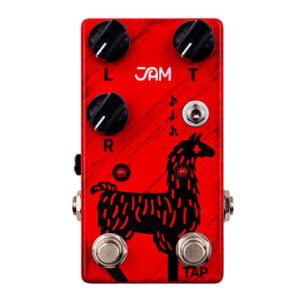
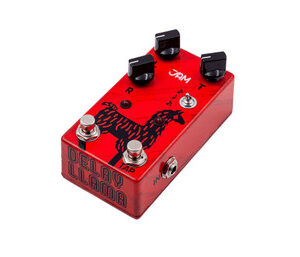

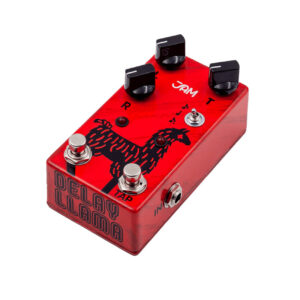
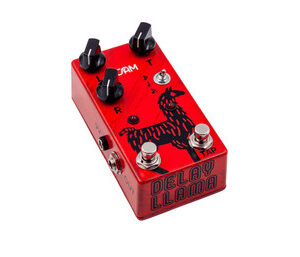
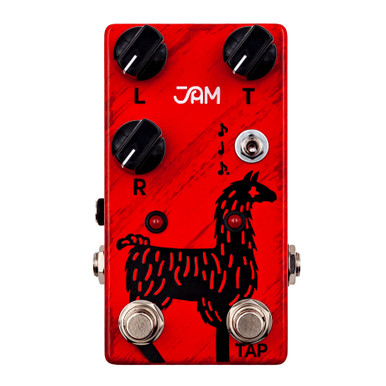
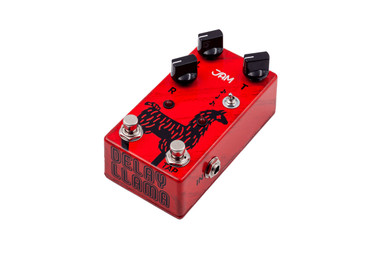
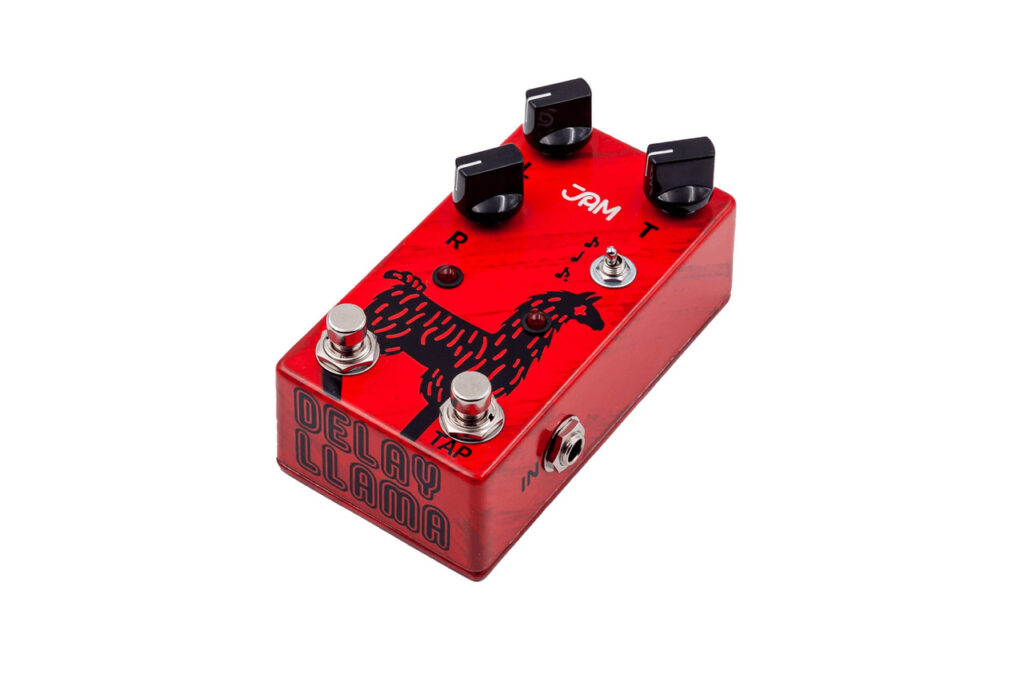
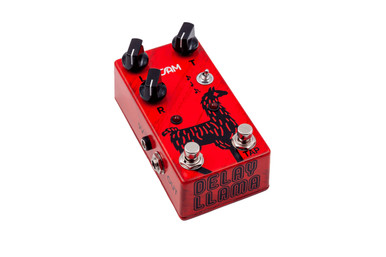
Jam Pedal’s analogue Delay Llama could be the closest thing to the perfect single pedal delay. It’s, durable, looks great and of course, produces a truly organic delay, using Bucket Brigade chips to bring warm, dark repeats for a roomy slapback, to a longer delay that will sit softly under the mix.
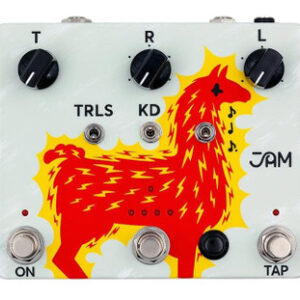
The clean three-control layout makes it easy to dial in a warm, natural analogue echo effect. And with 600ms of max delay, there’s plenty of wiggle room to experiment with different creative formulas.
Even better yet is the soft click switching, a great feature if you’re playing intimate shows. Simple, but oh so highly effective.
New Features to MK3
- Tap tempo / HOLD function
- 3-way-toggle switch for Tap Tempo subdivisions (eighth note, dotted eighth note, quarter note)
- Trails (buffered) or true bypass option
Here’s what Jam Pedals say about the Delay Llama:
The Delay Llama is a tone machine that will become an indispensable part of your sound adding warmth and depth through organic repeats which seamlessly integrate into your playing, courtesy of its BBD chips, faithful reproductions of the Panasonic MN3205.
Its straight forward traditional 3-knob layout is addressed to delay users who are looking to elegantly enhance their hard-earned tone, similarly to how a tape-echo machine would.
- The Delay Llama can also be used with bass guitars.
- Maximum delay time: 600 ms
- The Delay Llama features soft-click (relay) switching.
ARTISTS USING THE DELAY LLAMA
Bill Frisell, Marc Ribot, John Abercrombie, Nels Cline, Kurt Rosenwinkel, Daniel Lanois, David Hidalgo, Cesar Rosas, Jim Campilongo, Dweezil Zappa, Alex Skolnick, Jonny Lang, Greg Koch, Kenny Wayne Shepherd, Steve Lukather, Adrian Legg, Guy Pratt, Christian Fennesz, Bernie Marsden, James Sedwards, Kirk Fletcher
ARTISTS QUOTES
“…it’s the quality of the sound that will beat any digital delay!” – Vintage Guitar magazine
“I used the Delay Llama on this last tour, and not only to produce vintage sounding slap backs ! Also: light and durable: important for me!” – Marc Ribot
“I quickly dialed up a Rockabilly slap back that sounded very organic – very similar like my old tape Echoplex (without the squeaking analog tape!). Usually getting a slap back echo is tricky, especially on my Line 6, but because of the 3 knob design, I quickly got the setting. And it’s the best I’ve ever heard. I proceeded to getting some deep space sounds easily too. My girlfriend can borrow my Line 6, I’m converting to Delay Llama!” – Jim Campilongo
“Around 1980 many of us got into bucket brigade delays, little analog echo boxes. They were a lot less trouble than tape and disc echos. I loved them and the sound imprinted in my mind. Then digital arrived, and as we played with the magical bells and whistles, we slowly noticed that it didn’t always feel right. In 2010 I plugged into the bucket brigade Delay Llama and thirty years fell away. I’m home. It feels good!” – Adrian Legg
“It’s so musical and warm!” – Kirk Fletcher
Specifications
- Power: 9V DC Centre, Negative
- Circuit: BBD Analogue
- Bypass: Switchable (buffered trails / true bypass)
- Tap Temp: Yes