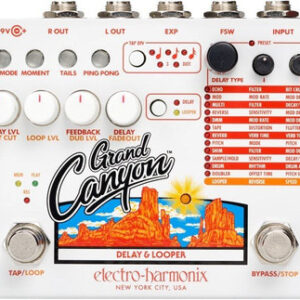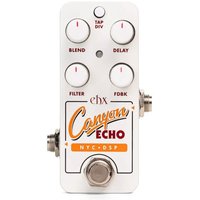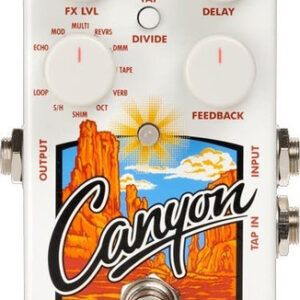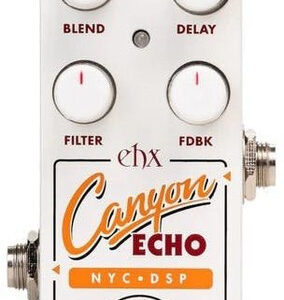

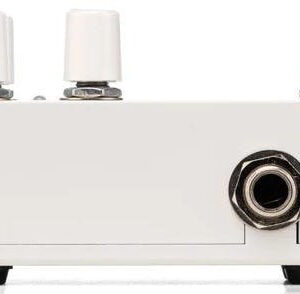
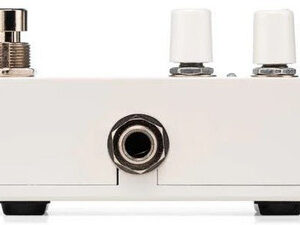
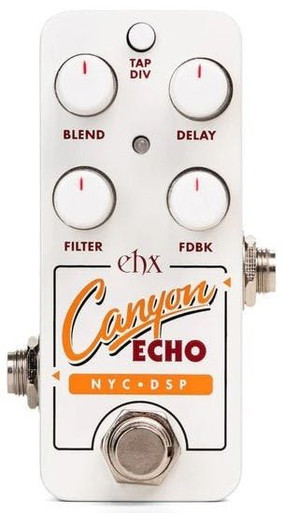
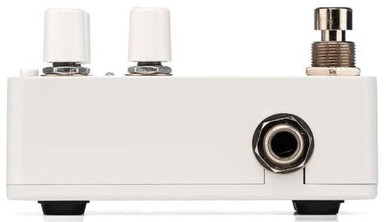
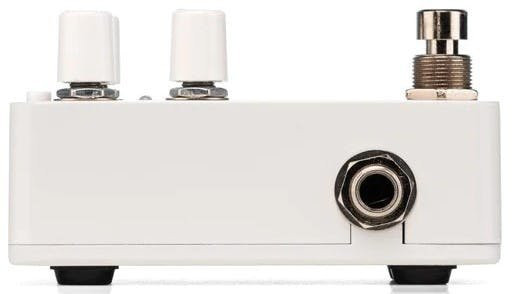
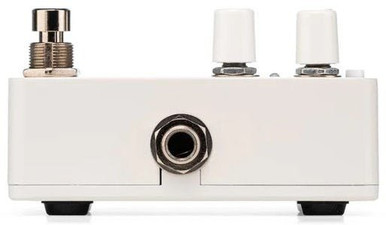
Taking the digital circuitry and delay from the successful Canyon Delay and Looper by Electro Harmonix, the Pico Canyon Echo Delay packs it all into one compact unit. Don’t let the size of this pedal detract from its mightiness. The crystal-clear delay gives you the ability to simply add filtering, change the tempo with the tap function, and add feedback with the adjustable knob to add subtle, yet powerful echo to bend time.
Featuring a Blend knob, you can create a wet and dry signal mix to expand your tonal horizons. The Delay knob sets the delay time from 8ms to 3s. The Feedback knob allows you to adjust from 1 repeat to an infinite number of repeats for expansive whooshes of highs and lows. By turning the Filter knob up for a high pass filter, and then down for a low pass filter. This compact pedal gives you a magnitude of sonic delay options in one simple and easy to use unit.
Key Features
- Compact and Powerful – Based off the Electro Harmonix’s original Delay pedal, the Pico presents all the great time warping features in one compact pedal that fits neatly on your pedal board.
- Easy To Use – With only four controls, this tiny stompbox is easy to use to be able to give you the best tonal experience possible, opening you up to a massive variety in tone.
- Selectable Tails Bypass – Allows for echoes to continue and be repeated after the pedal is bypassed to gives you a subtle delay.
Specifications
- Circuit: Digital
- Bypass: Buffered Bypass
- Audio: Mono
- Power Supply: 9.6VDC-200mA Power Adapter
- Dimensions: 3.65” x 2.0” x 2.0”
- Current Draw: 100mA