
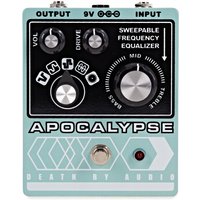
The Death By Audio Apocalypse Distortion & EQ Pedal works as an intuitive 5-in-1 distortion pedal. Utilising five distinct circuits the apocalypse is ideal for the soloist looking for a boost to their performance. The fuzz includes a Twin-T scoop War Fuzz Dual J-FET Octave Rect and a Gain x1000 all of which offer a different sound and intricacies for a diverse tone. This is fully customised through a set of three dials including a Volume Drive sweepable frequency EQ and finally waveform selector.
Death By Audio Apocalypse Distortion & EQ
£289.00
This is a New Death By Audio Apocalypse Distortion & EQ from Death By Audio its found in our Distortion Pedals on the Just Pedals menu. Read More below.
View Just Death By Audio
As an affiliate partner, we may earn a small commission when you buy through our links — at no extra cost to you.
Brand
Death By Audio
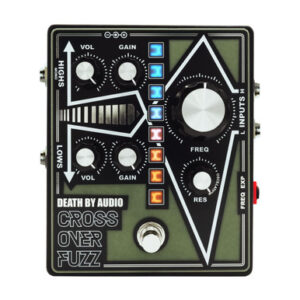
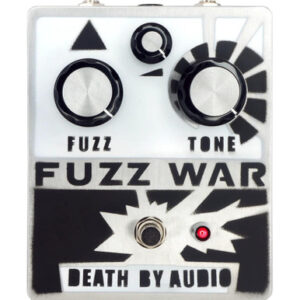
In the current JustPedals catalogue, Death By Audio is represented by Fuzz Pedals, Distortion Pedals and Reverb Pedals. Current listings include Fuzz War, Crossover Fuzz and Echo Dream 2 Delay. That makes the range relevant to players looking for drive, gain and clipping, plus time-based effects and ambience. Check each model for its exact circuit or processing platform, controls, power requirements and connections, particularly where the catalogue includes both pedals and supporting gear.
Category
Distortion Pedals
Distortion clips the waveform more firmly than overdrive, generating dense upper harmonics, longer sustain and a more compressed response. Circuit topology and filtering decide whether the sound is tight and focused, broad and aggressive, smooth or deliberately abrasive. Gain sets the amount of clipping, while pre- and post-distortion tone controls strongly influence low-end definition, midrange presence and high-frequency texture.
Tags
EQ
Raises or lowers defined frequency regions. Fixed-band graphic controls provide direct visual shaping, while parametric controls vary centre frequency and bandwidth; the available range and filter width determine whether the change is broad tonal balance or narrow corrective filtering.
Others Just Ordered :
- I Love A Happy Accident… – Animals Pedal

- Animals Pedal Vintage Van Driving is Very Fun Overdrive

- Animals Pedal Sunday Afternoon Is Infinity Bender

- Ninevolt Pedals | Bath Time Reverb (Animals Pedal)

- This Fuzz Pedal Makes No Sense… But It Sounds Incredible

- ANIME Pedals | Animals Pedal Custom Illustrated Series
