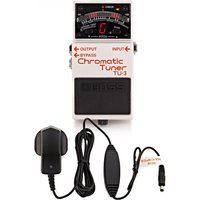
The Boss TU-3 Pedal Chromatic Tuner with Power Supply is a tuning pedal that offers an abundance of features to optimise and speed up your experience. This makes it a popular option for professional musicians worldwide. Utilising a 21-segment LED meter you can efficiently and accurately check the tuning of your instrument at any moment and thanks to a high brightness setting it works just as well in the spotlight as the back of the stage. It also comes with a bespoke Boss power supply so you can instantly power it up! Strong durable and impressive its an essential component of any setup.
Boss TU-3 Pedal Chromatic Tuner with Power Supply
£110.00
This is a New Boss TU-3 Pedal Chromatic Tuner with Power Supply from Boss its found in our Tuner Pedals on the Just Pedals menu. Read More below.
View Just Boss
As an affiliate partner, we may earn a small commission when you buy through our links — at no extra cost to you.
Related videos

Brand
Boss
BOSS began in Osaka in 1973 as MEG Electronics, a company dedicated to effects. Its first BOSS-branded effect was the CE-1 Chorus Ensemble in 1976; the OD-1, SP-1 and PH-1 launched the compact-effects series in 1977. The JustPedals catalogue includes familiar overdrives and distortions such as the OD-3, SD-1, BD-2, DS-1 and MT-2 Metal Zone, as well as utility items such as the PCS-20A cable. BOSS now spans compact pedals, multi-effects, loopers, tuners and controllers. Manufacturing origin should be checked by model rather than inferred from the brand’s Japanese history.
Category
Tuner Pedals
A tuner pedal measures the input frequency and shows whether the played note is sharp, flat or in tune. Detection speed, display resolution and note range affect accuracy, especially for low tunings and extended-range instruments. Buffered or true-bypass switching changes the signal path, while mute, strobe display, reference-pitch calibration and alternate-tuning modes shape operation.
Others Just Ordered :
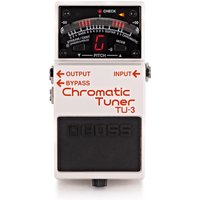
- I Love A Happy Accident… – Animals Pedal

- Animals Pedal Vintage Van Driving is Very Fun Overdrive

- Animals Pedal Sunday Afternoon Is Infinity Bender

- Ninevolt Pedals | Bath Time Reverb (Animals Pedal)
- This Fuzz Pedal Makes No Sense… But It Sounds Incredible

- ANIME Pedals | Animals Pedal Custom Illustrated Series