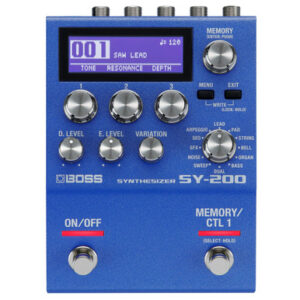
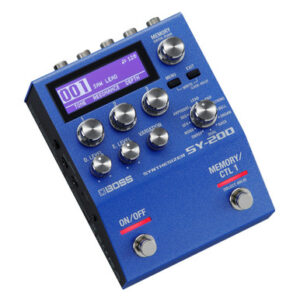

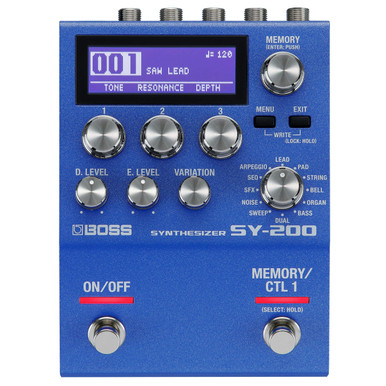
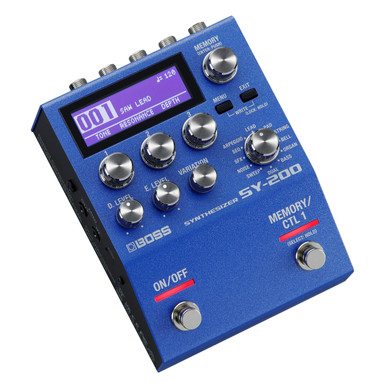
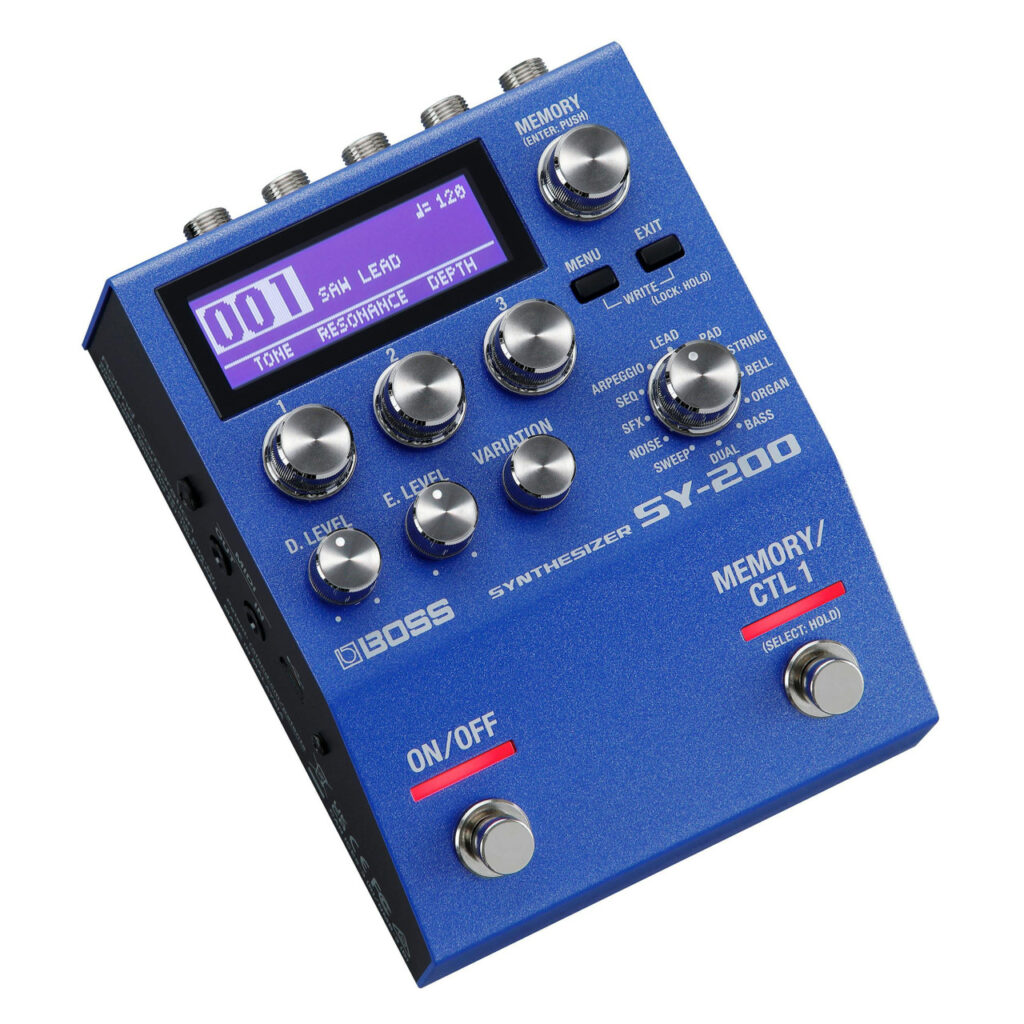
The SY-200 is one of Boss' most comprehensive guitar synth pedals to date! Providing a plethora of analogue-inspired polyphonic tones, this compact 200 Series stompbox makes it easy to expand your musical horizons — weaving Boss' expressive guitar and bass synth technology into all of your sonic endeavours!
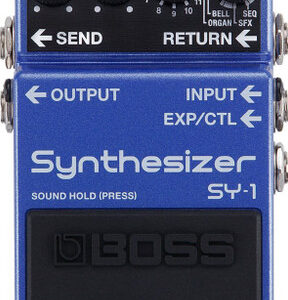
A more sophisticated version of Boss' acclaimed SY-1, the SY-200 is packed full of stellar synth sounds and boasts more tone-shaping parameters for versatile control. With 128 memories for storing your sonic creations too, the SY-200 gives you plenty of flexibility. And with two footswitches offering deep real-time performance control, you can take things even further with external switches, an expression pedal and MIDI. The possibilities are almost endless…
Key Features
- Advanced BOSS polyphonic guitar synth technology in a streamlined 200 series pedal.
- 12 analogue-style synth categories with many variations in each (171 sounds total).
- Three adjustable parameters for customising sounds.
- 128 memories for saving and recalling sounds.
- Fast sound creation with hands-on controls and large display.
- No special pickup required — play rich, dynamic synth tones with any guitar or bass!
- Latency-free performance for unrestricted musical expression.
- Assignable Memory/CTL 1 switch for memory change, hold, pitch control, and more.
- Blend synth and normal guitar sounds with independent level controls.
- Parallel send/return loop for easy integration with other pedals on your board.
- Selectable modes for globally optimising the synth engine for guitar or bass.
- Supports extended control with up to two external footswitches or an expression pedal.
- Full MIDI I/O provided with space-saving 3.5 mm TRS jacks (connection cables available separately).
- Micro USB jack for firmware updates.
- Runs on PSA-series AC adaptor or three AA-size batteries.
Transform your Guitar or Bass into a Synth!
Boss' amazing SY-200 pedal can make your guitar or bass sound like an irresistible analogue-flavoured synth — with zero latency! Infuse your music with dynamic, compelling and evocative new voices that'll endlessly entice your audience. This streamlined stomp gives you 171 total sounds organised in 12 intuitive categories, along with adjustable parameters for customising their tone and response:
- LEAD — A wide range of sounds suitable for single-note soloing.
- PAD — Full tones that work great with chords, from layered pads to synth brass and more.
- STRING — Classic analogue-style strings, including layered voices and sweeping textures.
- BELL — Percussive synth sounds with metallic resonance.
- ORGAN — A large selection of organ sounds, including many with rotary-style modulation.
- BASS — Fat synth bass sounds, including filtered and sub-octave tones.
- DUAL — Fat synth tones with stacked oscillators.
- SWEEP — Dynamic sounds with expressive and engaging movement.
- NOISE — Classic analogue-inspired synth noise. Great for percussive sounds and dramatic effects.
- SFX — A variety of synth sound effects, including explosive one-shot sounds, animated pitch/filter voices, and more!
- SEQ — Pulsating sounds with rhythmic pitch or filter changes.
- ARPEGGIO — Generate rhythmic arpeggios based on the notes you play.
Create Custom Sounds Easily
It’s fast and simple to call up sounds and balance your direct and synth levels, courtesy of the Boss SY-200’s intuitive display and hands-on controls. Boss' engineers have programmed a huge amount of preset synth sounds that are instantly energising and playable, but if you want to go deeper, you can tweak three different parameters for each sound via dedicated knobs.
Flexible Connectivity
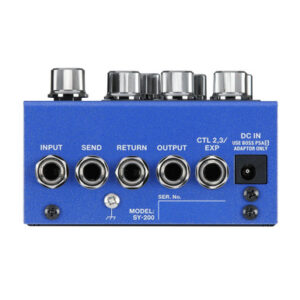
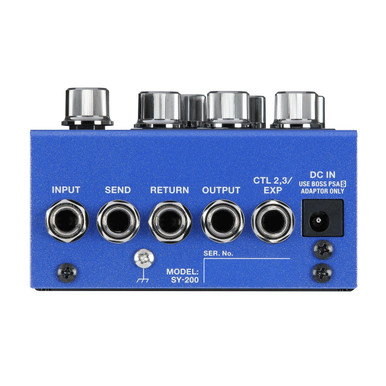
Thanks to an abundance of inputs and outputs, Boss' SY-200 pedal can smoothly integrate into your existing setup. Patch it in your chain like a regular stompbox, or use the send and output jacks to route synth and straight guitar sounds to different destinations for unique hybrid tones. And with the send/return loop and level knobs, it’s possible to blend one or more pedals in parallel with different synth voices!
Powerful Real-Time Control
In classic Boss style, the SY-200 provides plenty of real-time control despite its compact, pedalboard-friendly proportions. Boasting a pair of customisable footswitches which offer multi-functional operation with press-and-hold functionality — these allow you to control synth on/off, memory scrolling, pitch bend, synth hold, and more.
Expanded control is possible via external footswitches or an expression pedal, and MIDI I/O is also available to interface with other MIDI-equipped pedals and devices like the ES-8 and ES-5 loop switchers.
Specifications
- Sampling Frequency: 44.1 kHz
- AD/DA Conversion: 24 bits
- Processing: 32-bit floating point
- Modes: 12 modes
- Memory: 128
- Bypass: Buffered
- Display: Graphic LCD (132 x 32 dots, backlit LCD)
- Power Supply: Alkaline battery (AA, LR6) x 3, AC adaptor (sold separately)
- Current Draw: 230 mA
- Dimensions: 101 (W) x 138 (D) x 63 (H) mm
- Weight: 630 g / 700 g (including batteries)
Connectors
- INPUT jack, OUTPUT jack, SEND jack, RETURN jack: 1/4-inch phone type
- CTL 2, 3/EXP jack: 1/4-inch TRS phone type
- MIDI (IN, OUT) jacks: Stereo miniature phone type
- DC IN jack
- USB port: USB micro B-type (program update only)
Accessories
- Owner's Manual
- Leaflet "USING THE UNIT SAFELY"
- Alkaline battery (AA, LR6) x 3
- Rubber foot x 4
Options (sold separately)
- AC adaptor: PSA-S series
- Footswitch: FS-5U
- Dual footswitch: FS-6, FS-7
- Expression pedal: FV-500H, FV-500L, EV-30, Roland EV-5
- MIDI/TRS connecting cable: BMIDI-5-35