
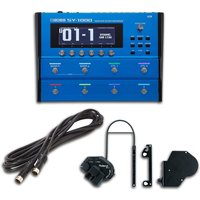
Revolutionise your sound. Because the Boss SY-1000 Guitar Synthesizer takes your playing to a whole other level of innovation. This is Boss most advanced guitar/bass synth yet featuring 6 times the processing power of its previous design. And it shows with absolutely every note you play. Intense analogue leads worn pads moving synth textures modelled electric sounds – all at once. The SY-1000 provides you with an unthinkable number of sonic possibilities. And with USB MIDI and GK connectivity players can go directly to their DAW to capture their unique sounds. The SY-1000 is even compatible with the Boss Tone Studio. So with 8 freely assignable footswitch slots you can customise and save all of your favourite effects and keep them right at your feet. Truthfully the SY-1000 has so much to offer that we cant even begin to cover every detail. Its beyond imagination. Wait theres more. This bundle also comes with the Roland GK-3 Divided Pickup and Roland GKC-5 Guitar Synth Cable. That means synthesising your sound just got a whole lot easier.
Boss SY-1000 with GK-3 Guitar Pickup and Cable
This is a New Boss SY-1000 with GK-3 Guitar Pickup and Cable from Boss is in our Multi-Effects Pedals category on Just Pedals. Read More below.
As an affiliate partner, we may earn a small commission when you buy through our links — at no extra cost to you.
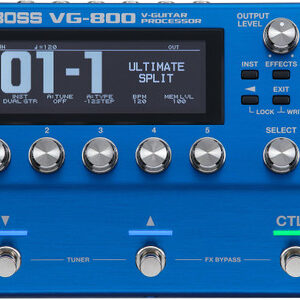
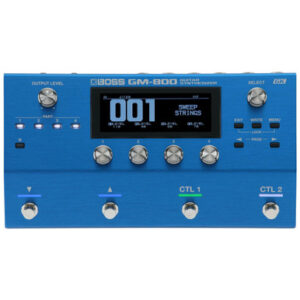
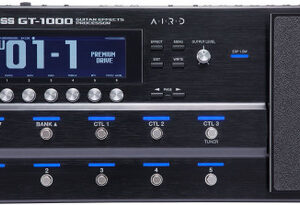
Related videos

Brand
Boss
BOSS began in Osaka in 1973 as MEG Electronics, a company dedicated to effects. Its first BOSS-branded effect was the CE-1 Chorus Ensemble in 1976; the OD-1, SP-1 and PH-1 launched the compact-effects series in 1977. The JustPedals catalogue includes familiar overdrives and distortions such as the OD-3, SD-1, BD-2, DS-1 and MT-2 Metal Zone, as well as utility items such as the PCS-20A cable. BOSS now spans compact pedals, multi-effects, loopers, tuners and controllers. Manufacturing origin should be checked by model rather than inferred from the brand’s Japanese history.
Category
Multi-Effects Pedals
A multi-effects processor combines several effect algorithms and signal-routing stages in one unit. Its sound depends not only on the individual models but on their order, parallel or serial routing, processing resolution and available control. Preset structure, switching gaps, foot control, expression assignment, amp or cabinet modelling, USB audio and MIDI determine how completely the processor can replace separate pedals.
Tags
Analogue
The signal is shaped by continuously varying electronic circuitry rather than being converted into a digital effect algorithm. Component choice, operating voltage and circuit tolerances influence headroom, noise, clipping texture and the small variations in response between designs.
Bass
Voiced or equipped to retain low-frequency fundamentals and the higher headroom of a bass signal. Clean blends, crossovers and bass-specific filter ranges can preserve weight and articulation while the effected portion adds harmonics, movement or ambience.
MIDI
Sends, receives or responds to Musical Instrument Digital Interface messages rather than carrying the instrument audio itself. Program changes recall presets, continuous controllers move parameters, and MIDI clock or transport messages synchronise timing between devices.
USB
Provides a Universal Serial Bus connection for power, audio, MIDI, firmware or editing data. The supported USB class and connector do not by themselves show its purpose; channel count, sample format, host compatibility and power demand define the actual function.
Others Just Ordered :
- I Love A Happy Accident… – Animals Pedal

- Animals Pedal Vintage Van Driving is Very Fun Overdrive

- Animals Pedal Sunday Afternoon Is Infinity Bender

- Ninevolt Pedals | Bath Time Reverb (Animals Pedal)

- This Fuzz Pedal Makes No Sense… But It Sounds Incredible

- ANIME Pedals | Animals Pedal Custom Illustrated Series
