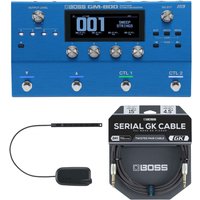
Boss GM-800 Guitar & Bass Synthesizer Pedal

£619.00

On the menu for January 2026 are the Boss Guitar Pedals, freshly added and carefully selected. These New units are available to order online with fast, secure delivery from trusted UK retailers. Read on for full details, specifications, demos, videos, reviews, and the best places to buy the Boss Guitar Pedals today.


Spread the love

Description

Spread the love

On the menu for January 2026 are the Boss Guitar Pedals, freshly added and carefully selected. These New units are available to order online with fast, secure delivery from trusted UK retailers. Read on for full details, specifications, demos, videos, reviews, and the best places to buy the Boss Guitar Pedals today.

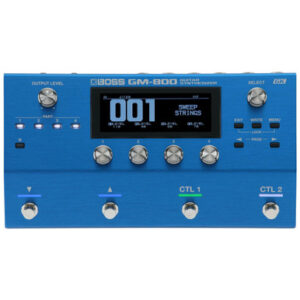
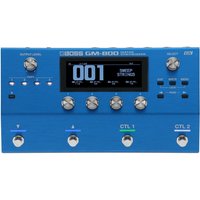
The Boss GM-800 elevates guitar synthesis into a new age of natural playability and boundless creative range. Driven by the newly-developed Serial GK interface, the advanced ZEN-Core sound engine unlocks any sound imaginable — from acoustic instruments to classic and modern synths — while high-performance DSP delivers tracking stability and expressive scope never before possible.

Freely combine and edit Tones with the intuitive Scene workflow, colour sounds with a huge selection of effects, and explore a universe of fresh content on Roland Cloud. Compact, streamlined, and ultra-versatile, the GM-800 infuses your guitar or bass with unlimited musical potential!

Key Features

  • Next-generation guitar and bass synthesizer with the newly-developed Serial GK interface.
  • Advanced ZEN-Core sound engine derived from flagship Roland synthesizers, including the Jupiter-X and Fantom keyboards.
  • Natural playing feel and solid tracking stability, realized through high-performance DSP.
  • Powerful Scene workflow with four Tones plus Rhythm.
  • Vast onboard sound library with over 1200 Tones and 70 Rhythm sounds.
  • Explore Sound Packs, Wave Expansions, legendary Roland instruments, and more on Roland Cloud.
  • Deep editing tools for each Tone, including sound parameters, sensitivity settings, and more.
  • 150 user-configurable Scenes, including 100 Scenes with professional ready-to-play sounds.
  • Over 90 total effect types available in each Scene.
  • Space-saving design flows into every setup, from pedalboard to desktop.
  • Serial GK expansion jack for connecting to another Boss guitar synthesizer product.
  • Two external control jacks, each with support for up to two footswitches or an expression pedal.
  • USB audio/MIDI connectivity and standard MIDI I/O.
  • Guitar to MIDI function for playing external MIDI instruments via USB or a MIDI cable.
  • Also functions as a standalone synthesizer sound module for MIDI keyboard use or DAW sound expansion.
  • Edit Scenes and organise sounds on your computer with Boss Tone Studio.
  • Download and share GM-800 Livesets at Boss Tone Exchange (for sharing on Boss Tone Exchange, Scenes in Livesets must be created using the internal GM-800 sounds).

Multifaceted Connectivity

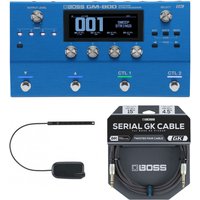
The GM-800 features the newly-developed Serial GK digital interface, which supports guitar/bass input from a Boss GK-5 or GK-5B Divided Pickup and easy linking of multiple GM-800 units. GKC-AD and GKC-DA conversion boxes are also available for classic 13-pin GK devices, allowing you to drive the GM-800 with a Roland GK-3 or GK-3B pickup and use Serial GK devices with the Boss SY-1000 and GP-10.

Specifications

  • Sound Generator: ZEN-Core
  • Parts: 5 (Play Part: 4, Rhythm Part: 1)
  • Scenes: 150
  • Display: Graphic LCD 256 x 80 dots
  • External Memory: USB Flash drive (Sold Separately)
  • Power Supply: AC Adaptor (Included)
  • Current Draw: 840 mA

Tones

  • Preset Tone: 1,200 or Greater
  • Preset Drum Kit: 70 or Greater
  • Import Tone: 256

Effects

  • Part Multi-Effects: 1 System (for Each Part), 93 Types
  • Part EQ: 1 System (for Each Part)
  • Reverb: 7 Types
  • Chorus/Delay: 9 Types
  • Scene MFX: 2 Systems (Serial or Parallel Selectable), 93 Types
  • Master EQ/Comp

Controls

  • SCENE DOWN Switch, SCENE UP Switch, CTL1–2 Switches
  • PART1–4 Buttons, PART R Button, EXIT Button, WRITE Button, MENU Button, PAGE Buttons
  • 1–4 Knobs, SELECT Knob, OUTPUT LEVEL Knob

Connectors

  • GK IN Jack: 1/4-inch TRS Phone Type (for BGK Cable Only)
  • GK OUT Jack: 1/4-inch TRS Phone Type (for BGK Cable Only)
  • OUTPUT (L/PHONES) Jacks: 1/4-inch TRS Phone Type
  • OUTPUT (R/MONO) Jacks: 1/4-inch Phone Type
  • CTL3, 4/EXP1 Jack, CTL5, 6/EXP2 Jack: 1/4-inch TRS Phone Type
  • USB COMPUTER Port: USB B Type (Supports High-Speed USB, USB Audio, and USB MIDI)
  • USB MEMORY Port
  • MIDI Connectors (IN, OUT)
  • DC IN Jack

Weight & Dimensions

  • Weight: 1.2 kg / 2.65 lbs
  • Dimensions (W x D x H): 246 x 134 x 63 mm / 9.685 x 5.276 x 2.48 inches

Accessories (Included)

  • AC Adaptor (PSB-1U & AC Cord Set)
  • Quick Start Guide
  • Leaflet (Using the Unit Safely)
  • Rubber Feet (x4)

Options (Sold Separately)

Additional information

Weight 2 kg

Brand

Boss

Boss is a prominent manufacturer of guitar effects pedals, multi-effects units, and related musical equipment, known for their durability, reliability, and wide range of effects. Founded in 1973 as a division of the Roland Corporation, Boss quickly became synonymous with high-quality effects pedals that are popular among guitarists and musicians worldwide.

Boss pedals are renowned for their rugged construction, intuitive controls, and signature sound quality. The company offers a comprehensive lineup of effects pedals covering various categories, including distortion, overdrive, delay, modulation, and more. Iconic pedals like the DS-1 Distortion, the DS-2 Turbo Distortion, the DD-3 Digital Delay, and the MT-2 Metal Zone have become staples on countless pedalboards due to their versatility and reliability.

Category

Guitar Pedals

Tags

Chorus

Delay

A delay pedal records your signal and plays it back after a set time, creating echoes that can range from tight, slapback repeats to long, atmospheric trails. It’s one of the most versatile effects, used to thicken tones, add rhythmic depth, or build spacious, ambient layers. Analogue delays offer warm, decaying repeats that blend naturally with your tone, while digital units provide pristine echoes with precise control over time, feedback, and mix levels.

From classic rockabilly and tape-style echoes to modern looping and shimmer effects, delay pedals have become essential tools for shaping sound. They can make solos soar, rhythms pulse, or transform simple chord progressions into cinematic textures. Whether used subtly to add dimension or boldly to create soundscapes, a good delay pedal can completely redefine the feel and atmosphere of your music.

EQ

While Ed Sheeran primarily relies on the natural sound of his acoustic guitar and vocals, he occasionally uses EQ (Equalization) to shape and enhance his tone during live performances or in the studio. EQ pedals or onboard preamps can allow him to adjust the frequency response of his guitar signal to suit the acoustics of different venues or to achieve specific tonal characteristics. Here’s how EQ might be utilized in Ed Sheeran’s setup:

1. **Tonal Shaping**: EQ can be used to adjust the balance of frequencies in the guitar signal, allowing Ed Sheeran to shape his tone to his liking. For example, he might boost the midrange frequencies to bring out the warmth and presence of his acoustic guitar, or cut certain frequencies to reduce any harshness or mud in the sound.

2. **Feedback Control**: In a live setting, EQ can help control feedback by notching out problematic frequencies that might cause the guitar signal to feed back through the amplification system. This can be particularly useful when performing in venues with challenging acoustics or high volume levels.

3. **Room Correction**: In situations where the venue’s acoustics are less than ideal, EQ can be used to compensate for any deficiencies in the sound. By adjusting the EQ settings, Ed Sheeran can tailor the guitar tone to sound more balanced and natural, regardless of the room’s acoustic properties.

4. **Matching Gear**: EQ can also be used to match the tone of Ed Sheeran’s guitar to the sound of other instruments or equipment in his setup. For example, he might adjust the EQ to complement the tonal characteristics of his vocal microphone or to blend seamlessly with backing tracks or other instruments.

Overall, while EQ may not be a central component of Ed Sheeran’s guitar effects setup, it can still play a valuable role in shaping his tone and ensuring that he achieves the desired sound in different performance environments. Whether used subtly for tonal shaping or more aggressively for feedback control, EQ allows Ed Sheeran to tailor his guitar tone to suit his musical vision and performance needs.

Expression

Expression pedals allow real-time control over specific parameters on compatible guitar pedals, such as volume, delay time, modulation depth, or filter sweep. Used with an expression input, they let players shape effects dynamically with their foot, adding movement and performance control that cannot be achieved with fixed knob settings.

MIDI

MIDI pedals use the Musical Instrument Digital Interface standard to communicate with other guitar pedals, effects units, and hardware. They allow control over presets, parameters, and switching across multiple devices from a single controller. MIDI integration makes it possible to build complex, synchronised pedal setups while keeping control simple and consistent.

New

This is brand new, fresh in, and a UK warranty is included. New Gear always comes from trusted UK music retailers.

Reverb

A reverb pedal is like the rich sauce that ties every flavour on the plate into one smooth experience. It adds depth, warmth, and atmosphere — the sonic equivalent of a perfectly reduced glaze that lingers on the tongue. Whether you’re after the subtle ambience of a cosy café (spring or plate reverb) or the grand echoes of a cathedral (hall or shimmer reverb), this is where your tone breathes and expands. A touch of reverb can turn a dry sound into something lush and inviting — but pour on too much, and it’s all you can taste. Used with finesse, it’s the finishing touch that transforms your tone from plain to unforgettable.

Synth

A synth pedal transforms your guitar signal into rich, layered tones that mimic the sounds of a synthesiser. Using pitch tracking and waveform generation, it can produce everything from deep bass lines to shimmering pads and futuristic leads. Synth pedals open up a wide creative range, blending the expressiveness of guitar playing with electronic textures, making them ideal for experimental sounds, ambient music, or adding a modern edge to classic riffs.

Volume

Volume pedals control the output level of a guitar signal using a foot-operated treadle. They allow smooth volume swells, dynamic control during playing, and easy muting between songs. Volume pedals can be placed at different points in the signal chain to either control overall loudness or adjust gain and drive behaviour when positioned before distortion or overdrive pedals.

Available for Amazon Prime