
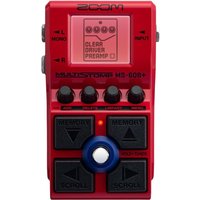
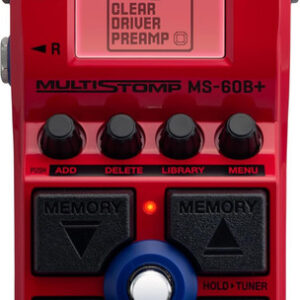
The Zoom MS-60B+ Multistomp Bass Pedal is a compact and powerful unit designed to deliver a complete range of tones in one box. With over 95 effects 11 amp models and 11 preamp models it lets you craft everything from deep punchy lows to clean modern bass sounds. Its improved analogue circuitry ensures a pure signal path while the ability to chain up to six effects gives you the flexibility to build your ideal setup. Navigation is made simple with the colour-coded LCD and four cross key switches allowing quick access to patches and effects on stage. With 100 memory patches USB MIDI support and stereo outputs for split signal routing the MS-60B+ adapts to any playing environment. Its portable single-stompbox design tuner support for all bass tunings and compatibility with the Handy Guitar Lab app make it a versatile tool to add to your rig.
Zoom MS-60B+ Multistomp Bass Pedal
This is a New Zoom MS-60B+ Multistomp Bass Pedal from Zoom is in our Specialist Effects Pedals category on Just Pedals. Read More below.
As an affiliate partner, we may earn a small commission when you buy through our links — at no extra cost to you.
Related videos
Brand
Zoom
ZOOM CORPORATION is a Tokyo-based Japanese maker founded in 1983. After developing audio components and rhythm equipment, it released the compact 9002 multi-effects processor in 1990 and later the popular 505 Guitar. Today its guitar, bass and acoustic processors range from small practice units to larger floorboards. JustPedals listings include the G1X FOUR and B1 FOUR, plus the A1 FOUR for acoustic instruments and its expression-pedal version. Compare each model’s instrument focus and expression controls: similarly sized Zoom units can be built around different effects and playing needs.
Category
Specialist Effects Pedals
Specialist effects alter the signal in ways that do not sit cleanly inside one established family. They may use granular processing, frequency shifting, resonators, freeze or sustain, bit reduction, ring modulation, feedback networks or combinations of several techniques. The relevant distinction is the underlying process, its tracking or latency, and how completely the dry signal can be blended or replaced.
Tags
Analogue
The signal is shaped by continuously varying electronic circuitry rather than being converted into a digital effect algorithm. Component choice, operating voltage and circuit tolerances influence headroom, noise, clipping texture and the small variations in response between designs.
Bass
Voiced or equipped to retain low-frequency fundamentals and the higher headroom of a bass signal. Clean blends, crossovers and bass-specific filter ranges can preserve weight and articulation while the effected portion adds harmonics, movement or ambience.
MIDI
Sends, receives or responds to Musical Instrument Digital Interface messages rather than carrying the instrument audio itself. Program changes recall presets, continuous controllers move parameters, and MIDI clock or transport messages synchronise timing between devices.
Stereo
Processes, creates or passes two audio channels. True stereo preserves separate left and right inputs, while mono-to-stereo effects generate spatial differences internally; routing, phase behaviour and whether trails remain stereo determine the resulting image. Some outputs sum to mono when only one socket is connected, which can change level or modulation depth.
USB
Provides a Universal Serial Bus connection for power, audio, MIDI, firmware or editing data. The supported USB class and connector do not by themselves show its purpose; channel count, sample format, host compatibility and power demand define the actual function.
Others Just Ordered :
- I Love A Happy Accident… – Animals Pedal

- Animals Pedal Vintage Van Driving is Very Fun Overdrive

- Animals Pedal Sunday Afternoon Is Infinity Bender

- Ninevolt Pedals | Bath Time Reverb (Animals Pedal)
- This Fuzz Pedal Makes No Sense… But It Sounds Incredible

- ANIME Pedals | Animals Pedal Custom Illustrated Series