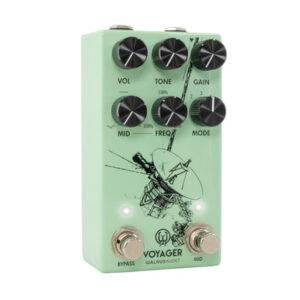
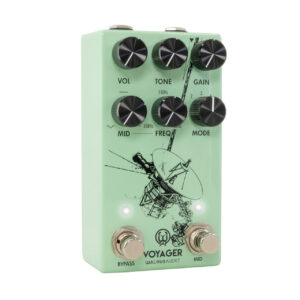
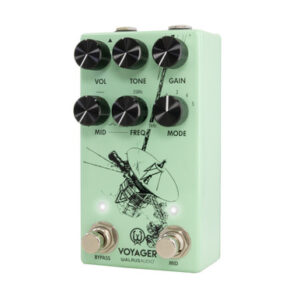
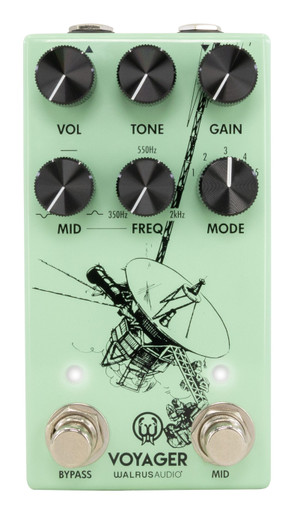
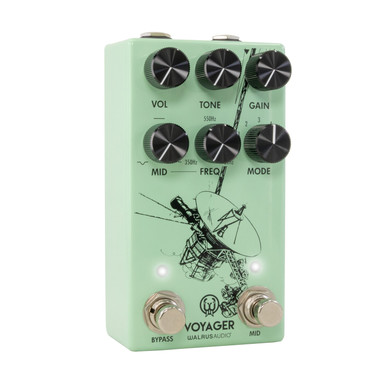
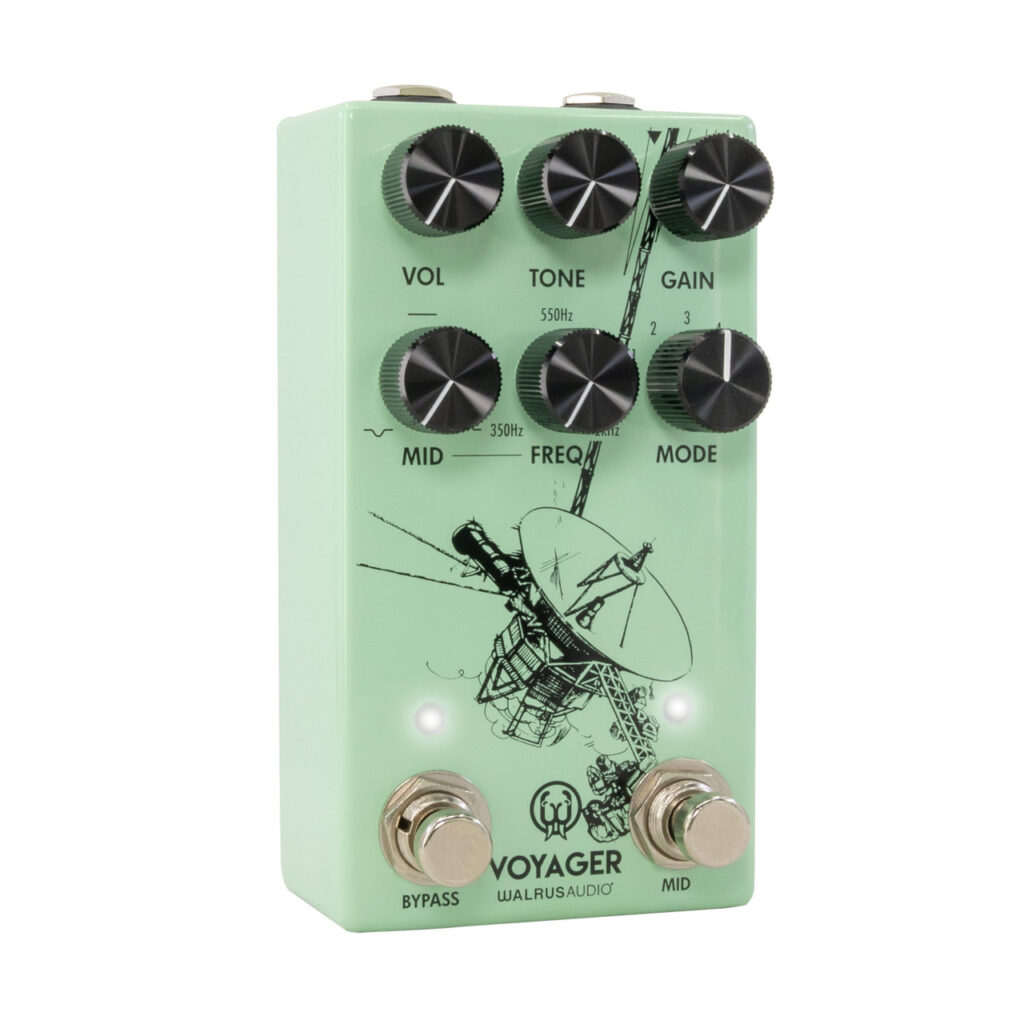
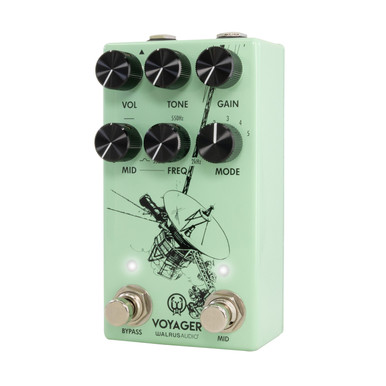
Walrus Audio Voyager MKII Preamp Overdrive Pedal in Seafoam

£245.00

On the menu for January 2026 are the Walrus Audio Guitar Pedals, freshly added and carefully selected. These New units are available to order online with fast, secure delivery from trusted UK retailers. Read on for full details, specifications, demos, videos, reviews, and the best places to buy the Walrus Audio Guitar Pedals today.


Spread the love

Description

Spread the love

On the menu for January 2026 are the Walrus Audio Guitar Pedals, freshly added and carefully selected. These New units are available to order online with fast, secure delivery from trusted UK retailers. Read on for full details, specifications, demos, videos, reviews, and the best places to buy the Walrus Audio Guitar Pedals today.

Here’s what Walrus Audio say about the Voyager MKII:

The Voyager MKII is a mid-focused overdrive/preamp that contains all the mythical magic from the original Voyager and adds a wealth of features not seen before in a Klon-style pedal.

From its lowest to highest settings, the Voyager provides a uniquely superb amount of clarity to any playing style. At lower gain settings, it brightens the signal and adds clarity to each note. With the gain turned up, the Voyager transforms into a thick overdrive, providing depth to chorded playing while retaining the clarity needed to break through solos.

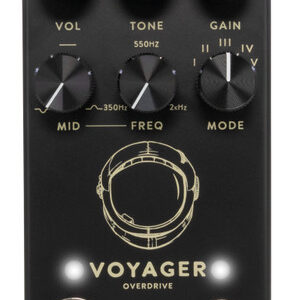
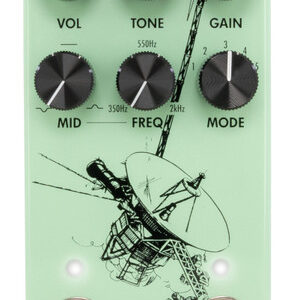
The Voyager MKII breaks out of the traditional Centaur three-knob topography by adding a foot-switchable parametric mid-frequency EQ with a boost/cut range of +/-12dB. The Freq (Frequency) knob then controls the center frequency of where the Mid knob is set, giving a range of 250Hz-2kHz. Great for accommodating any guitar and pickup combination and tailoring your tone to your own style of playing.

Further customize the Voyager’s sound with the five-way rotary switch:

  1. Classic 1N34A Germanium Diodes (most compressed). This is the original Voyager sound.
  2. Classic 1N34A Germanium Diodes with bass boost (trust us).
  3. Symmetric Silicon Diodes (more open and dynamic).
  4. Asymmetric Silicon Diodes (least compressed, open & driven).
  5. Asymmetric Silicon Diodes with bass boost (least compressed, open & driven with a bass boost.)

Think of each position as a different “flavour” of the pedal. Fine-tune each of these modes with the Mid/Freq EQ for a near-infinite supply of gain options.

Specifications

  • The Voyager comes in two variants:
    • Seafoam with black ink with the Voyager satellite illustrated by the original Voyager artist, Nathan Price.
    • The minimalist version comes in matte black with cream ink with the space helmet illustrated by Christi Du Toit.
  • Input: 1/4″ TS, Unbalanced, 1M impedance, Output: 1/4″ TS, Unbalanced, 100k impedance
  • True Bypass
  • 9V DC, center negative,100mA min
  • Designed and assembled in the USA.
  • The use of an isolated power supply is recommended for powering all Walrus Audio Pedals
  • Daisy chain power supplies are not recommended.
  • Power supply not included

Additional information

Weight 1 kg

Brand

Walrus Audio

Walrus Audio is an American boutique guitar effects pedal company based in Oklahoma City, known for its high-quality, innovative designs and artistic approach to pedal-making. Founded in 2011 by Brady Smith, the company quickly gained a reputation for creating pedals that offer a unique blend of rich, expressive tones and striking visual aesthetics.

Each Walrus Audio pedal is designed with meticulous attention to detail, often incorporating complex circuitry that allows for a wide range of sonic possibilities.

The pedals feature distinctive, hand-drawn artwork on their enclosures, making them visually appealing as well. Walrus Audio’s product lineup includes a variety of effects such as reverb, delay, overdrive, modulation, and more, and their pedals are widely appreciated by musicians for their creativity, durability, and superior sound quality.

Category

Guitar Pedals

Preamp Pedals

Tags

Boost

EQ

While Ed Sheeran primarily relies on the natural sound of his acoustic guitar and vocals, he occasionally uses EQ (Equalization) to shape and enhance his tone during live performances or in the studio. EQ pedals or onboard preamps can allow him to adjust the frequency response of his guitar signal to suit the acoustics of different venues or to achieve specific tonal characteristics. Here’s how EQ might be utilized in Ed Sheeran’s setup:

1. **Tonal Shaping**: EQ can be used to adjust the balance of frequencies in the guitar signal, allowing Ed Sheeran to shape his tone to his liking. For example, he might boost the midrange frequencies to bring out the warmth and presence of his acoustic guitar, or cut certain frequencies to reduce any harshness or mud in the sound.

2. **Feedback Control**: In a live setting, EQ can help control feedback by notching out problematic frequencies that might cause the guitar signal to feed back through the amplification system. This can be particularly useful when performing in venues with challenging acoustics or high volume levels.

3. **Room Correction**: In situations where the venue’s acoustics are less than ideal, EQ can be used to compensate for any deficiencies in the sound. By adjusting the EQ settings, Ed Sheeran can tailor the guitar tone to sound more balanced and natural, regardless of the room’s acoustic properties.

4. **Matching Gear**: EQ can also be used to match the tone of Ed Sheeran’s guitar to the sound of other instruments or equipment in his setup. For example, he might adjust the EQ to complement the tonal characteristics of his vocal microphone or to blend seamlessly with backing tracks or other instruments.

Overall, while EQ may not be a central component of Ed Sheeran’s guitar effects setup, it can still play a valuable role in shaping his tone and ensuring that he achieves the desired sound in different performance environments. Whether used subtly for tonal shaping or more aggressively for feedback control, EQ allows Ed Sheeran to tailor his guitar tone to suit his musical vision and performance needs.

New

This is brand new, fresh in, and a UK warranty is included. New Gear always comes from trusted UK music retailers.

Overdrive

Like a golden layer of melted cheese — warm, gooey, and just put it all over. It adds just the right amount of richness and grit, turning a clean signal into something smooth and savoury. Designed to mimic the natural breakup of a tube amp pushed to its sweet spot, overdrive delivers the flavour of classic rock and blues in every bite. From creamy mid-gain warmth to crisp edge-of-breakup sparkle, it’s the comfort food of guitar tone — simple, satisfying, and endlessly versatile. Whether it’s a mild crunch or a full-bodied roar, overdrive is where good taste begins.

Preamp

A preamp pedal shapes and boosts your guitar’s signal before it reaches your amp or recording interface, giving you control over tone, gain, and headroom. It acts as the first stage of amplification, adding warmth, clarity, and character while preparing your signal for the next part of the chain. Some preamps emulate the response of classic valve circuits, while others offer clean, transparent tone shaping ideal for acoustic instruments or direct recording setups.

Used on its own, a preamp pedal can serve as the foundation of your tone, providing a consistent core sound wherever you play. When combined with other effects, it enhances dynamics and helps each pedal sound more defined and natural. Whether you’re looking to push your amp harder, bring life to a dull signal, or refine your sound for the studio, a good preamp pedal adds presence, punch, and musicality to any rig.

Rotary

Rotary pedals recreate the swirling, moving sound of a rotating speaker cabinet, adding rich modulation and a sense of motion to guitar tones. They typically simulate the changing pitch and volume caused by spinning speakers, producing anything from subtle shimmer to deep, pulsating swirl. Rotary effects are often used for clean and lightly driven sounds to add depth, movement, and a classic, organ-inspired character.