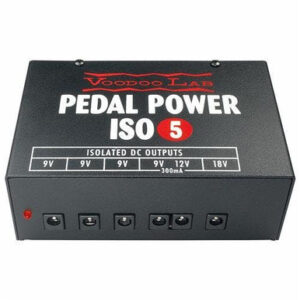

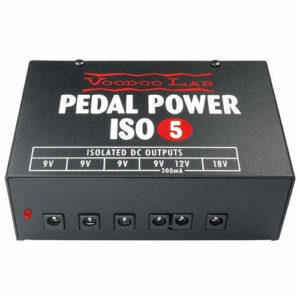
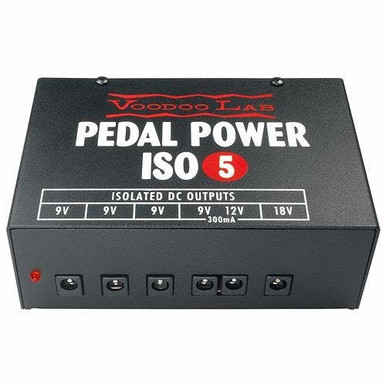
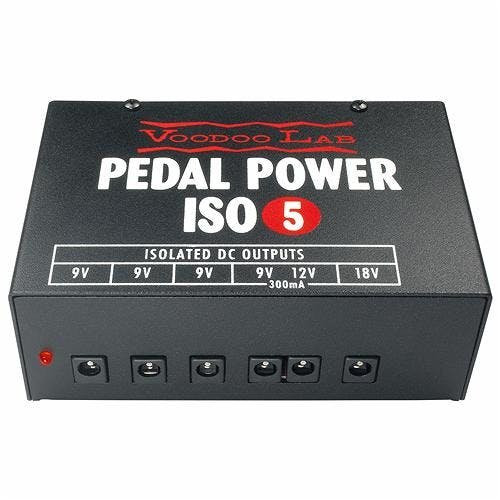
Voodoo Labs ISO 5 Pedal Power
Looking for a professional grade power supply that's robust enough for live use night after night? Look no further! The ISO 5 not only features Voodoo Lab's high build quality and the cleanest possible power source so as not to interfere with your guitar tone; it also has isolated outputs (to avoid ground loop hum), a 12V and 18V output for specialised pedals, and short circuit protection so if one of your pedals stops working, the rest will not lose power and you can carry on with the show.
Here's what Voodoo Labs say about the ISO
Pedal Power ISO-5 is an isolated power supply for powering guitar pedal effects and accessories. It's the ultimate compact solution for smaller pedalboards, rack shelves, or even as an additional power supply for larger boards. With five isolated, filtered and regulated output sections, ISO-5 keeps even the most sensitive vintage and boutique analog pedals dead quiet.
Pedal Power ISO-5 includes a high-current output which will properly power modern digital power-hungry effects like those from Eventide, Line 6, and TC Electronic. There's also a dedicated 18V output for those pedals which need the higher voltage for extra headroom.
Designed to meet the needs of professional users, Pedal Power ISO-5 will provide clean, consistent power, even with the poor AC line conditions often found on stage. Completely isolated output sections eliminate ground loops and unwanted interactions between effects, resulting in lower noise and noticeably improved tone.
Mounting Brackets for pedalboard sold separately
Features
- Five isolated outputs
- Compatible with all battery operated pedals
- Includes high current 9V and 12V outputs, plus dedicated 18V output
- Powers Boss Twin, Eventide, Line 6 modelers, and TC Electronic Nova pedals
- Linear regulation and toroidal transformer for lowest possible noise
- Compact design fits small pedalboards and rack shelves
- Includes cables and detachable AC line cord
- Engineered and handmade in the USA
Input
- Detachable IEC (computer-type) line cord
- 230V 50/60Hz (Europe/Australia model)
Outputs
5.5 x 2.1mm barrel connectors center negative (Short circuit protected)
- 9VDC (3) – 100mA
- 9/12VDC – 300mA
- 18VDC – 100mA
Included Cables
- 5.5 x 2.1mm right angle barrel connectors (4)
- 5.5 x 2.1mm right angle to straight barrel connector (1)
- 5.5 x 2.5mm right angle red barrel (1)
- 3.5mm right angle mini plug (1)
Physical
- 4.9" wide x 3.4" deep x 1.8" tall (124 x 86 x 44 mm)
- Weight: 1.24 lbs (0.56 kg)
Special
- Toroidal power transformer
- Warranty: 5 years
Short Circuit Protection
Every output on Pedal Power ISO-5 is individually short-circuit protected. This means that if you have a short in a power cable, or one of your pedals malfunctions, ISO-5 will turn off the power to only that pedal. All other outputs will continue to function normally with no long-term damage