
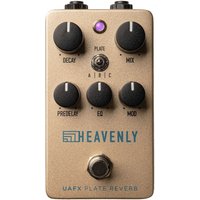
The Universal Audio UAFX Heavenly Plate Reverb Pedal is a guitar effects pedal that brings the magic of classic 50s studio plate reverbs right to your pedalboard. This compact stompbox faithfully recreates the haunting ambience found on countless hit records from that era. Drawing inspiration from the award-winning Golden Reverberator the Heavenly Plate Reverb pedal captures the rich and immersive textures of 1950s German-made studio plate reverbs. It delivers an authentic haunting and moody sound that outshines other “plate effect” pedals on the market. With three uniquely voiced plate settings namely Vintage Bright Vintage Dark and Modern Full you can easily dial in the perfect shimmer tonality and dimension for your sound. The pedal also features intuitive controls for Pre-delay EQ Mod and Rate allowing for effortless effect sculpting. Designed to stand the test of time the Heavenly Plate Reverb pedal is built to withstand the rigours of the stage and studio. It comes equipped with switchable true/trails bypass and analogue dry through functionalities ensuring that your plate effects sound divine and will last a lifetime.
Universal Audio UAFX Heavenly Plate Reverb Pedal
This is a New Universal Audio UAFX Heavenly Plate Reverb Pedal from Universal Audio its found in our Reverb Pedals on the Just Pedals menu. Read More below.
As an affiliate partner, we may earn a small commission when you buy through our links — at no extra cost to you.
Related videos
Brand
Universal Audio
Universal Audio’s roots go back to Bill Putnam Sr.’s recording equipment work in 1958. The company now makes studio hardware and software alongside UAFX pedals that bring classic recording processors and amplifier sounds to a guitar rig. The line includes the 1176 Studio Compressor, Dream ’65 Reverb Amplifier, Starlight Echo Station, Galaxy ’74 Tape Echo and Evermore reverb. JustPedals carries several UAFX models, including Dream ’65, Starlight, Galaxy ’74 and the 1176. The range suits players looking for detailed, studio-inspired compression, amp tones, delays and reverbs in pedalboard formats.
Category
Reverb Pedals
Reverb creates the dense pattern of reflections heard after sound enters a physical or imagined space. Room, hall, plate and spring models differ in reflection density, frequency decay and modulation, while ambient algorithms extend or transform the tail beyond natural acoustics. Decay, pre-delay, damping, diffusion and wet/dry balance define the apparent size, surface and distance of that space.
Tags
Analogue
The signal is shaped by continuously varying electronic circuitry rather than being converted into a digital effect algorithm. Component choice, operating voltage and circuit tolerances influence headroom, noise, clipping texture and the small variations in response between designs.
Others Just Ordered :
- I Love A Happy Accident… – Animals Pedal

- Animals Pedal Vintage Van Driving is Very Fun Overdrive

- Animals Pedal Sunday Afternoon Is Infinity Bender

- Ninevolt Pedals | Bath Time Reverb (Animals Pedal)

- This Fuzz Pedal Makes No Sense… But It Sounds Incredible

- ANIME Pedals | Animals Pedal Custom Illustrated Series
